

5 patacas – Macau
Add to wishlist
China
Context
Material
Diameter: 29 mm
Weight: 10.7 g
Thickness: 2.16 mm
Shape: Round
Composition: Copper-nickel
Technique: Milled
Alignment: Medal alignment
flip
References
KM: #
Numista: #11342
Value
Exchange value: 5 MOP
Obverse
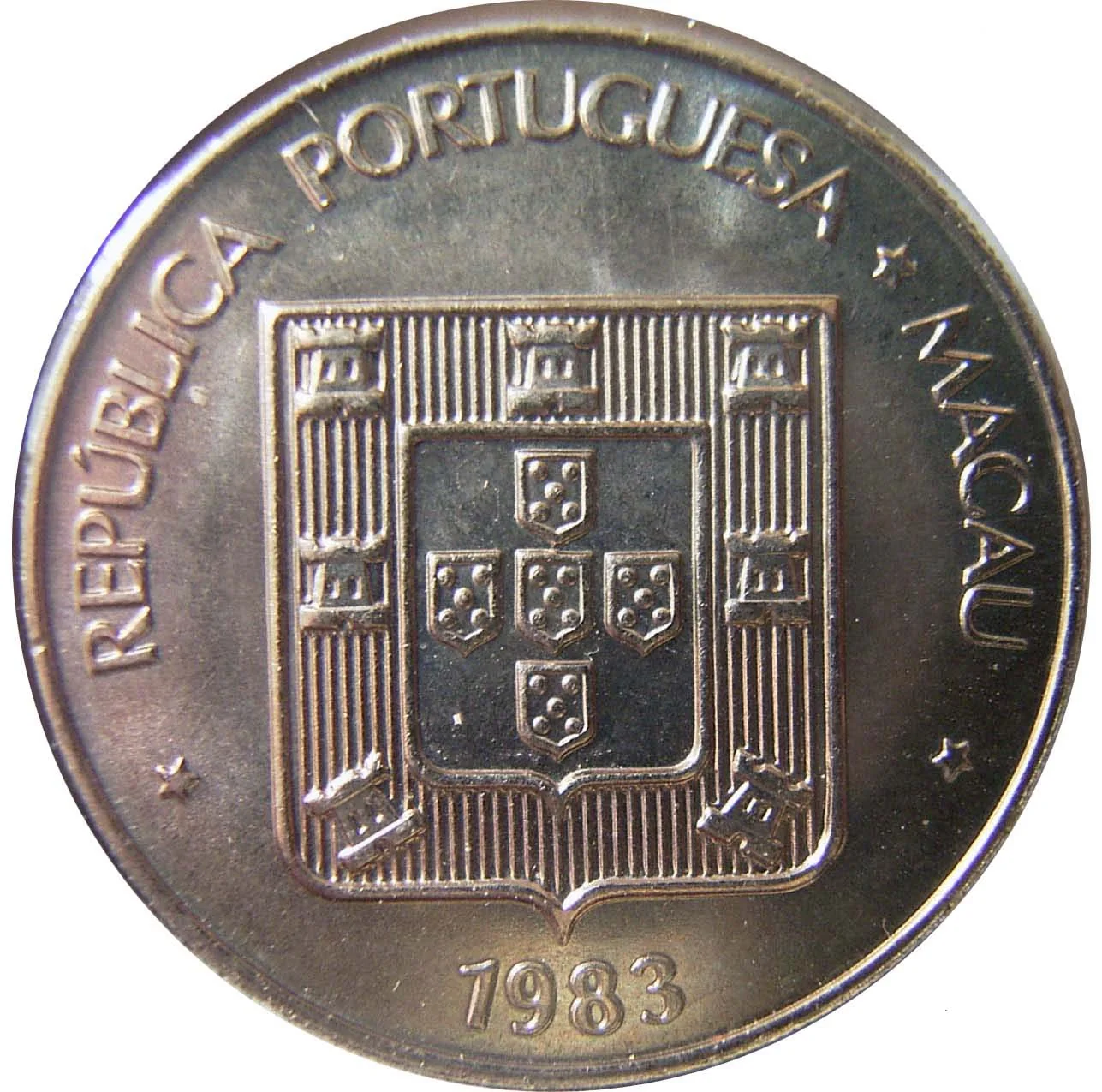
Description:
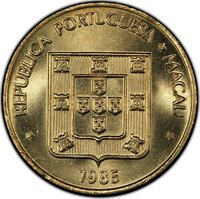
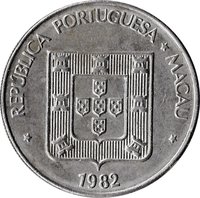
Portuguese shield above date, stars flank legend. Photo shows KM24.1 variety with high stars.
Inscription:
☆ REPUBLICA PORTUGUESA ☆ MACAU ☆
1983
1983
Translation:
Portuguese Republic Macau
1983
1983
Script: Latin
Language: Portuguese
Reverse
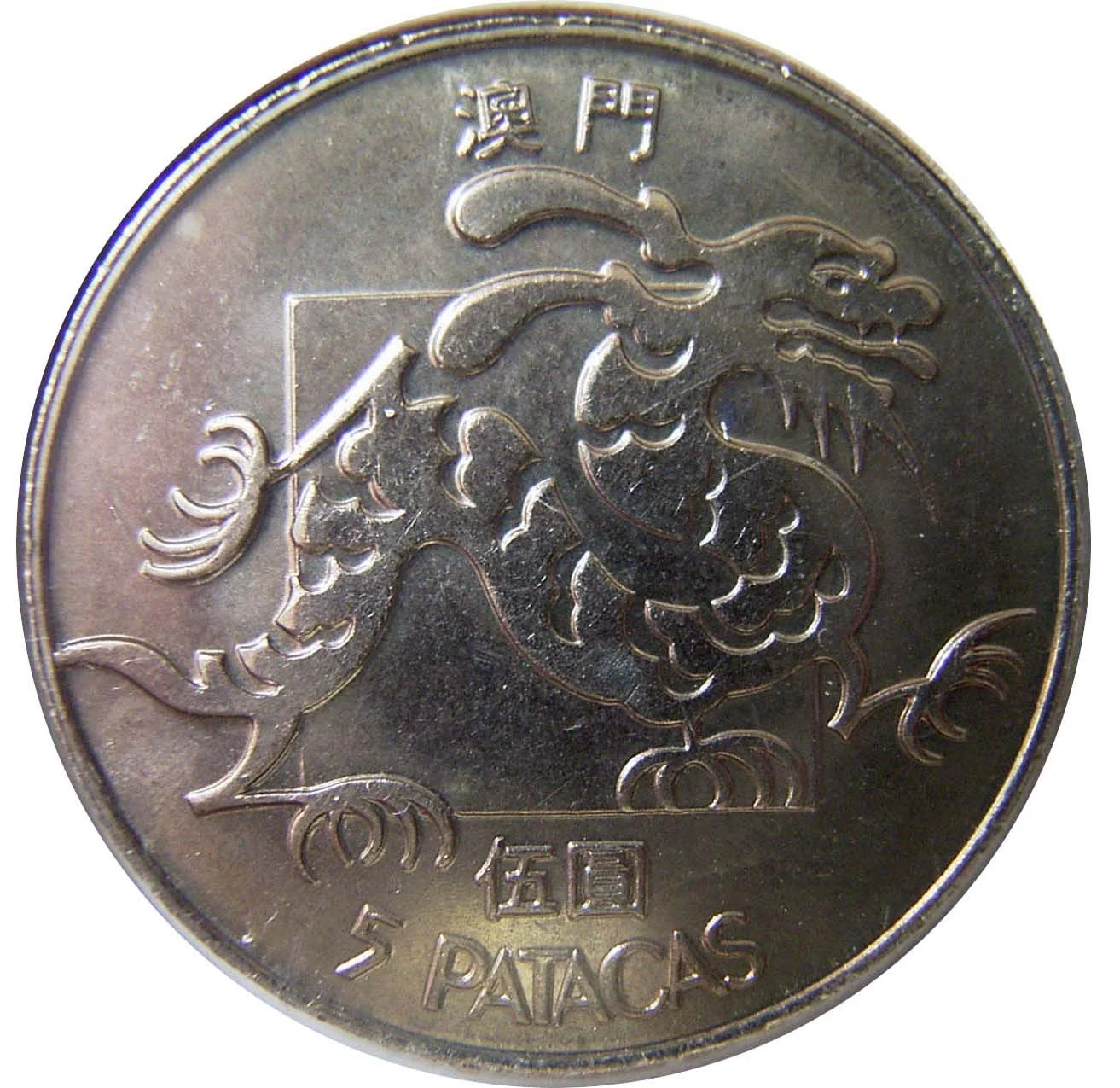
Description:
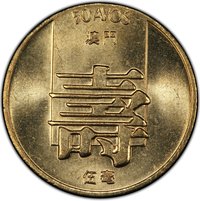
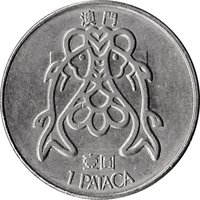
Large dragon above value, KM24.1 variety.
Inscription:
澳 門
伍 圓
5 PATACAS
伍 圓
5 PATACAS
Translation:
Macau
Five Patacas
5 Patacas
Five Patacas
5 Patacas
Languages: Portuguese, Chinese
Edge
Reeded
Mints
| Name | Mark |
|---|---|
| Singapore Mint | — |
Mintings
| Year | Mint Mark | Mintage | Quality | Collection |
|---|---|---|---|---|
| 1982 | — | 1,102,000 | ||
| 1983 | — | 2,148,000 | ||
| 1984 | — | — | ||
| 1985 | — | — | ||
| 1988 | — | 20,000,000 |
Historical background
In 1982, Macau's currency situation was characterized by a unique dual circulation system, dominated by the Portuguese pataca (MOP) but heavily reliant on the Hong Kong dollar (HKD). The pataca, issued by the Banco Nacional Ultramarino, was the official legal tender. However, due to Macau's small, open economy and deep commercial and financial ties with its neighbor, the Hong Kong dollar was widely accepted and often preferred for larger transactions, property deals, and in the tourism sector. This created a de facto hierarchy of currencies, with the HKD seen as a more stable and internationally convertible reserve currency, while the pataca served for everyday local transactions.
This dependency highlighted underlying vulnerabilities. The pataca's stability was not managed by an independent central bank but was instead pegged to the Portuguese escudo, a currency itself prone to fluctuation. Recognizing the economic risks of this peg to a distant and weakening European currency, Macanese authorities and Portuguese administrators were actively engaged in monetary reforms. The key objective was to re-peg the pataca to the stronger and more regionally relevant Hong Kong dollar, a move seen as essential for bolstering economic confidence, stabilizing local prices, and better integrating Macau with the booming East Asian financial system.
Thus, 1982 was a pivotal year of transition in Macau's monetary history. The groundwork was being laid for a formal shift that would eventually occur in 1983, when the pataca was successfully re-pegged to the Hong Kong dollar. This change aimed to end the instability of the escudo peg, curb the territory's excessive reliance on a foreign currency in circulation, and assert greater control over its own monetary policy, all while preparing the economy for a future beyond Portuguese administration.
This dependency highlighted underlying vulnerabilities. The pataca's stability was not managed by an independent central bank but was instead pegged to the Portuguese escudo, a currency itself prone to fluctuation. Recognizing the economic risks of this peg to a distant and weakening European currency, Macanese authorities and Portuguese administrators were actively engaged in monetary reforms. The key objective was to re-peg the pataca to the stronger and more regionally relevant Hong Kong dollar, a move seen as essential for bolstering economic confidence, stabilizing local prices, and better integrating Macau with the booming East Asian financial system.
Thus, 1982 was a pivotal year of transition in Macau's monetary history. The groundwork was being laid for a formal shift that would eventually occur in 1983, when the pataca was successfully re-pegged to the Hong Kong dollar. This change aimed to end the instability of the escudo peg, curb the territory's excessive reliance on a foreign currency in circulation, and assert greater control over its own monetary policy, all while preparing the economy for a future beyond Portuguese administration.
Series: 1982 Macau circulation coins
🌱 Common