

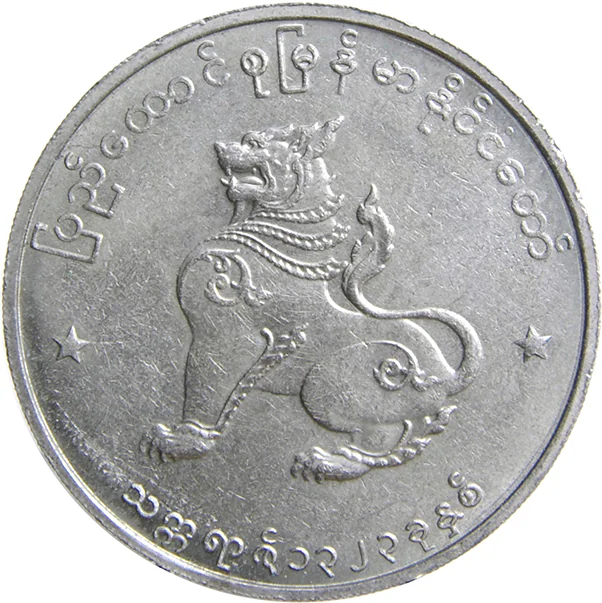
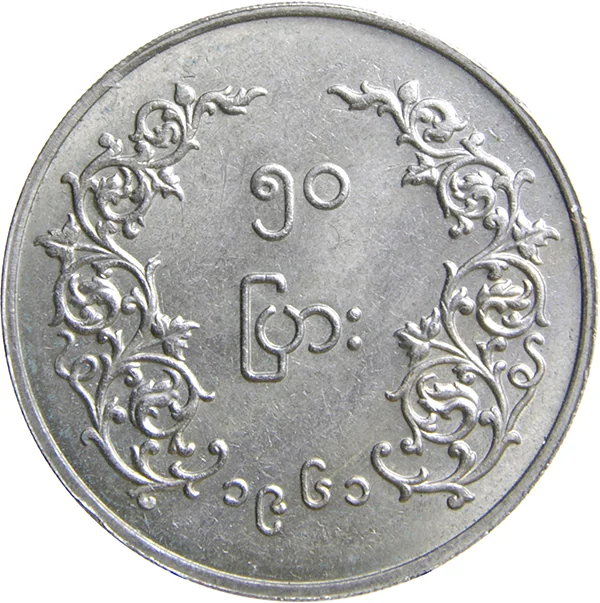
50 Pyas – Myanmar
Myanmar
Context
Years: 1952–1966
Issuer: Myanmar 
Period:
(1948—1974)
Currency:
(since 1952)
Total mintage: 36,100,200
Material
Diameter: 26 mm
Weight: 7.8 g
Thickness: 1.7 mm
Shape: Round
Standard: Silver quarter ounce
Technique: Milled
Alignment: Medal alignment
flip
References
KM: #Click to copy to clipboard36
Numista: #7690
Value
Exchange value: 0.50 MMK
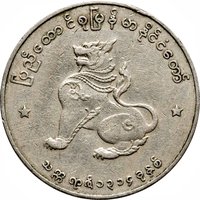
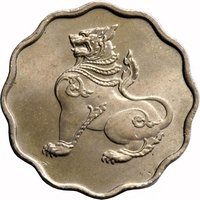
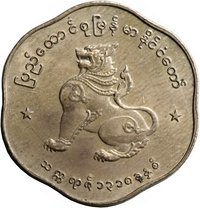
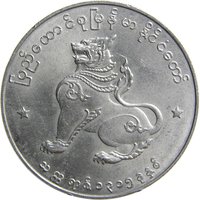
Obverse
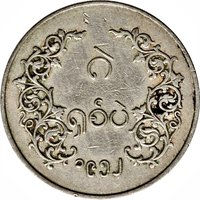
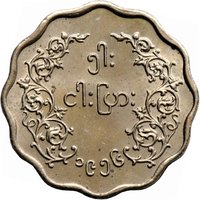
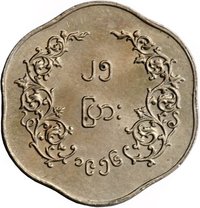
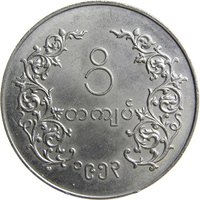
Reverse
Edge
Security edge
Mints
| Name | Mark |
|---|---|
| Berlin | — |
| Royal Mint (Tower Hill) | — |
Mintings
| Year | Mint Mark | Mintage | Quality | Collection |
|---|---|---|---|---|
| 1952 | — | 2,500,000 | ||
| 1952 | — | 100 | Proof | |
| 1954 | — | — | Proof | |
| 1954 | — | 12,000,000 | ||
| 1956 | — | 8,000,000 | ||
| 1956 | — | — | Proof | |
| 1961 | — | 2,000,000 | ||
| 1961 | — | — | Proof | |
| 1962 | — | 600,000 | ||
| 1962 | — | 100 | Proof | |
| 1963 | — | 4,800,000 | ||
| 1963 | — | — | Proof | |
| 1965 | — | 2,800,000 | ||
| 1965 | — | — | Proof | |
| 1966 | — | 3,400,000 | ||
| 1966 | — | — | Proof |
Historical background
In 1952, Myanmar (then known as the Union of Burma) was navigating a complex monetary landscape just four years after gaining independence from Britain. The foundational currency, the Burmese kyat, was introduced in 1952 to replace the Indian rupee, which had circulated under colonial rule. This change was a significant symbolic act of economic sovereignty, with the new kyat initially pegged at par to the Indian rupee and tied to the British pound sterling, reflecting the country's ongoing economic linkages within the Commonwealth and its former imperial trade networks.
The government, led by Prime Minister U Nu, faced immense challenges in stabilizing the currency and building a independent financial system. The economy was still recovering from the severe devastation of World War II, and the country was grappling with multiple internal communist and ethnic insurgencies that disrupted production and state control. Furthermore, the loss of guaranteed markets for rice exports—a major source of foreign exchange—created balance of payments pressures, testing the stability of the new kyat and limiting the government's ability to fund ambitious welfare and development programs.
Consequently, the currency situation in 1952 was one of fragile institution-building amidst broader economic and political instability. While the introduction of the kyat marked a decisive break from the colonial monetary system, the state's capacity to manage it effectively was constrained by internal conflict, post-war reconstruction needs, and a challenging transition in the global economy. This period set the stage for the increasing adoption of socialist economic policies later in the decade, which would include the nationalization of banks and further state control over the financial sector.
The government, led by Prime Minister U Nu, faced immense challenges in stabilizing the currency and building a independent financial system. The economy was still recovering from the severe devastation of World War II, and the country was grappling with multiple internal communist and ethnic insurgencies that disrupted production and state control. Furthermore, the loss of guaranteed markets for rice exports—a major source of foreign exchange—created balance of payments pressures, testing the stability of the new kyat and limiting the government's ability to fund ambitious welfare and development programs.
Consequently, the currency situation in 1952 was one of fragile institution-building amidst broader economic and political instability. While the introduction of the kyat marked a decisive break from the colonial monetary system, the state's capacity to manage it effectively was constrained by internal conflict, post-war reconstruction needs, and a challenging transition in the global economy. This period set the stage for the increasing adoption of socialist economic policies later in the decade, which would include the nationalization of banks and further state control over the financial sector.
Series: 1952 Myanmar circulation coins
🌱 Common