

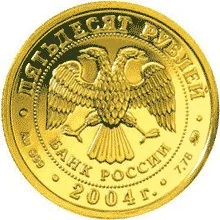

50 Rubles – Russian Federation
Russia
Context
Year: 2004
Country: Russia 
Issuer: Russian Federation
Period:
(since 1991)
Currency:
(since 1998)
Total mintage: 10,000
Material
Diameter: 22.6 mm
Weight: 7.89 g
Gold weight: 7.88 g
Thickness: 1.6 mm
Shape: Round
Composition: 99.9% Gold
Standard: Silver quarter ounce
Magnetic: No
Technique: Milled
Alignment: Medal alignment
flip

References
Value
Exchange value: 50 RUB
Bullion value: $1317.46
Inflation-adjusted value: 323.23 RUB
Obverse
Description:
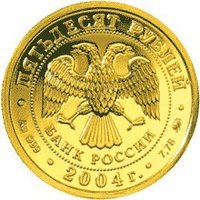
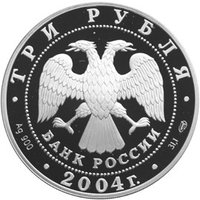
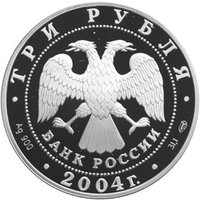
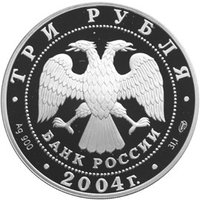
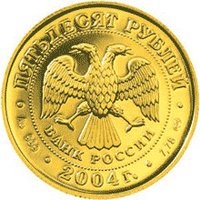
The obverse features the Bank of Russia emblem (a two-headed eagle with wings down, above the inscription "БАНК РОССИИ") within a dotted circle. The rim inscriptions read "ПЯТЬДЕСЯТ РУБЛЕЙ" at the top, and the year "2004" at the bottom. To the left are the metal and fineness marks; to the right, the pure metal content and mint mark.
Inscription:
ПЯТЬДЕСЯТ РУБЛЕЙ
БАНК РОССИИ
• Au 999 • 2004 г. • 7,78 ММД •
БАНК РОССИИ
• Au 999 • 2004 г. • 7,78 ММД •
Translation:
FIFTY RUBLES
BANK OF RUSSIA
• Au 999 • 2004 • 7.78 SPMD •
BANK OF RUSSIA
• Au 999 • 2004 • 7.78 SPMD •
Language: Russian
Designer and engraver: Alexander Vasilyevich Baklanov
Reverse
Description:
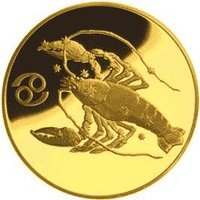
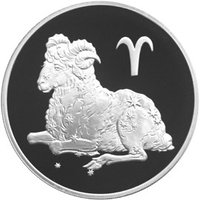
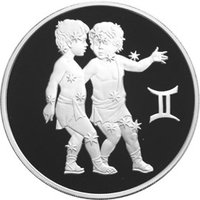
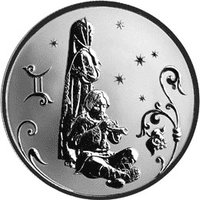
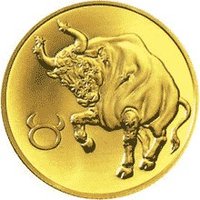
Twin children against a starry background with the Gemini constellation symbol to the right.
Inscription:
♊︎
Engraver: Alexey Igorevich Parfenov
Designers: Sergey Kozlov, Anton Dmitrievich Schablykin
Edge
134 corrugations
Categories
| Astrology> Western astrological sign |
Mints
| Name | Mark |
|---|---|
| Moscow Mint | (ММД) |
Mintings
| Year | Mint Mark | Mintage | Quality | Collection |
|---|---|---|---|---|
| 2004 | ММД | 10,000 | BU |
Historical background
In 2004, the Russian Federation's currency situation was characterized by a period of remarkable stability and strengthening for the ruble, a dramatic reversal from the crises of the 1990s. This stability was underpinned by a potent combination of soaring global oil prices and stringent fiscal discipline under President Vladimir Putin's government. The Central Bank of Russia (CBR) operated a managed float regime, actively intervening in the foreign exchange market to smooth volatility and prevent excessive appreciation, while accumulating vast foreign currency reserves, which grew from $73 billion to over $120 billion during the year. This accumulation was a direct result of large trade surpluses from hydrocarbon exports, creating significant upward pressure on the ruble's value.
The government's key policy, operational since 2003, was the stabilization fund, designed to sterilize windfall oil revenues. By sequestering excess petrodollars, the fund mitigated inflationary pressures and "Dutch disease" effects, where a resource boom harms other export sectors. Consequently, inflation, though still a concern, was on a downward trend, falling from 12% in 2003 to 11.7% by year's end. The nominal exchange rate appreciated moderately, but the CBR's focus was on curbing real effective appreciation to maintain the competitiveness of non-oil industries. This careful management fostered growing public and investor confidence in the ruble, encouraging de-dollarization as citizens and businesses began to hold more assets in the national currency.
Looking forward, the stability of 2004 presented both opportunities and challenges. It provided a foundation for economic planning and attracted foreign investment. However, it also starkly highlighted the Russian economy's deepening dependence on volatile global commodity markets. Policymakers were acutely aware that the robust currency position was fragile, hinging on sustained high oil prices. Thus, while 2004 represented a year of hard-won monetary stability and growing macroeconomic credibility, it also underscored the long-term structural vulnerabilities that would define Russia's economic policy debates in the years to come.
The government's key policy, operational since 2003, was the stabilization fund, designed to sterilize windfall oil revenues. By sequestering excess petrodollars, the fund mitigated inflationary pressures and "Dutch disease" effects, where a resource boom harms other export sectors. Consequently, inflation, though still a concern, was on a downward trend, falling from 12% in 2003 to 11.7% by year's end. The nominal exchange rate appreciated moderately, but the CBR's focus was on curbing real effective appreciation to maintain the competitiveness of non-oil industries. This careful management fostered growing public and investor confidence in the ruble, encouraging de-dollarization as citizens and businesses began to hold more assets in the national currency.
Looking forward, the stability of 2004 presented both opportunities and challenges. It provided a foundation for economic planning and attracted foreign investment. However, it also starkly highlighted the Russian economy's deepening dependence on volatile global commodity markets. Policymakers were acutely aware that the robust currency position was fragile, hinging on sustained high oil prices. Thus, while 2004 represented a year of hard-won monetary stability and growing macroeconomic credibility, it also underscored the long-term structural vulnerabilities that would define Russia's economic policy debates in the years to come.
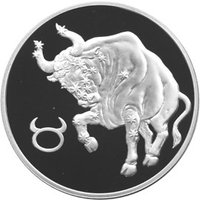
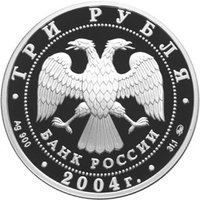
Series: Signs of the Zodiac
✨ Legendary