

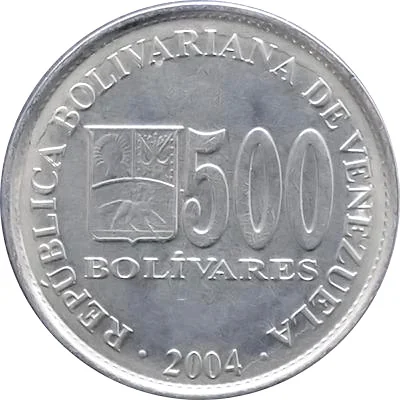
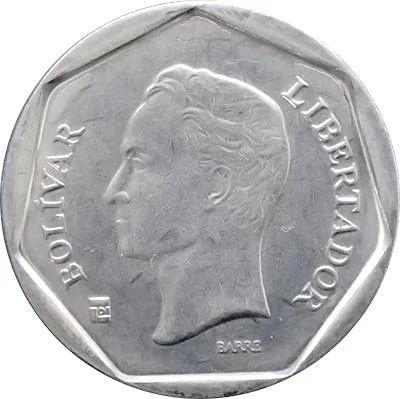
500 Bolivars – Venezuela
Venezuela
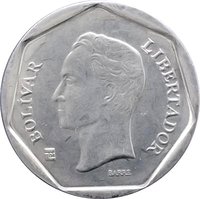
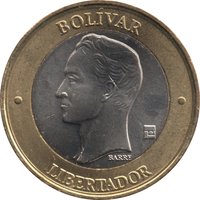
Obverse
Reverse
Edge
Segmented reeding
Categories
| Animal> Horse |
| Person> Military leader |
| Person> Politician |
| Symbols> Coat of Arms |
Mints
| Name | Mark |
|---|---|
| Casa de la Moneda de Venezuela | — |
Mintings
| Year | Mint Mark | Mintage | Quality | Collection |
|---|---|---|---|---|
| 2004 | — | 175,000,000 |
Historical background
In 2004, Venezuela's currency situation was defined by strict exchange controls implemented by President Hugo Chávez's government the previous year. Facing capital flight and a sharp decline in international reserves following a devastating national strike and political turmoil in 2002-2003, the government created the CADIVI agency to administer a fixed exchange rate regime. The official rate was pegged at 1,600 bolívares to the US dollar, but access to these dollars was heavily restricted, reserved primarily for importing essential goods like food and medicine, and for government debt payments.
This control system immediately created a significant divergence between the official rate and a thriving black-market rate. Businesses and individuals unable to obtain official dollar approvals turned to the parallel market, where the bolívar traded at a steep discount—often around 2,800 bolívares per dollar in 2004, nearly 75% weaker than the official peg. This duality led to widespread distortions, fostering a culture of corruption within CADIVI, as those with connections secured cheap dollars, while the general public faced increasing difficulties and a de facto devaluation of their currency's purchasing power for international transactions.
Economically, the strong oil prices of 2004, with Venezuela's crude averaging over $30 per barrel, provided a crucial buffer. This petrodollar influx allowed the government to sustain the costly fixed exchange rate and finance expansive social programs, masking the system's inherent inefficiencies in the short term. However, the controls established in this period planted the seeds for future crises by discouraging domestic production, encouraging import dependency, and institutionalizing a multi-tiered currency system that would become increasingly unsustainable in the following decade.
This control system immediately created a significant divergence between the official rate and a thriving black-market rate. Businesses and individuals unable to obtain official dollar approvals turned to the parallel market, where the bolívar traded at a steep discount—often around 2,800 bolívares per dollar in 2004, nearly 75% weaker than the official peg. This duality led to widespread distortions, fostering a culture of corruption within CADIVI, as those with connections secured cheap dollars, while the general public faced increasing difficulties and a de facto devaluation of their currency's purchasing power for international transactions.
Economically, the strong oil prices of 2004, with Venezuela's crude averaging over $30 per barrel, provided a crucial buffer. This petrodollar influx allowed the government to sustain the costly fixed exchange rate and finance expansive social programs, masking the system's inherent inefficiencies in the short term. However, the controls established in this period planted the seeds for future crises by discouraging domestic production, encouraging import dependency, and institutionalizing a multi-tiered currency system that would become increasingly unsustainable in the following decade.
🌱 Common