

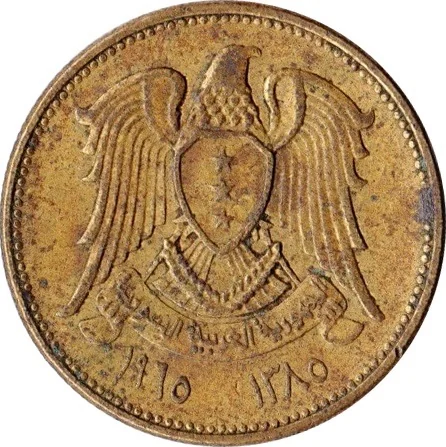
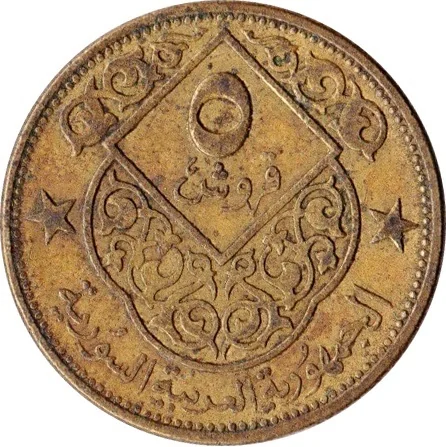
5 piastres – Syria
Add to wishlist
Syria
Context
Years: 1962–1965
Issuer: Syria
Period:
(since 1961)
Currency:
(since 1919)
Demonetized: Yes
Total mintage: 25,000,000
Material
References
KM: #
Numista: #7632
Value
Exchange value: 0.05 SYP
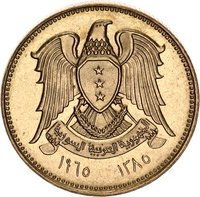
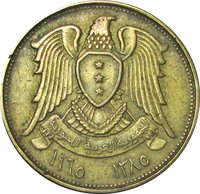
Obverse
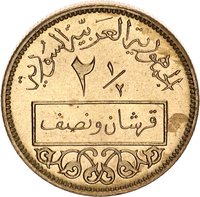
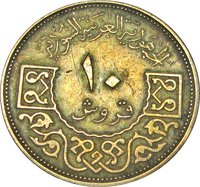
Reverse
Edge
Reeded
Categories
| Animal> Bird |
| Symbols> Coat of Arms |
Mints
| Name | Mark |
|---|---|
| Bern | — |
Mintings
| Year | Mint Mark | Mintage | Quality | Collection |
|---|---|---|---|---|
| 1962 | — | 7,000,000 | ||
| 1965 | — | 18,000,000 |
Historical background
In 1962, Syria's currency situation was defined by its recent separation from the United Arab Republic (UAR), the political union with Egypt that had dissolved in September 1961. During the union (1958-1961), the Syrian pound was replaced by the Egyptian pound as the official currency, and Syria’s independent central banking functions were effectively suspended under Cairo's control. The post-separation period was thus one of urgent monetary reconstruction, as the new Syrian government sought to reassert its economic sovereignty and stabilize its finances.
The immediate task was the reintroduction of a national currency. In 1962, the newly re-established Central Bank of Syria issued the "Syrian pound" once again, severing the monetary link to Egypt. This was not merely a symbolic act but a critical step to control money supply, manage foreign exchange reserves, and direct credit toward national development priorities. The government faced the challenge of building confidence in this new currency while managing the legacy of economic policies from the UAR era, which had included nationalizations and trade disruptions.
Consequently, the currency situation in 1962 was inherently transitional and fragile. The economy was adjusting to independence, and the value and stability of the resurrected Syrian pound were contingent on the government's ability to manage budget deficits, attract foreign investment, and navigate the geopolitical tensions of the Cold War era. The success of this monetary re-founding was crucial for the Syrian Arab Republic's broader project of post-UAR state-building and economic independence in the early 1960s.
The immediate task was the reintroduction of a national currency. In 1962, the newly re-established Central Bank of Syria issued the "Syrian pound" once again, severing the monetary link to Egypt. This was not merely a symbolic act but a critical step to control money supply, manage foreign exchange reserves, and direct credit toward national development priorities. The government faced the challenge of building confidence in this new currency while managing the legacy of economic policies from the UAR era, which had included nationalizations and trade disruptions.
Consequently, the currency situation in 1962 was inherently transitional and fragile. The economy was adjusting to independence, and the value and stability of the resurrected Syrian pound were contingent on the government's ability to manage budget deficits, attract foreign investment, and navigate the geopolitical tensions of the Cold War era. The success of this monetary re-founding was crucial for the Syrian Arab Republic's broader project of post-UAR state-building and economic independence in the early 1960s.
Series: 1962 Syria circulation coins
🌱 Very Common