

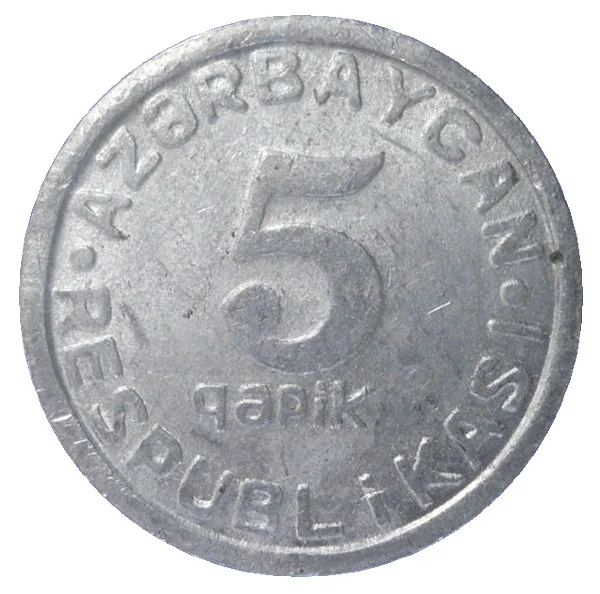
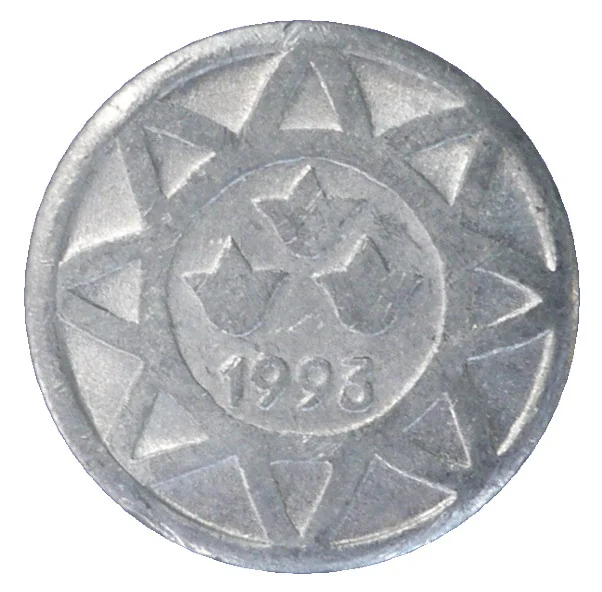
5 Qapiks – Azerbaijan
Azerbaijan
Context
Year: 1993
Issuer: Azerbaijan 
Period:
(since 1991)
Currency:
(1992—2006)
Demonetization: 1 January 2006
Material
References
KM: #Click to copy to clipboard1a
Numista: #7626
Value
Exchange value: 0.05 AZM
Obverse
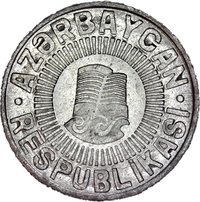
Description:
Denomination
Inscription:
AZƏRBAYCAN
• RESPUBLİKASI •
5
qəpik
• RESPUBLİKASI •
5
qəpik
Translation:
AZERBAIJAN
• REPUBLIC •
5
qapik
• REPUBLIC •
5
qapik
Script: Latin
Language: Azerbaijani
Reverse
Edge
Plain
Mintings
| Year | Mint Mark | Mintage | Quality | Collection |
|---|---|---|---|---|
| 1993 | — | — |
Historical background
In 1993, Azerbaijan’s currency situation was characterized by severe hyperinflation and the collapse of monetary control, set against the backdrop of political turmoil and war. Following the dissolution of the Soviet Union, the country initially used the Russian ruble before introducing the Azerbaijani ruble (or manat) in August 1992. However, the new currency lacked credibility and stability. The government, led by President Abulfaz Elchibey and then from June 1993 by Heydar Aliyev, financed massive budget deficits—primarily to fund the war with Armenia over Nagorno-Karabakh—by printing money with little restraint. This led to a loss of fiscal and monetary discipline, sending the economy into a tailspin.
The economic consequences were catastrophic. Annual inflation skyrocketed to an estimated 1,200% or more in 1993, eroding savings and wages virtually overnight. The currency’s value plummeted on the black market, and a severe shortage of goods, including basic necessities, plagued the population. The economy was further crippled by the conflict, which displaced over a million people and disrupted key industries and agriculture. This period represented the nadir of Azerbaijan’s post-Soviet economic transition, with the currency system failing to function as a reliable store of value or medium of exchange.
The crisis of 1993 set the stage for profound reforms. Recognizing the need for stabilization, the government, under Heydar Aliyev, began seeking international assistance and laid the groundwork for a new currency. This culminated in the 1994 introduction of a second, re-denominated manat, which was part of a broader shift towards macroeconomic stabilization. Concurrently, the signing of the "Contract of the Century" for Caspian oil exploration in late 1994 promised future foreign investment and revenue, offering a path away from hyperinflation and toward a managed, if initially fragile, currency regime.
The economic consequences were catastrophic. Annual inflation skyrocketed to an estimated 1,200% or more in 1993, eroding savings and wages virtually overnight. The currency’s value plummeted on the black market, and a severe shortage of goods, including basic necessities, plagued the population. The economy was further crippled by the conflict, which displaced over a million people and disrupted key industries and agriculture. This period represented the nadir of Azerbaijan’s post-Soviet economic transition, with the currency system failing to function as a reliable store of value or medium of exchange.
The crisis of 1993 set the stage for profound reforms. Recognizing the need for stabilization, the government, under Heydar Aliyev, began seeking international assistance and laid the groundwork for a new currency. This culminated in the 1994 introduction of a second, re-denominated manat, which was part of a broader shift towards macroeconomic stabilization. Concurrently, the signing of the "Contract of the Century" for Caspian oil exploration in late 1994 promised future foreign investment and revenue, offering a path away from hyperinflation and toward a managed, if initially fragile, currency regime.
🌱 Common