

50 francs – Belgium
Add to wishlist
Belgium
Context
Years: 1987–1993
Issuer: Belgium
Ruler: Baudouin I
Currency:
(1832—2001)
Demonetization: 28 February 2002
Total mintage: 97,000,000
Material
References
KM: #
Numista: #761
Value
Exchange value: 50 BEF
Inflation-adjusted value: 115.69 BEF
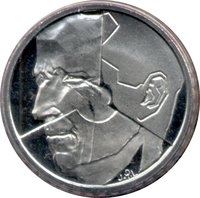
Obverse
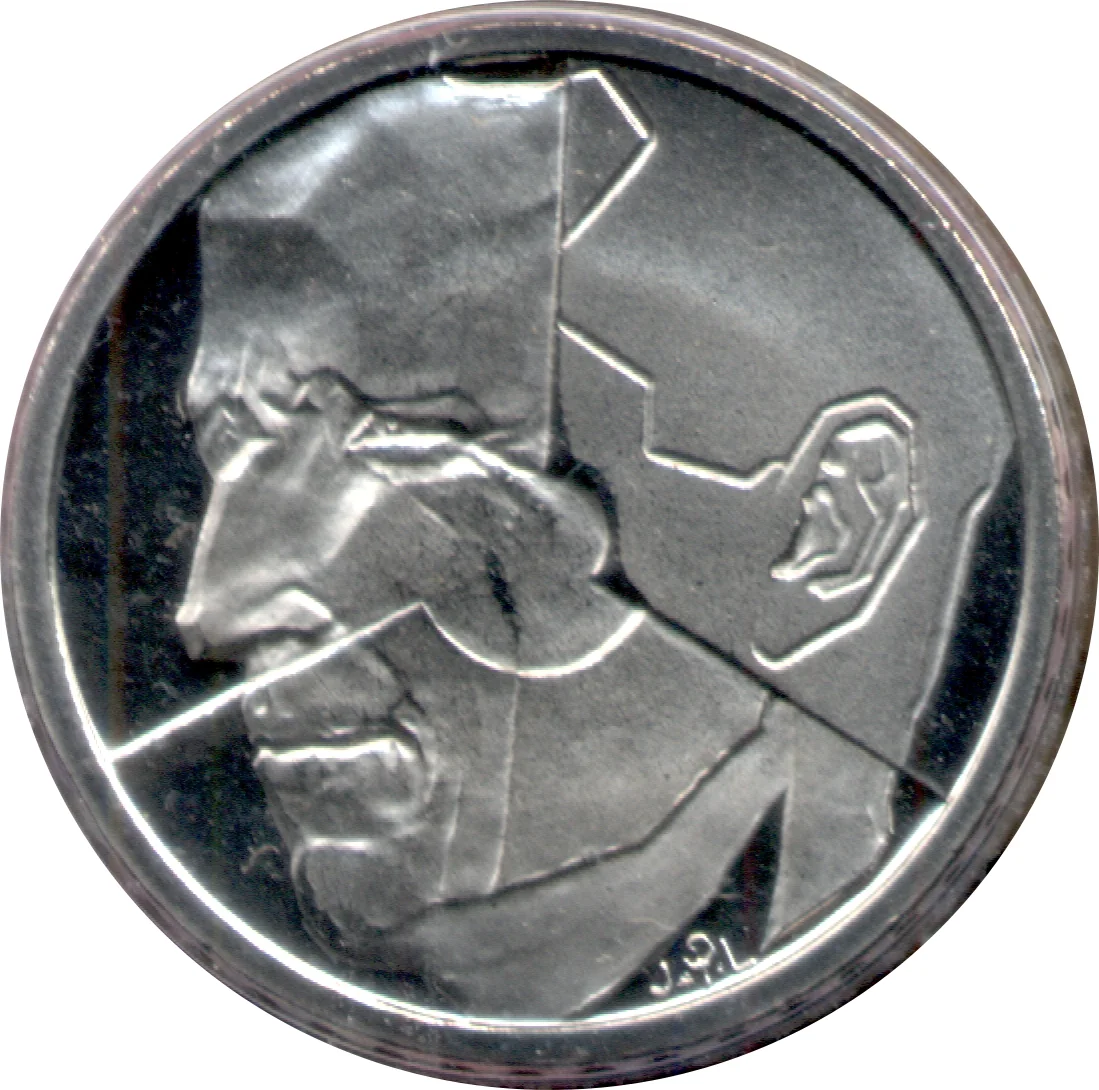
Description:
Stylized left-facing portrait of Baudouin I, designer's name beneath.
Inscription:
J-P.L
Script: Latin
Engraver: Jean-Paul Laenen
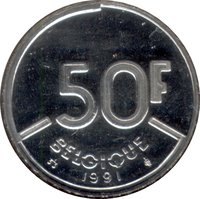
Reverse
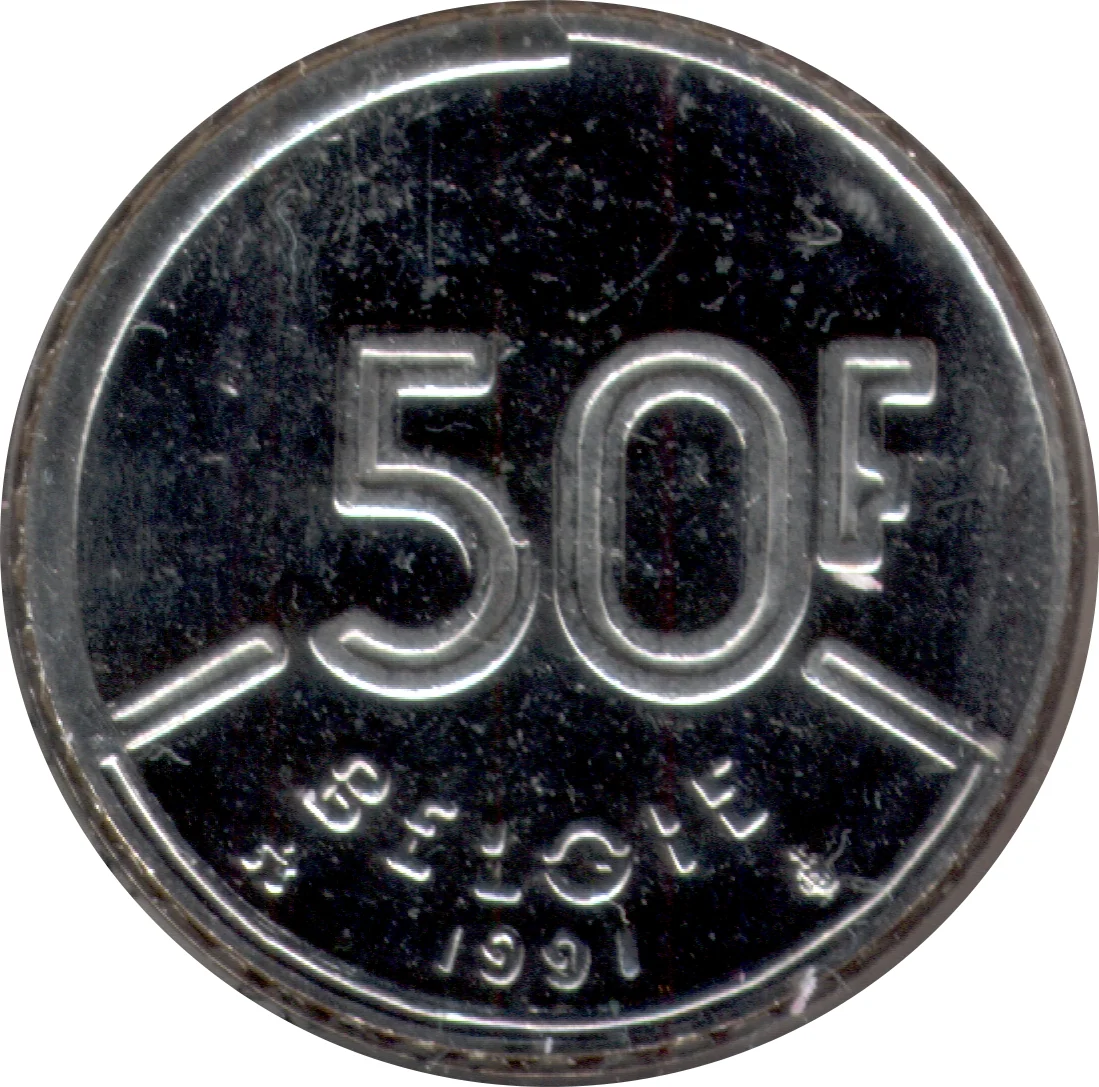
Description:
Center denomination, Dutch legend below. Year at bottom between privy and mint marks.
Inscription:
50F
BELGIË
1991
BELGIË
1991
Translation:
Belgium
1991
1991
Script: Latin
Engraver: Jean-Paul Laenen
Edge
Coarsely reeded
Mints
| Name | Mark |
|---|---|
| Royal Mint of Belgium | — |
Mintings
| Year | Mint Mark | Mintage | Quality | Collection |
|---|---|---|---|---|
| 1987 | — | 30,000,000 | ||
| 1988 | — | 3,500,000 | ||
| 1989 | — | 15,000,000 | ||
| 1990 | — | 15,000,000 | ||
| 1991 | — | 3,500,000 | ||
| 1992 | — | 15,000,000 | ||
| 1993 | — | 15,000,000 |
Historical background
In 1987, Belgium operated within the European Monetary System (EMS), a framework established in 1979 to reduce exchange rate variability and achieve monetary stability in Europe. The Belgian franc (BEF) was part of the EMS's Exchange Rate Mechanism (ERM), which pegged it within a narrow band (±2.25%) against a central rate defined by the European Currency Unit (ECU). This system required the National Bank of Belgium to intervene in foreign exchange markets to maintain the franc's value, a task complicated by the country's specific economic challenges.
Domestically, the Belgian franc faced significant pressure due to longstanding structural issues. Belgium carried one of the highest public debt-to-GDP ratios in the industrialized world, exceeding 120% in 1987, a legacy of past deficits. This high debt burden fueled persistent concerns about the currency's strength and the government's fiscal credibility. Furthermore, Belgium had a history of high wage inflation, which eroded its international competitiveness. To defend the franc's ERM parity and curb inflation, the National Bank maintained relatively high interest rates throughout the mid-1980s, a necessary but economically restrictive policy.
Consequently, the currency situation in 1987 was one of managed stability within the European framework, but achieved at a cost. The high-interest-rate policy, essential for supporting the franc and meeting EMS obligations, acted as a drag on domestic economic growth and investment. The underlying tensions between the need for exchange rate stability and the demands of addressing massive public debt and wage-price dynamics defined the monetary policy landscape. This period underscored Belgium's commitment to European monetary integration, a path that would ultimately lead to its adoption of the euro in 1999.
Domestically, the Belgian franc faced significant pressure due to longstanding structural issues. Belgium carried one of the highest public debt-to-GDP ratios in the industrialized world, exceeding 120% in 1987, a legacy of past deficits. This high debt burden fueled persistent concerns about the currency's strength and the government's fiscal credibility. Furthermore, Belgium had a history of high wage inflation, which eroded its international competitiveness. To defend the franc's ERM parity and curb inflation, the National Bank maintained relatively high interest rates throughout the mid-1980s, a necessary but economically restrictive policy.
Consequently, the currency situation in 1987 was one of managed stability within the European framework, but achieved at a cost. The high-interest-rate policy, essential for supporting the franc and meeting EMS obligations, acted as a drag on domestic economic growth and investment. The underlying tensions between the need for exchange rate stability and the demands of addressing massive public debt and wage-price dynamics defined the monetary policy landscape. This period underscored Belgium's commitment to European monetary integration, a path that would ultimately lead to its adoption of the euro in 1999.
🌱 Very Common