

1 franc – Belgium
Add to wishlist
Belgium
Context
Years: 1989–1993
Issuer: Belgium
Ruler: Baudouin I
Currency:
(1832—2001)
Demonetization: 28 February 2002
Total mintage: 615,280,000
Material
References
KM: #
Numista: #1245
Value
Exchange value: 1 BEF
Inflation-adjusted value: 2.25 BEF
Obverse
Description:
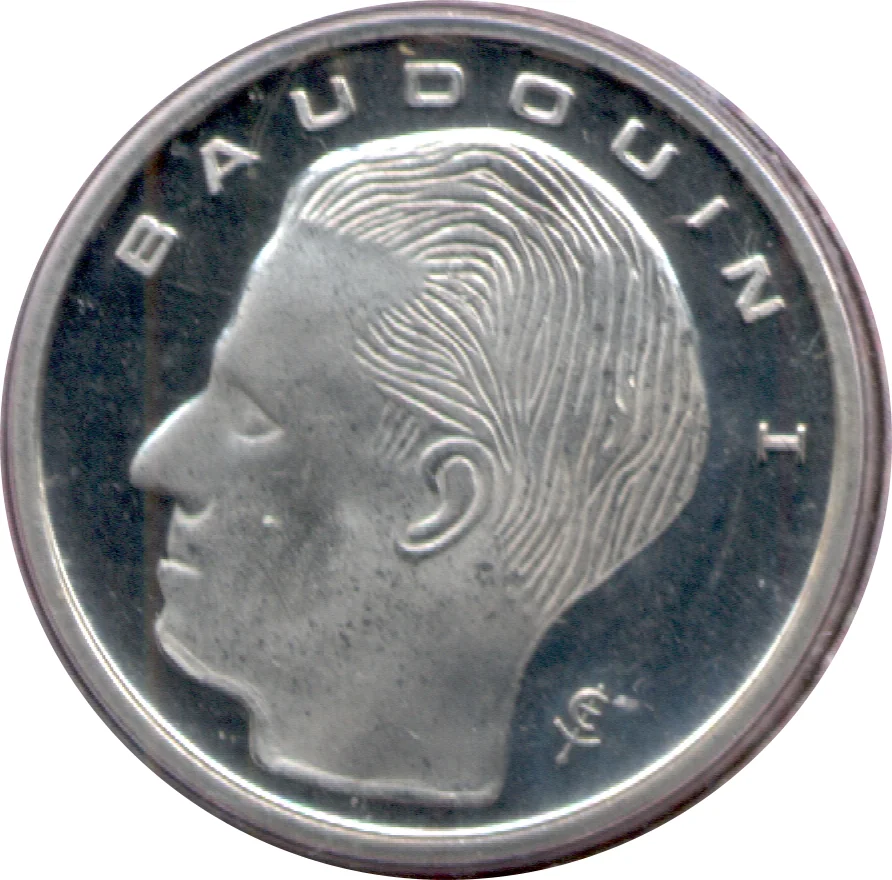
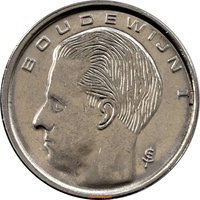
Left-profile portrait of Baudouin I of Belgium. French name above, designer mark lower right.
Inscription:
BAUDOUIN I
Script: Latin
Engraver: Harry Elstrøm
Reverse
Description:
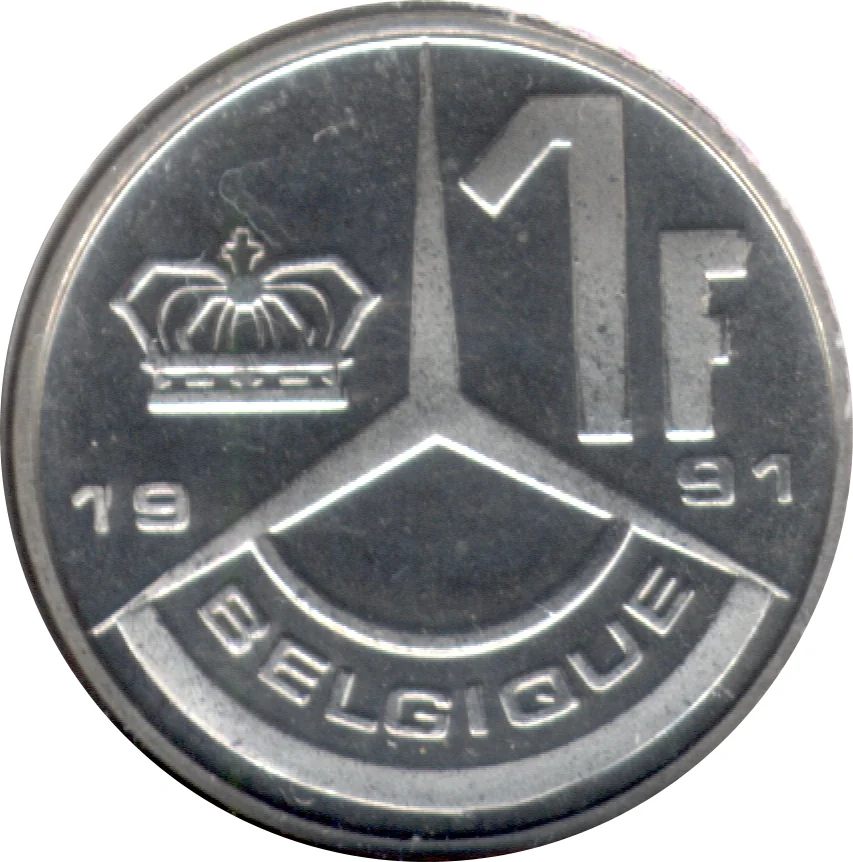
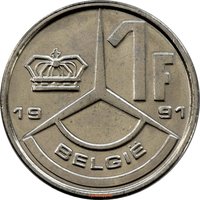
Central three-pointed star divides year. French crown, value, legend.
Inscription:
1F
1991
BELGIQUE
1991
BELGIQUE
Translation:
BELGIQUE
1991
1991
Script: Latin
Language: French
Engraver: Harry Elstrøm
Edge
Plain
Mints
| Name | Mark |
|---|---|
| Royal Mint of Belgium | — |
Mintings
| Year | Mint Mark | Mintage | Quality | Collection |
|---|---|---|---|---|
| 1989 | — | 200,060,000 | ||
| 1990 | — | 200,060,000 | ||
| 1991 | — | 200,060,000 | ||
| 1992 | — | 60,000 | In sets | |
| 1993 | — | 15,040,000 |
Historical background
In 1989, Belgium's currency situation was firmly embedded within the European Monetary System (EMS), a framework designed to reduce exchange rate volatility and achieve monetary stability in Europe. The Belgian franc (BEF) was a central participant in the Exchange Rate Mechanism (ERM), pegged within a narrow band (±2.25%) against a basket of European currencies, with the Deutsche Mark serving as its de facto anchor. This arrangement was crucial for Belgium, a small, open economy heavily dependent on trade, as it provided stability for its exporters and importers within the Common Market.
However, this stability came at a significant domestic cost. To maintain the franc's strong parity, particularly against the powerful Deutsche Mark, the National Bank of Belgium was compelled to pursue a policy of "franc fort" (strong franc). This involved maintaining high interest rates to attract capital and defend the currency's value. While successful in its exchange rate goal, this tight monetary policy stifled domestic investment and contributed to higher unemployment, creating a persistent tension between external monetary commitments and internal economic needs.
The year 1989 fell within a period of relative calm for the EMS before the major crises of the early 1990s. Belgium was simultaneously preparing for the next phase of European integration, as the Delors Report, published in April 1989, laid out a three-stage plan for Economic and Monetary Union (EMU). Thus, the Belgian franc's management was not just a matter of national policy but a stepping stone toward the ultimate goal of a single European currency, a path Belgium strongly supported despite the short-term economic sacrifices required to keep its currency aligned.
However, this stability came at a significant domestic cost. To maintain the franc's strong parity, particularly against the powerful Deutsche Mark, the National Bank of Belgium was compelled to pursue a policy of "franc fort" (strong franc). This involved maintaining high interest rates to attract capital and defend the currency's value. While successful in its exchange rate goal, this tight monetary policy stifled domestic investment and contributed to higher unemployment, creating a persistent tension between external monetary commitments and internal economic needs.
The year 1989 fell within a period of relative calm for the EMS before the major crises of the early 1990s. Belgium was simultaneously preparing for the next phase of European integration, as the Delors Report, published in April 1989, laid out a three-stage plan for Economic and Monetary Union (EMU). Thus, the Belgian franc's management was not just a matter of national policy but a stepping stone toward the ultimate goal of a single European currency, a path Belgium strongly supported despite the short-term economic sacrifices required to keep its currency aligned.
🌱 Very Common