

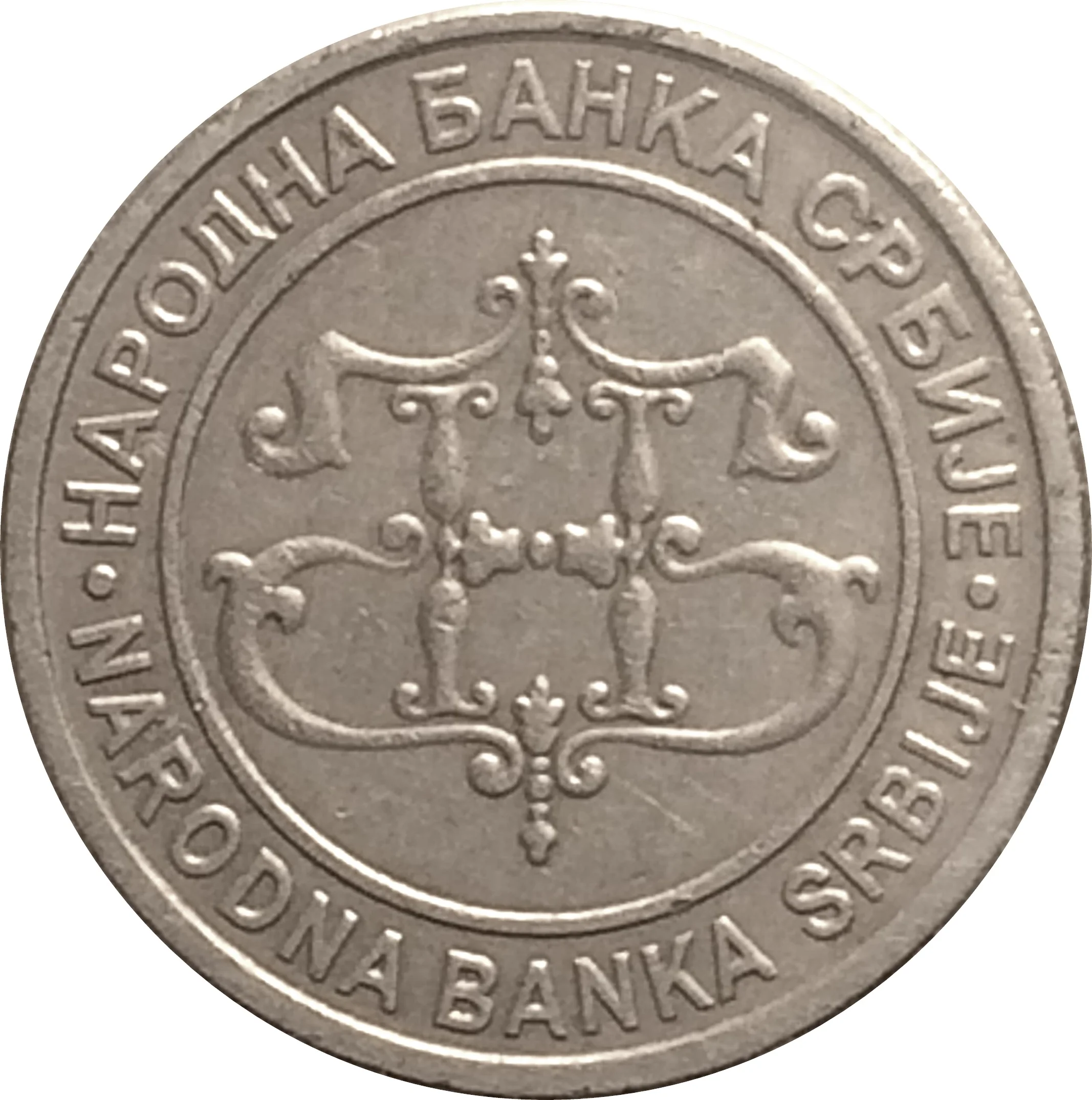
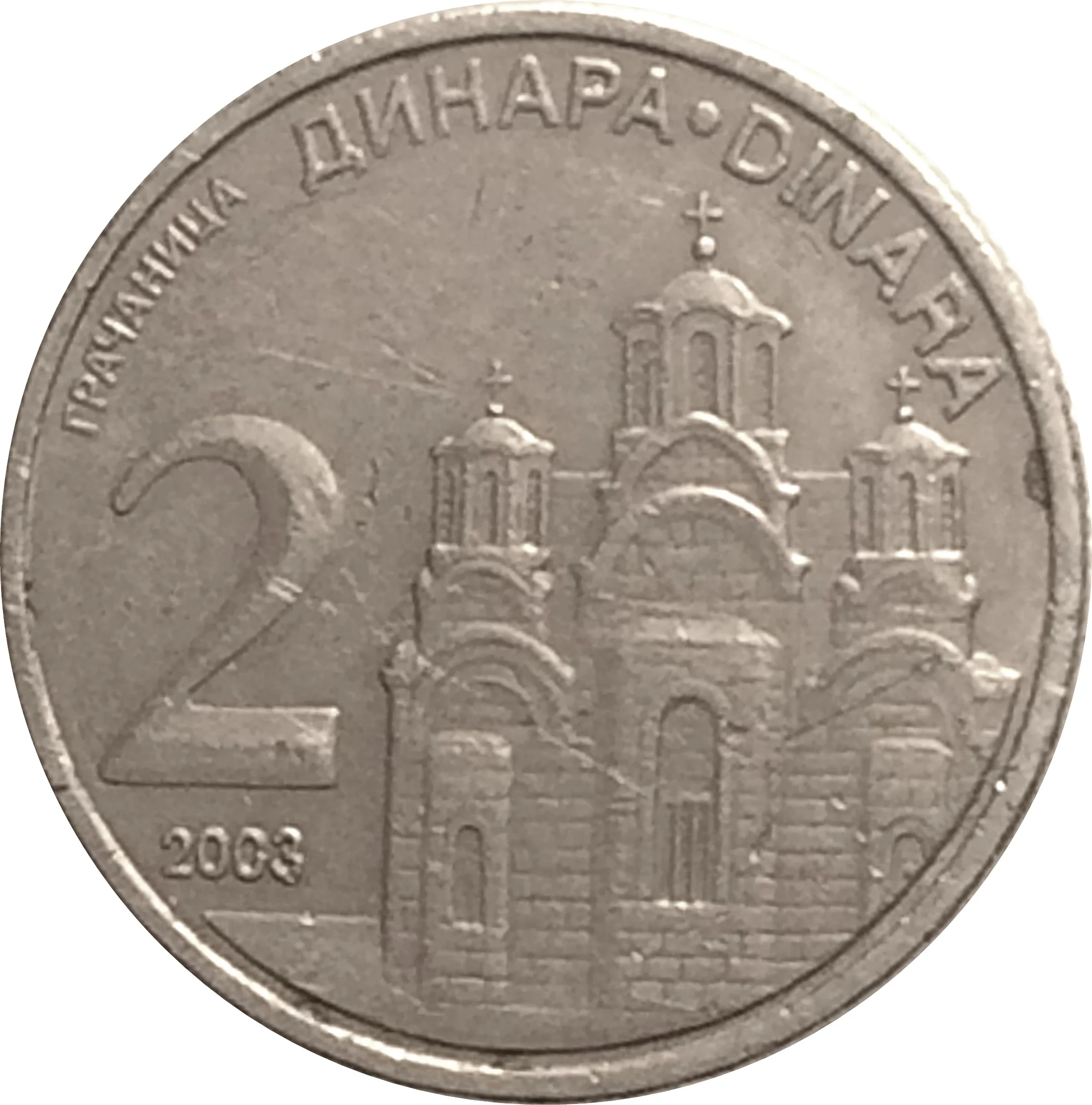
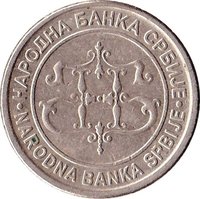
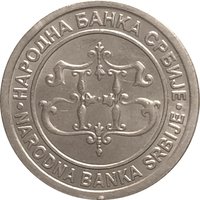
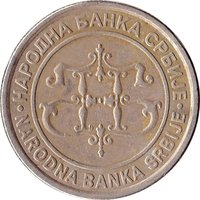
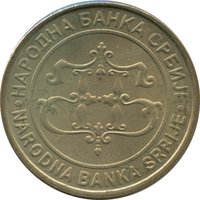
Obverse
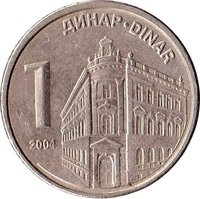
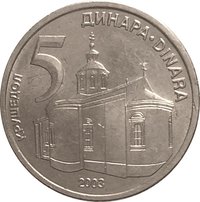
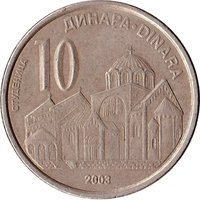
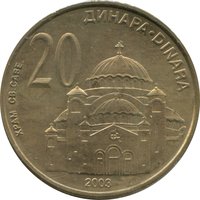
Reverse
Edge
Reeded
Categories
| Building> Religious building |
Mints
| Name | Mark |
|---|---|
| Belgrade | — |
Mintings
| Year | Mint Mark | Mintage | Quality | Collection |
|---|---|---|---|---|
| 2003 | — | 4,688,000 | ||
| 2003 | — | — | In sets |
Historical background
In 2003, Serbia's currency situation was defined by a period of relative stability following a history of severe monetary turbulence. The country was using the Yugoslav Dinar (YUM), which had been successfully re-stabilized after the hyperinflation of the early 1990s and the economic devastation of the Milošević era. A key reform in this stabilization was the official adoption of a "managed float" regime in 2001, where the National Bank of Serbia (NBS) intervened in the foreign exchange market to smooth out excessive volatility, but did not target a fixed exchange rate. This pragmatic approach aimed to build credibility and control inflation without depleting foreign reserves.
The primary focus of monetary policy was "dinarization"—restoring public confidence in the domestic currency and reducing the widespread use of the euro in everyday savings and transactions (euroization). Despite progress, the economy remained highly euroized, with a significant portion of loans, deposits, and real estate prices still indexed to or conducted in foreign currency. The NBS maintained a tight monetary policy, with high interest rates, to continue anchoring inflation and encouraging the use of the dinar, though this came at the cost of constrained economic growth.
This period was also one of institutional and political transition. 2003 saw the formal dissolution of the State Union of Serbia and Montenegro, which had a shared central bank. In preparation for full independence, Serbia began laying the groundwork for its own central banking authority, which would take full control of monetary policy. The relative stability of the dinar in 2003 was thus a hard-won foundation, but one that remained fragile, requiring continued discipline to overcome the legacy of past crises and deep-seated public preference for the euro.
The primary focus of monetary policy was "dinarization"—restoring public confidence in the domestic currency and reducing the widespread use of the euro in everyday savings and transactions (euroization). Despite progress, the economy remained highly euroized, with a significant portion of loans, deposits, and real estate prices still indexed to or conducted in foreign currency. The NBS maintained a tight monetary policy, with high interest rates, to continue anchoring inflation and encouraging the use of the dinar, though this came at the cost of constrained economic growth.
This period was also one of institutional and political transition. 2003 saw the formal dissolution of the State Union of Serbia and Montenegro, which had a shared central bank. In preparation for full independence, Serbia began laying the groundwork for its own central banking authority, which would take full control of monetary policy. The relative stability of the dinar in 2003 was thus a hard-won foundation, but one that remained fragile, requiring continued discipline to overcome the legacy of past crises and deep-seated public preference for the euro.
Series: 2003 Serbia circulation coins
🌱 Very Common