

500 Francs – Djibouti
Djibouti
Context
Years: 1989–2010
Issuer: Djibouti 
Period:
(since 1977)
Currency:
(since 1977)
Total mintage: 852,150
Material
Diameter: 28 mm
Weight: 12.9 g
Thickness: 3 mm
Shape: Round
Composition: Aluminium bronze
Magnetic: No
Technique: Milled
Alignment: Coin alignment
flip
References
KM: #Click to copy to clipboard27
Numista: #7582
Value
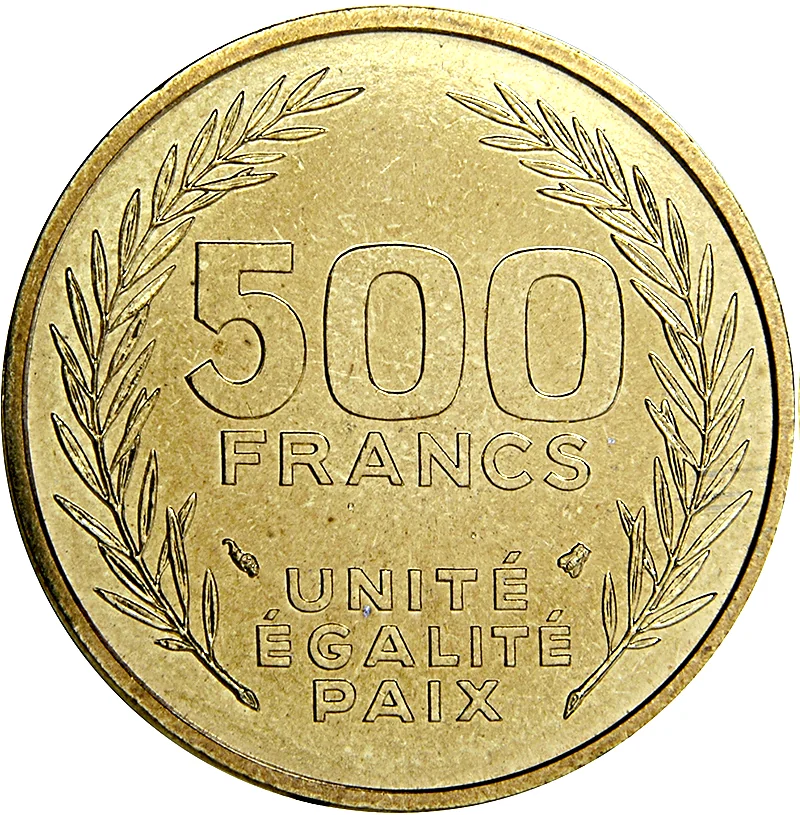
Exchange value: 500 DJF
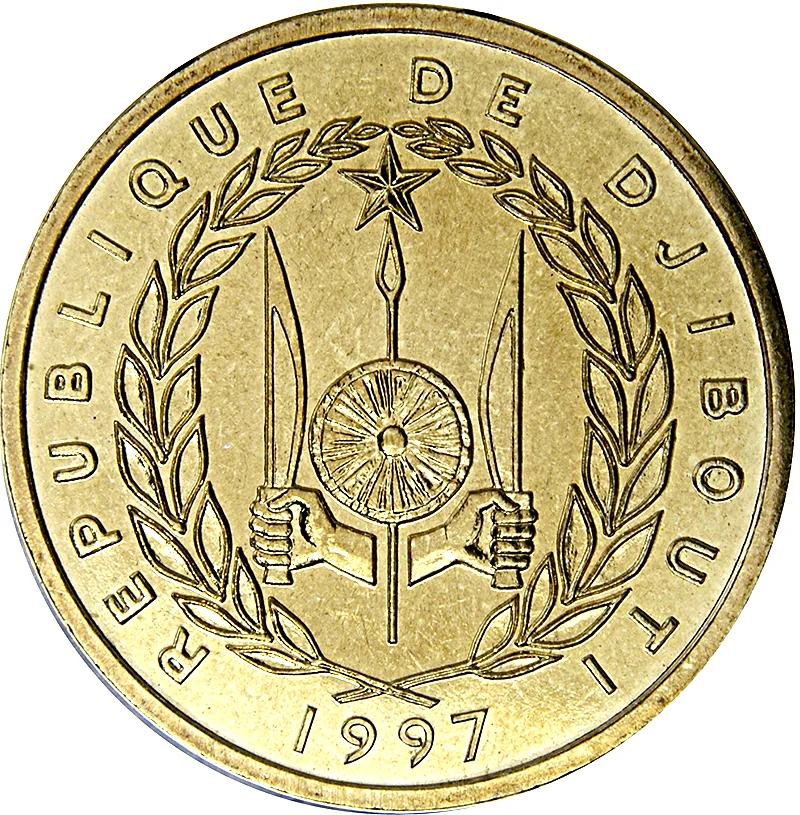
Obverse
Reverse
Edge
Plain
Categories
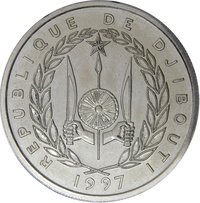
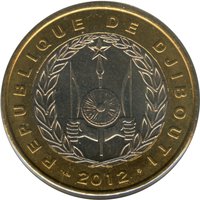
| Symbols> Coat of Arms |
| Symbol> Wreath |
| Object> Cold weapons |
Mints
| Name | Mark |
|---|---|
| Monnaie de Paris | — |
Mintings
| Year | Mint Mark | Mintage | Quality | Collection |
|---|---|---|---|---|
| 1989 | — | 300,000 | ||
| 1991 | — | 550,000 | ||
| 1997 | — | 350 | In sets | |
| 1999 | — | 1,800 | In sets | |
| 2010 | — | — |
Historical background
In 1989, Djibouti's currency situation was defined by the stability of the Djiboutian franc (DJF), which had been pegged at a fixed rate to the US dollar since 1949. This peg, initially established when Djibouti was the French Territory of the Afars and the Issas, survived the country's independence in 1977. The exchange rate was set at 177.721 DJF = 1 USD, a parity that provided remarkable long-term stability in a region often plagued by monetary volatility. This arrangement was managed by the Caisse d'Emission de Djibouti (Djibouti Issue Bank), which operated under a strict currency board system, requiring full foreign exchange reserves to back the local currency in circulation.
This dollar peg was a cornerstone of Djibouti's economic policy, primarily serving its strategic role as a hub for international trade and services. The country's economy relied heavily on its port, the French military base, and the railway link to Ethiopia, making monetary stability crucial for attracting foreign commerce and maintaining predictable transactions. The fixed exchange rate effectively imported US monetary discipline, controlling inflation and fostering confidence among international traders and financial institutions. However, it also meant Djibouti surrendered autonomous control over its monetary policy, unable to adjust interest rates or devalue its currency to respond to domestic economic conditions.
By the late 1980s, while the currency regime itself was stable, the broader economic backdrop was challenging. Djibouti faced high unemployment, a reliance on food imports, and the economic strain of hosting large refugee populations from regional conflicts. The fixed exchange rate, while a pillar of macroeconomic stability, did not directly address these structural issues. Consequently, the currency situation in 1989 was one of a well-anchored but somewhat rigid system, providing a stable financial foundation while the government grappled with deeper socio-economic problems that required fiscal and structural solutions beyond the scope of monetary policy.
This dollar peg was a cornerstone of Djibouti's economic policy, primarily serving its strategic role as a hub for international trade and services. The country's economy relied heavily on its port, the French military base, and the railway link to Ethiopia, making monetary stability crucial for attracting foreign commerce and maintaining predictable transactions. The fixed exchange rate effectively imported US monetary discipline, controlling inflation and fostering confidence among international traders and financial institutions. However, it also meant Djibouti surrendered autonomous control over its monetary policy, unable to adjust interest rates or devalue its currency to respond to domestic economic conditions.
By the late 1980s, while the currency regime itself was stable, the broader economic backdrop was challenging. Djibouti faced high unemployment, a reliance on food imports, and the economic strain of hosting large refugee populations from regional conflicts. The fixed exchange rate, while a pillar of macroeconomic stability, did not directly address these structural issues. Consequently, the currency situation in 1989 was one of a well-anchored but somewhat rigid system, providing a stable financial foundation while the government grappled with deeper socio-economic problems that required fiscal and structural solutions beyond the scope of monetary policy.
🌱 Common