

250 francs – Djibouti
Add to wishlist
Djibouti
Obverse
Description:
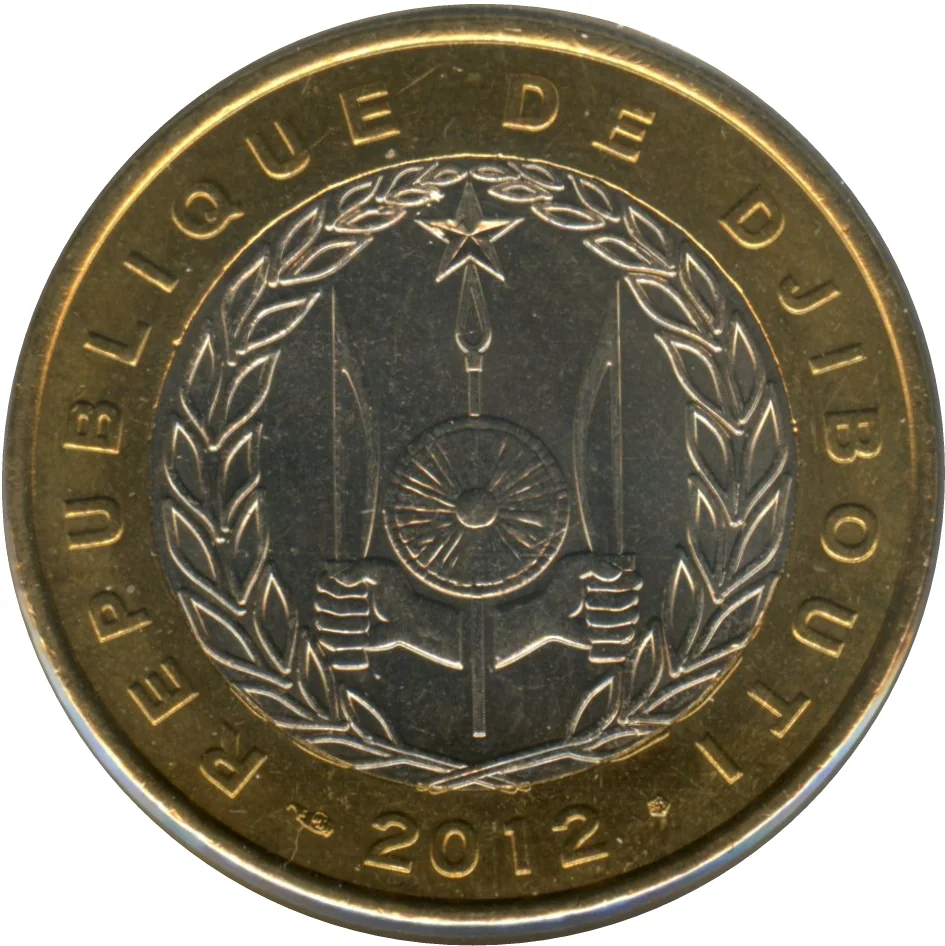
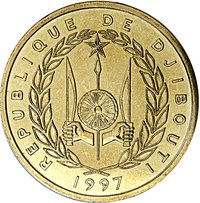
Two laurel branches frame the national coat of arms: a central spear behind a traditional shield, with two swords held by arms representing the Afar and Issa peoples. It was adopted upon independence on June 25, 1977.
Inscription:
REPUBLIQUE DE DJIBOUTI
2012
2012
Translation:
REPUBLIC OF DJIBOUTI
2012
2012
Script: Latin
Language: French
Reverse
Description:
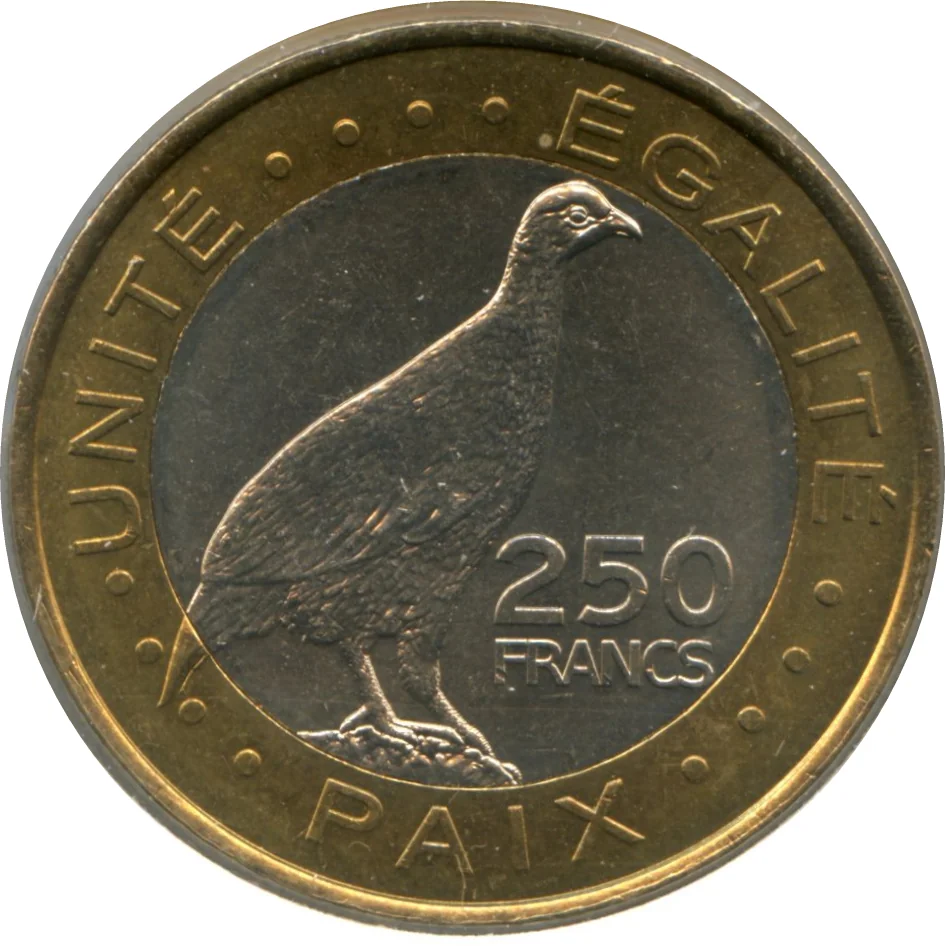
The Djibouti francolin (Pternistis ochropectus), called Gogorri in Somali and Kokaaqe in Afar, is a threatened bird endemic to the Monts Goda and Mabla forests.
Inscription:
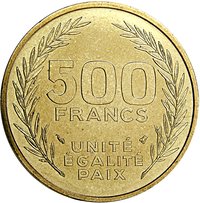
UNITÉ ···· ÉGALITÉ ···· PAIX
250 FRANCS
250 FRANCS
Translation:
UNITY ···· EQUALITY ···· PEACE
250 FRANCS
250 FRANCS
Script: Latin
Language: French
Edge
Reeded
Categories
| Animal> Bird |
| Symbols> Coat of Arms |
| Symbol> Wreath |
| Object> Cold weapons |
Mints
| Name | Mark |
|---|---|
| Monnaie de Paris | — |
Mintings
| Year | Mint Mark | Mintage | Quality | Collection |
|---|---|---|---|---|
| 2012 | — | — |
Historical background
In 2012, Djibouti's currency situation was defined by its long-standing peg to the US dollar, a policy established in 1949 when the Djiboutian franc (DJF) was first issued. The peg was set at a fixed rate of 177.721 DJF to 1 USD, a level that had remained unchanged for decades. This arrangement provided a crucial anchor for stability in a small, open economy heavily reliant on trade, port services, and foreign military presence. The peg helped control inflation, facilitated international transactions, and attracted foreign investment by eliminating exchange rate risk against the dollar, which was particularly important for a nation serving as a key maritime and logistics hub for the Horn of Africa.
However, this stability came with significant trade-offs. The fixed exchange rate limited the Central Bank of Djibouti's ability to conduct independent monetary policy, as it had to maintain sufficient foreign exchange reserves to defend the peg. The currency's value was largely dictated by the strength of the US dollar, which could make Djibouti's services and exports less competitive compared to neighbors with more flexible currencies, like Ethiopia. Furthermore, the regional context was volatile, with Djibouti bordering countries experiencing high inflation and currency instability, making the franc's predictability both a shield and a potential source of economic strain in terms of regional price competitiveness.
Overall, the currency situation in 2012 reflected a deliberate choice for predictable stability over monetary flexibility. The government and central bank prioritized maintaining the dollar peg as a cornerstone of economic policy, believing the benefits for trade, investment, and price stability outweighed the constraints on policy tools and export competitiveness. This stance underscored Djibouti's strategic orientation as a stable financial and commercial gateway within an otherwise turbulent region.
However, this stability came with significant trade-offs. The fixed exchange rate limited the Central Bank of Djibouti's ability to conduct independent monetary policy, as it had to maintain sufficient foreign exchange reserves to defend the peg. The currency's value was largely dictated by the strength of the US dollar, which could make Djibouti's services and exports less competitive compared to neighbors with more flexible currencies, like Ethiopia. Furthermore, the regional context was volatile, with Djibouti bordering countries experiencing high inflation and currency instability, making the franc's predictability both a shield and a potential source of economic strain in terms of regional price competitiveness.
Overall, the currency situation in 2012 reflected a deliberate choice for predictable stability over monetary flexibility. The government and central bank prioritized maintaining the dollar peg as a cornerstone of economic policy, believing the benefits for trade, investment, and price stability outweighed the constraints on policy tools and export competitiveness. This stance underscored Djibouti's strategic orientation as a stable financial and commercial gateway within an otherwise turbulent region.
🌱 Common