
Logo Title
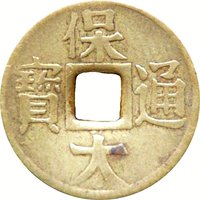
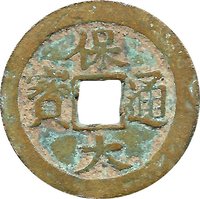
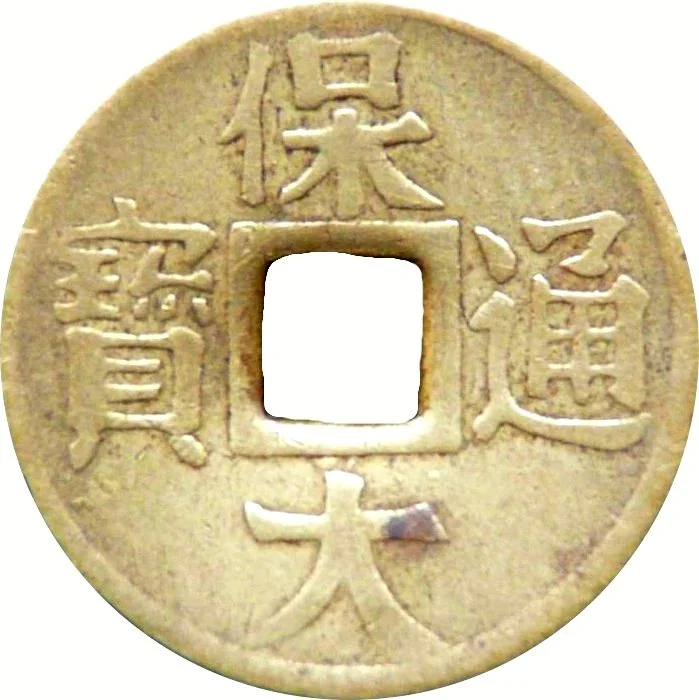
obverse
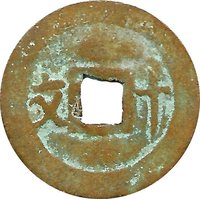
reverse
La Rondelle

1 Cash – Empire of Vietnam

Vietnam
Context
Year: 1933
Country: Vietnam Country flag
Demonetized: Yes
Material
Diameter: 18 mm
Weight: 1.4 g
Composition: Brass
Magnetic: No
Technique: Milled
Alignment: Medal alignment
Obverse
OBVERSE ↑
flip
Reverse
REVERSE ↑
References
KM: #Click to copy to clipboard662
Numista: #11311

Obverse

Description:
Four Chinese characters read vertically, right to left.
Inscription:


寶 通

 大
Translation:
Guaranteed Treasure

Circulating Treasure

Great
Language: Chinese
Engraver: René Mercier

Reverse

Description:
Blank (uniface).

Edge

Plain

Mintings

YearMint MarkMintageQualityCollection
1933

Historical background

In 1933, the currency situation in the Empire of Vietnam was not an independent system but was entirely subsumed within the monetary framework of French Indochina, administered by the Banque de l'Indochine. The Empire, a short-lived Japanese-backed puppet state, would not exist until 1945. Therefore, in 1933, Vietnam was part of the colony of French Indochina, and its circulating currency was the French Indochinese piastre (Đông Dương Tệ). This was a distinctive colonial currency, pegged not to the French franc but to a silver standard and later to the franc at a fixed, privileged rate that facilitated lucrative exchange arbitrage for the French administration and the bank's shareholders.

The piastre was a strong, stable currency often described as "harder than the franc itself," which benefited French exporters and investors but created significant economic strain within Vietnam. Its high value made Vietnamese agricultural exports, like rice and rubber, more expensive on the world market, while simultaneously making imports cheaper, a structure that served colonial economic interests by turning Indochina into a captive market for French goods. This monetary policy stifled local industrialization and contributed to the wealth extraction characteristic of the colonial economy.

Consequently, the monetary landscape for the Vietnamese people in 1933 was one of imposed stability that masked deeper economic disparities. The currency was physically represented by banknotes and coins issued by the Banque de l'Indochine, featuring iconic Indochinese imagery. There was no autonomous Vietnamese monetary authority or national currency. The system's stability was ultimately designed to serve French financial control, a point of growing resentment among Vietnamese intellectuals and entrepreneurs who were acutely aware of how the "strong piastre" policy constrained the indigenous economy for metropolitan benefit.
Somewhat Rare