

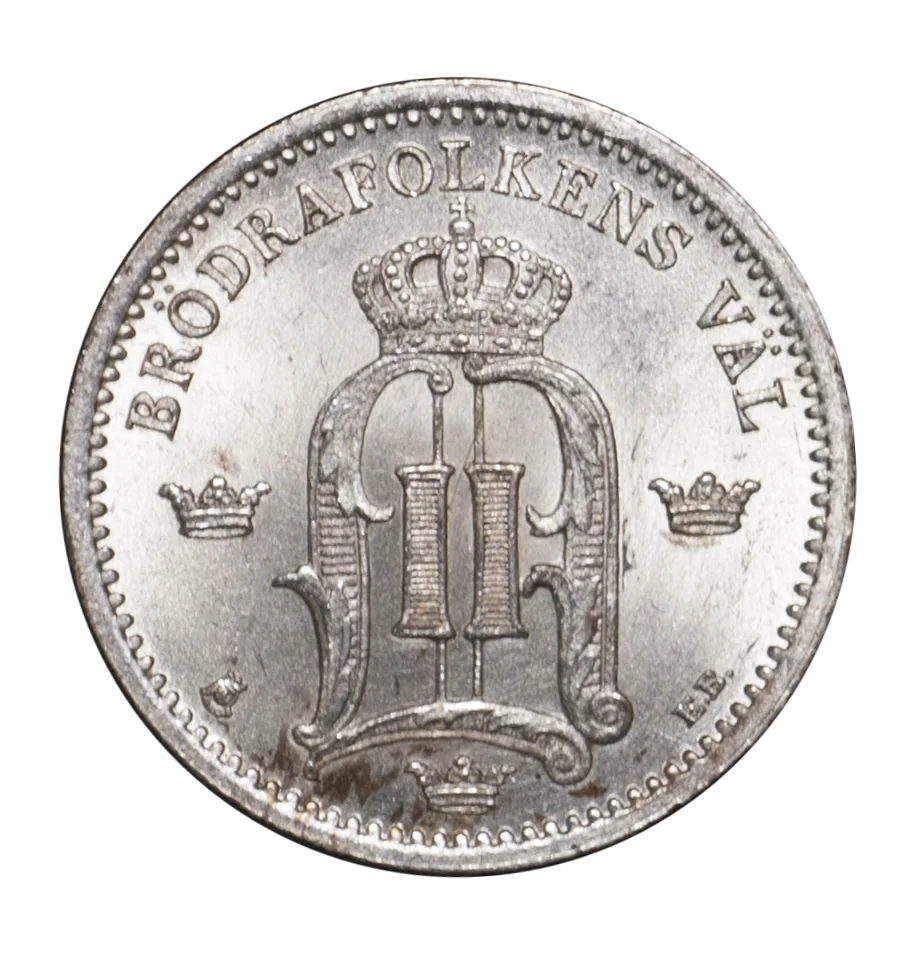
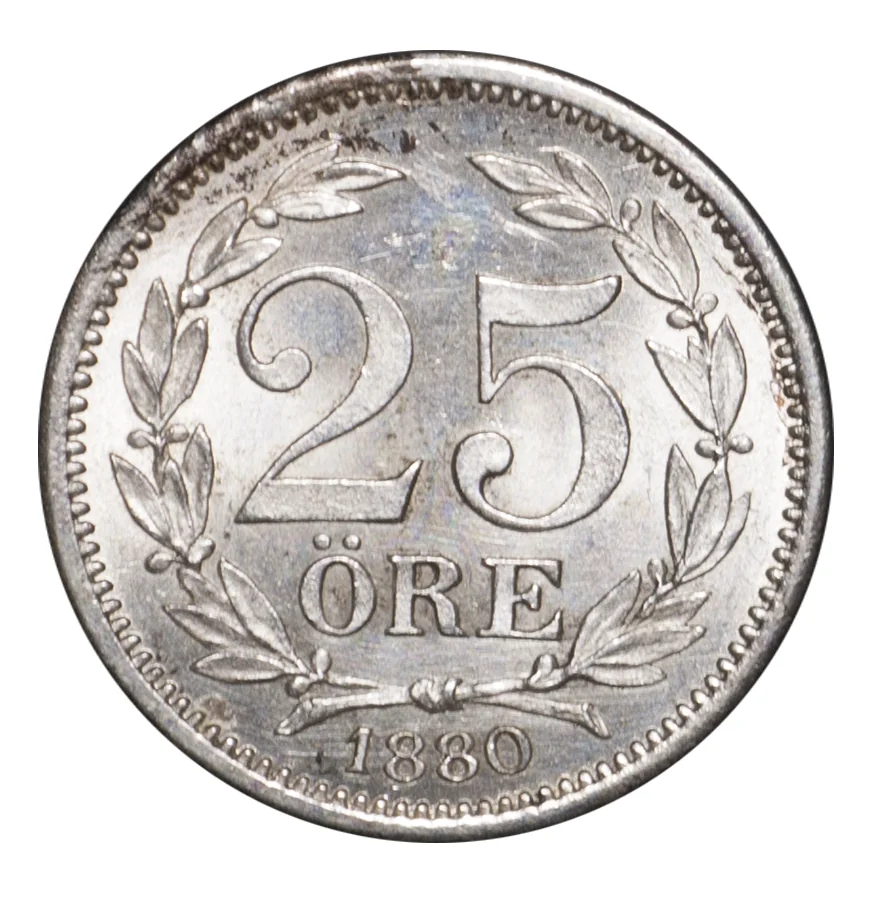

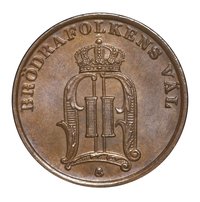
Obverse
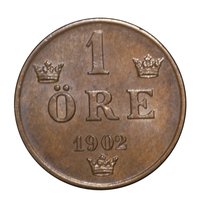
Reverse
Edge
Plain
Mints
| Name | Mark |
|---|---|
| Kungliga Myntet | — |
Mintings
| Year | Mint Mark | Mintage | Quality | Collection |
|---|---|---|---|---|
| 1880 | — | 1,180,000 | ||
| 1881 | — | 1,391,553 | ||
| 1883 | — | 1,100,339 | ||
| 1885 | — | 1,168,383 | ||
| 1889 | — | 421,589 | ||
| 1890 | — | 469,417 | ||
| 1896 | — | 793,546 | ||
| 1897 | — | 1,097,301 | ||
| 1898 | — | 1,457,998 | ||
| 1899 | — | 1,458,479 | ||
| 1902 | — | 1,249,036 | ||
| 1904 | — | 692,888 | ||
| 1905 | — | 732,000 |
Historical background
In the 1880s, Sweden was in the final phase of a significant monetary transition, moving from a silver-based to a gold-based standard. Since the early 1870s, a global decline in silver prices had caused instability for nations on a silver standard, as their currencies depreciated against gold-backed currencies like the British pound. Sweden, along with its Scandinavian neighbours Denmark and Norway, had formed the Scandinavian Monetary Union (SMU) in 1873, primarily to adopt the gold standard and create monetary stability. By 1880, the union was well-established, with the Swedish krona (crown) fixed to gold at a rate of 2,480 kronor per kilogram of fine gold, ensuring its value was stable and internationally credible.
This shift to the gold standard profoundly influenced Sweden's economy in the 1880s. It facilitated greater integration into the global financial system, attracting foreign investment crucial for the nation's rapid industrialisation. The stability of the currency reduced exchange rate risks for exporters and importers, boosting international trade. However, the strict discipline of the gold standard also meant that the Riksbank's ability to respond to domestic economic fluctuations was limited; monetary policy was largely dictated by the need to maintain gold reserves, which could exacerbate periods of deflation or economic contraction.
Domestically, the currency situation was characterised by the smooth circulation of not only Swedish coins and notes but also those from Denmark and Norway, as the SMU allowed for the free acceptance of member states' gold coins at par. This practical interoperability made cross-border trade within Scandinavia exceptionally easy. Thus, by 1880, Sweden had largely completed its move to the classical gold standard, a system that provided external stability and fostered economic growth but also tied the nation's monetary fate to international gold flows, a framework that would remain in place until the outbreak of World War I.
This shift to the gold standard profoundly influenced Sweden's economy in the 1880s. It facilitated greater integration into the global financial system, attracting foreign investment crucial for the nation's rapid industrialisation. The stability of the currency reduced exchange rate risks for exporters and importers, boosting international trade. However, the strict discipline of the gold standard also meant that the Riksbank's ability to respond to domestic economic fluctuations was limited; monetary policy was largely dictated by the need to maintain gold reserves, which could exacerbate periods of deflation or economic contraction.
Domestically, the currency situation was characterised by the smooth circulation of not only Swedish coins and notes but also those from Denmark and Norway, as the SMU allowed for the free acceptance of member states' gold coins at par. This practical interoperability made cross-border trade within Scandinavia exceptionally easy. Thus, by 1880, Sweden had largely completed its move to the classical gold standard, a system that provided external stability and fostered economic growth but also tied the nation's monetary fate to international gold flows, a framework that would remain in place until the outbreak of World War I.
🌱 Common