

5 Centavos – Nicaragua
Nicaragua
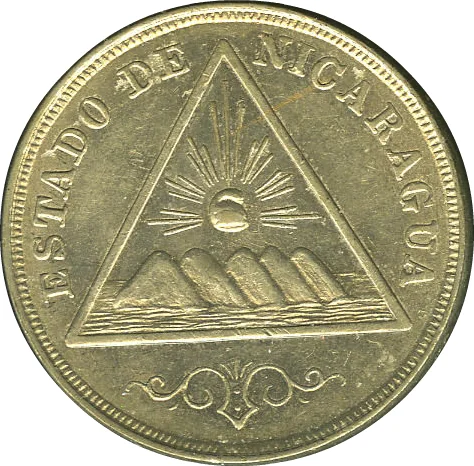
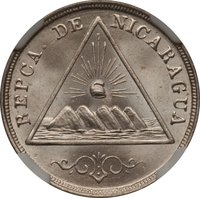
Obverse
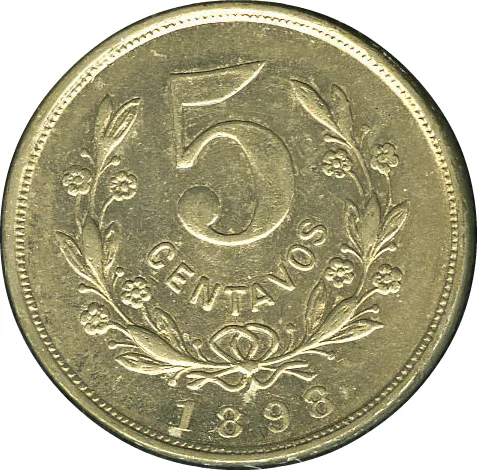
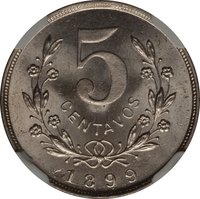
Reverse
Edge
Plain
Categories
| Symbols> Coat of Arms |
| Symbol> Wreath |
Mints
| Name | Mark |
|---|---|
| Scovill Manufacturing Company | — |
Mintings
| Year | Mint Mark | Mintage | Quality | Collection |
|---|---|---|---|---|
| 1898 | — | 2,000,000 |
Historical background
In 1898, Nicaragua's currency situation was characterized by significant instability and fragmentation, a legacy of the 19th-century global shift from silver to gold standards and domestic political turmoil. The nation lacked a unified, strong national currency. While the official unit of account was the Nicaraguan peso, its value was not stable, and multiple foreign and domestic currencies circulated simultaneously. These included Mexican silver pesos, U.S. gold dollars, British sovereigns, and even Chilean and Peruvian coins, leading to a complex and often chaotic monetary environment where exchange rates fluctuated based on metal content and merchant agreement.
This monetary disarray was exacerbated by Nicaragua's heavy reliance on agricultural exports, particularly coffee. The global price shocks of the 1890s, including a severe decline in coffee prices, strained the economy and reduced the state's ability to manage its currency. Furthermore, the government, often in debt and with limited fiscal capacity, had a history of issuing inconvertible paper money (billetes de curso forzoso) that frequently depreciated. Although the most extreme episodes of hyperinflation from earlier paper issues had passed, public trust in government-issued currency remained low, reinforcing the preference for hard foreign coin, especially the U.S. dollar in commercial centers.
The year 1898 fell within a period of relative political stability under the Conservative Dynasty, which had governed since 1893. This administration sought economic modernization and was actively working to attract foreign investment, particularly for railways and the nascent banana industry. A stable currency was seen as essential for this goal. Consequently, discussions and preliminary steps were likely underway to reform the monetary system, which would culminate just a few years later with the Currency Law of 1912. That law would formally adopt the gold standard and introduce the córdoba, named after the founder of Granada, finally replacing the peso and creating a unified national currency backed by gold reserves.
This monetary disarray was exacerbated by Nicaragua's heavy reliance on agricultural exports, particularly coffee. The global price shocks of the 1890s, including a severe decline in coffee prices, strained the economy and reduced the state's ability to manage its currency. Furthermore, the government, often in debt and with limited fiscal capacity, had a history of issuing inconvertible paper money (billetes de curso forzoso) that frequently depreciated. Although the most extreme episodes of hyperinflation from earlier paper issues had passed, public trust in government-issued currency remained low, reinforcing the preference for hard foreign coin, especially the U.S. dollar in commercial centers.
The year 1898 fell within a period of relative political stability under the Conservative Dynasty, which had governed since 1893. This administration sought economic modernization and was actively working to attract foreign investment, particularly for railways and the nascent banana industry. A stable currency was seen as essential for this goal. Consequently, discussions and preliminary steps were likely underway to reform the monetary system, which would culminate just a few years later with the Currency Law of 1912. That law would formally adopt the gold standard and introduce the córdoba, named after the founder of Granada, finally replacing the peso and creating a unified national currency backed by gold reserves.
🌟 Uncommon