

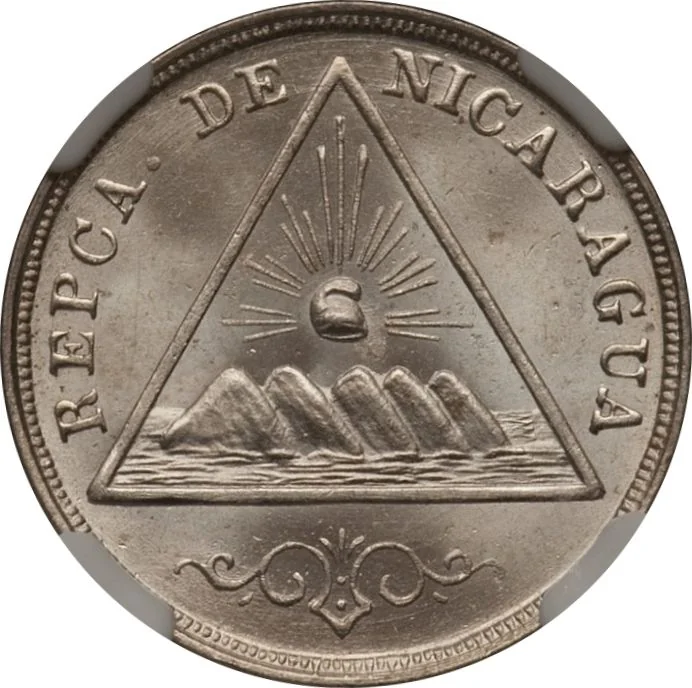
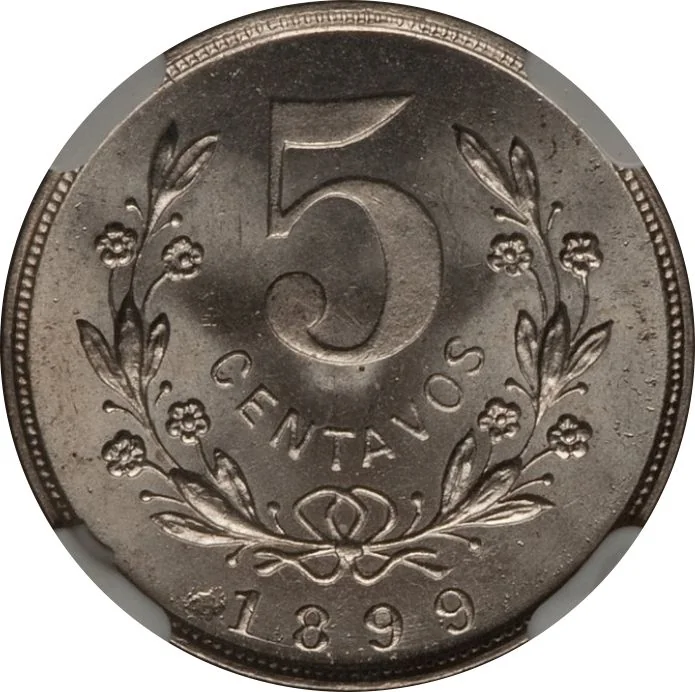
5 Centavos – Nicaragua
Nicaragua
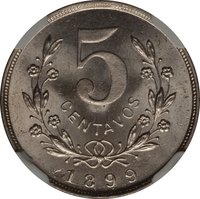
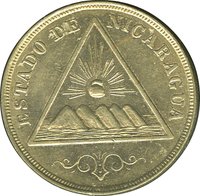
Obverse
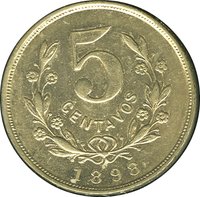
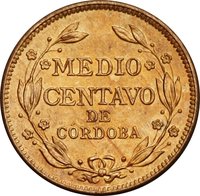
Reverse
Edge
Plain
Categories
| Symbols> Coat of Arms |
| Symbol> Wreath |
Mints
| Name | Mark |
|---|---|
| Scovill Manufacturing Company | — |
Mintings
| Year | Mint Mark | Mintage | Quality | Collection |
|---|---|---|---|---|
| 1899 | — | 2,000,000 |
Historical background
In 1899, Nicaragua's currency situation was characterized by significant instability and fragmentation, a direct legacy of the 19th-century "peso" era common across Latin America. The nation lacked a unified, state-controlled monetary system. Instead, the circulating medium was a chaotic mix of foreign and domestic coins, primarily the Nicaraguan peso (also called the peso moneda corriente), which had severely depreciated due to excessive printing by various governments to finance budget deficits, especially during the Liberal-Conservative conflicts. Alongside these devalued paper notes and low-quality silver coins, foreign currency—particularly the British sovereign, the US gold dollar, and silver coins from neighboring countries—circulated freely and was preferred for major transactions due to its reliability.
This monetary anarchy created a dual-system economy, hindering commerce and state finances. International trade and banking were conducted in stable foreign gold currencies, while the depreciating domestic currency was used for everyday local transactions, causing confusion and exchange rate fluctuations. The situation was exacerbated by a global shift toward the gold standard, which Nicaragua, with its depleted finances and silver-based peso, could not join. This disconnect from the international financial system further isolated the economy and highlighted the government's inability to assert monetary sovereignty or control inflation.
The chronic instability of 1899 set the stage for a major monetary reform just a few years later. Recognizing that economic modernization was impossible without sound currency, the government of President José Santos Zelaya, with the assistance of American financial advisors, enacted the Monetary Law of 1912. This law formally abandoned the old peso and introduced the gold-standard córdoba, named after the Spanish founder of Granada, Francisco Hernández de Córdoba. Thus, the turmoil of 1899 represents the final chapter of Nicaragua's 19th-century monetary struggles, directly precipitating the creation of its modern currency system in the early 20th century.
This monetary anarchy created a dual-system economy, hindering commerce and state finances. International trade and banking were conducted in stable foreign gold currencies, while the depreciating domestic currency was used for everyday local transactions, causing confusion and exchange rate fluctuations. The situation was exacerbated by a global shift toward the gold standard, which Nicaragua, with its depleted finances and silver-based peso, could not join. This disconnect from the international financial system further isolated the economy and highlighted the government's inability to assert monetary sovereignty or control inflation.
The chronic instability of 1899 set the stage for a major monetary reform just a few years later. Recognizing that economic modernization was impossible without sound currency, the government of President José Santos Zelaya, with the assistance of American financial advisors, enacted the Monetary Law of 1912. This law formally abandoned the old peso and introduced the gold-standard córdoba, named after the Spanish founder of Granada, Francisco Hernández de Córdoba. Thus, the turmoil of 1899 represents the final chapter of Nicaragua's 19th-century monetary struggles, directly precipitating the creation of its modern currency system in the early 20th century.
🌱 Fairly Common