

Obverse
Description:
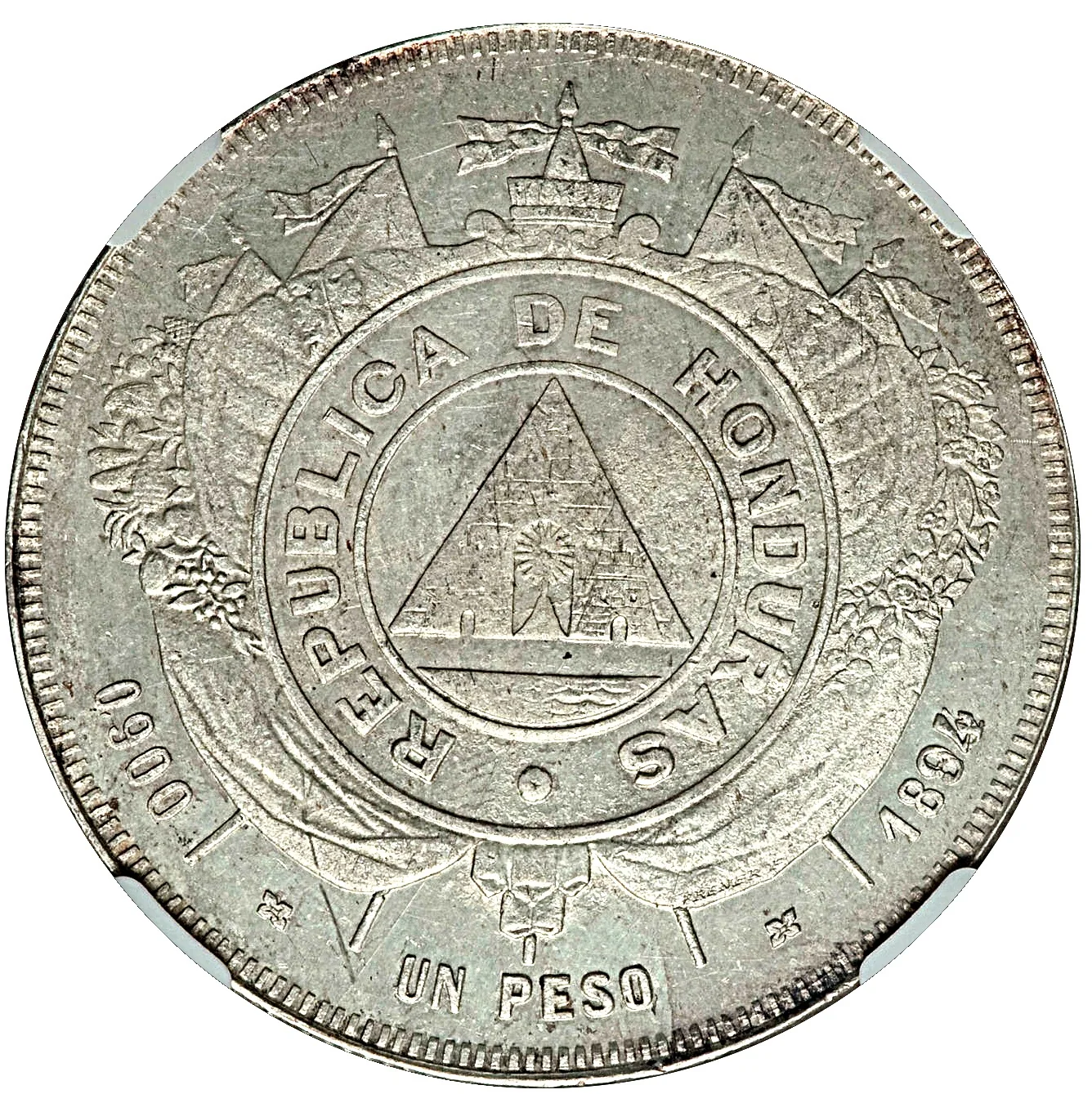
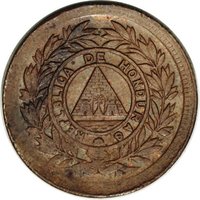
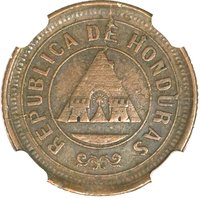
Coat of arms with central seal. Fineness, value, and date below.
Inscription:
REPUBLICA DE HONDURAS
0.900 UN PESO 1894
0.900 UN PESO 1894
Translation:
REPUBLIC OF HONDURAS
0.900 ONE PESO 1894
0.900 ONE PESO 1894
Script: Latin
Language: Spanish
Engraver: Jean-Baptiste Frener
Reverse
Description:
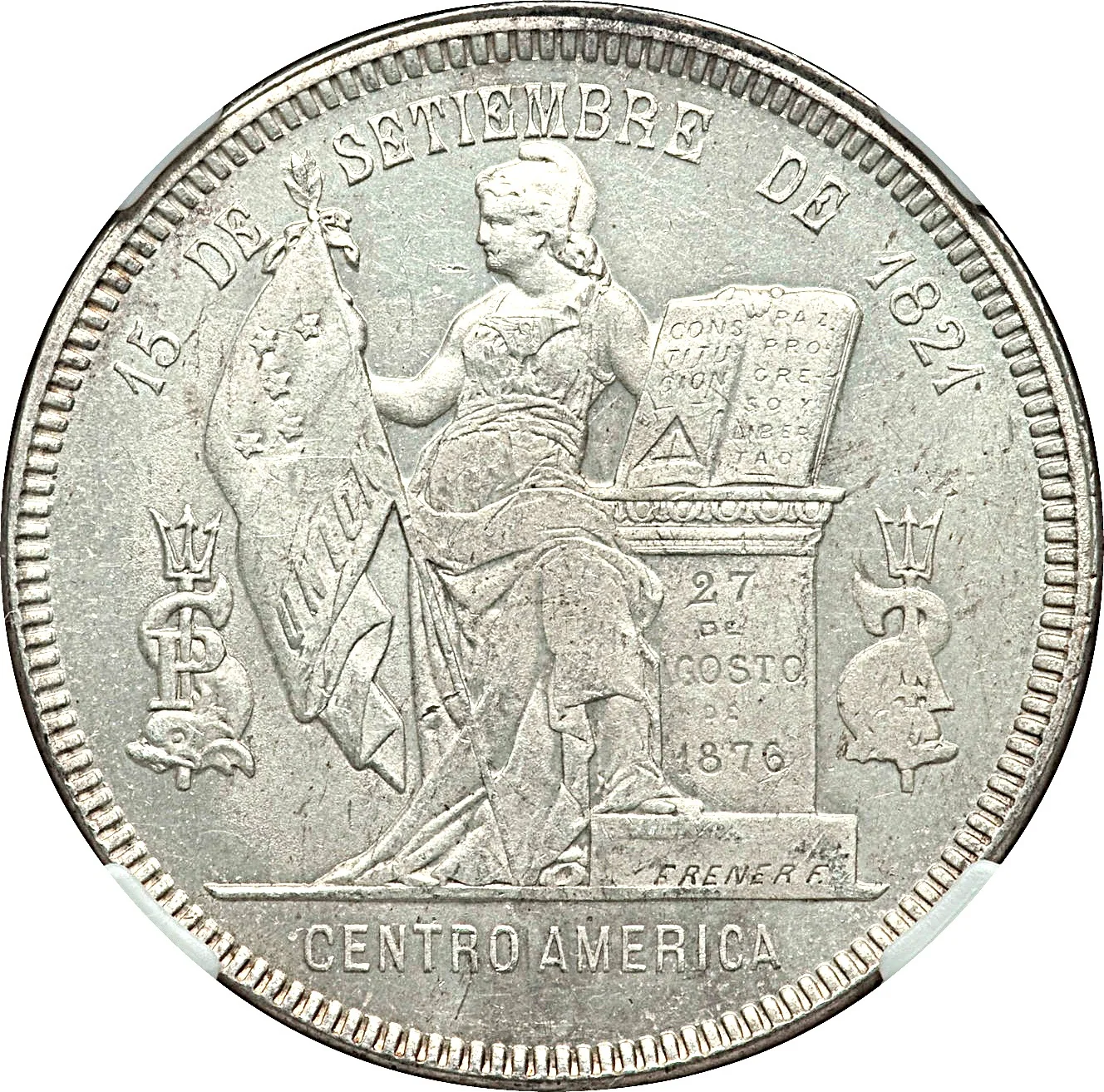
Liberty stands beside a column, holding a flag marked "UNION" and resting her hand on the Constitution. Tritons with tridents flank the sides. Legends appear above and below.
Inscription:
15 DE SETIEMBRE DE 1821
UNION
CONSTITUCIÓN
PAZ PROGRESO I LIBERTAD
27 DE AGOSTO DE 1876
P A
CENTRO-AMERICA
UNION
CONSTITUCIÓN
PAZ PROGRESO I LIBERTAD
27 DE AGOSTO DE 1876
P A
CENTRO-AMERICA
Translation:
Fifteenth of September of 1821
Union
Constitution
Peace Progress and Liberty
Twenty-seventh of August of 1876
P A
Central America
Union
Constitution
Peace Progress and Liberty
Twenty-seventh of August of 1876
P A
Central America
Script: Latin
Language: Spanish
Engraver: Jean-Baptiste Frener
Edge
Mints
| Name | Mark |
|---|---|
| Casa Nacional de la Moneda | — |
Mintings
| Year | Mint Mark | Mintage | Quality | Collection |
|---|---|---|---|---|
| 1894 | — | — | ||
| 1895 | — | — | ||
| 1896 | — | 21,492 |
Historical background
In 1894, Honduras was entrenched in a period of monetary instability and transition, characteristic of its economic vulnerability in the late 19th century. The national currency, the Honduran peso, was severely depreciated and circulated alongside a confusing array of foreign coins, primarily silver Mexican pesos, U.S. gold dollars, and British sovereigns. This chaotic system hampered commerce and state finances, as the government struggled to assert control over the money supply and maintain a stable standard of value. The situation was exacerbated by the country's heavy reliance on foreign loans, particularly from British creditors, and the economic dominance of foreign-owned banana and mining companies, which often operated with their own monetary practices.
The root of the instability lay in the global shift from a bimetallic (gold and silver) standard to a gold standard. As the price of silver plummeted internationally in the 1870s and 1880s, the silver-based Honduran peso lost value against gold-backed currencies like the British pound and U.S. dollar, in which the country's substantial foreign debt was denominated. This created a crippling "silver debt" problem: it took an ever-increasing number of devalued silver pesos to service debts fixed in gold, pushing the government toward default and further undermining confidence in the national currency.
Against this backdrop, President Policarpo Bonilla, who took office in 1894, sought financial reform. His administration, recognizing the need for monetary order and hoping to attract foreign investment, began serious preparations to adopt the gold standard. This culminated in the Monetary Law of 1894-95, which established the Honduran gold peso (peso oro) as the new unit of account, theoretically valued at par with the U.S. dollar. While this legislative step was crucial, full implementation and stabilization would prove a prolonged challenge, as the government lacked sufficient gold reserves and the economy remained dependent on volatile commodity exports, setting the stage for continued financial difficulties in the early 20th century.
The root of the instability lay in the global shift from a bimetallic (gold and silver) standard to a gold standard. As the price of silver plummeted internationally in the 1870s and 1880s, the silver-based Honduran peso lost value against gold-backed currencies like the British pound and U.S. dollar, in which the country's substantial foreign debt was denominated. This created a crippling "silver debt" problem: it took an ever-increasing number of devalued silver pesos to service debts fixed in gold, pushing the government toward default and further undermining confidence in the national currency.
Against this backdrop, President Policarpo Bonilla, who took office in 1894, sought financial reform. His administration, recognizing the need for monetary order and hoping to attract foreign investment, began serious preparations to adopt the gold standard. This culminated in the Monetary Law of 1894-95, which established the Honduran gold peso (peso oro) as the new unit of account, theoretically valued at par with the U.S. dollar. While this legislative step was crucial, full implementation and stabilization would prove a prolonged challenge, as the government lacked sufficient gold reserves and the economy remained dependent on volatile commodity exports, setting the stage for continued financial difficulties in the early 20th century.
💎 Extremely Rare