

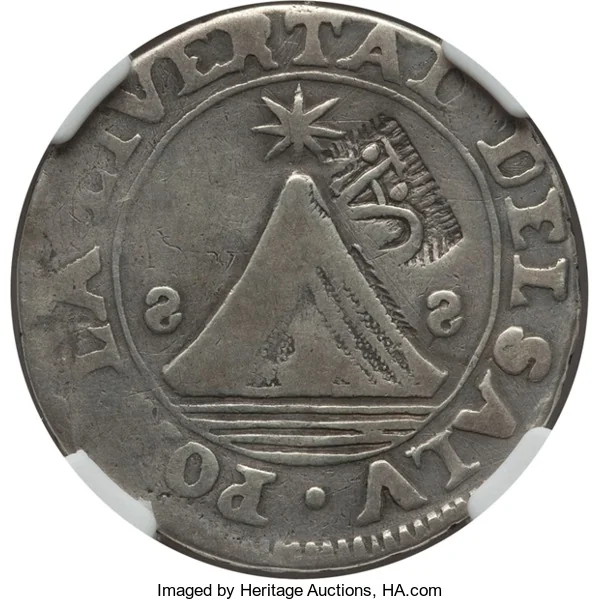
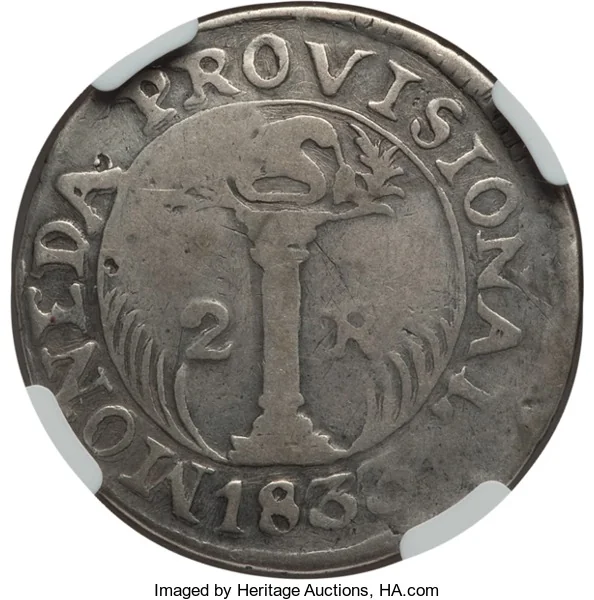
2 reales – El Salvador
Add to wishlist
El Salvador
Context
Material
Diameter: 25 mm
Weight: 5.4 g
Silver Weight:: 3.42 g
Shape: Round
Composition: 63.3% Silver
Magnetic: No
Techniques: Milled, Countermarked
Alignment: Medal alignment
flip
References
KM: #
Numista: #75412
Value
Bullion value: $8.73
Obverse
Description:
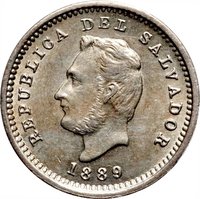
Mark: Monogram SAP with lines converging centrally in a circle.
Script: Latin
Reverse
Script: Latin
Edge
Mintings
| Year | Mint Mark | Mintage | Quality | Collection |
|---|---|---|---|---|
| 1836 | — | — |
Historical background
In 1836, El Salvador, as a state within the Federal Republic of Central America, faced a complex and challenging currency situation defined by scarcity, inconsistency, and economic fragmentation. The federal government had attempted to establish a unified monetary system, authorizing the minting of national coins in the 1820s. However, production was limited, and these coins failed to fully circulate or displace the wide variety of foreign and obsolete currencies still in use. The most common of these were Spanish colonial coins, particularly the silver real and gold escudo, but these were often in short supply, hampering daily commerce and economic growth.
This scarcity led to a reliance on a problematic substitute: cacao beans. While officially demonetized by federal law, cacao continued to be used as a de facto currency, especially in rural areas and for small transactions, due to the chronic lack of metallic coinage. This barter-like system was inefficient and highlighted the government's inability to provide a sufficient and stable medium of exchange. Furthermore, the economic instability of the federation and the beginning of political tensions between conservative and liberal factions eroded confidence in any centralized financial authority.
Consequently, El Salvador's monetary landscape in 1836 was one of transition and disorder. The ideal of a federal currency remained unrealized, leaving the state with a fractured system where old Spanish coins, limited federal issues, and informal commodities like cacao all competed. This monetary confusion reflected the broader struggles of the fragile Central American federation and acted as a significant impediment to internal trade and economic development within Salvadoran territory.
This scarcity led to a reliance on a problematic substitute: cacao beans. While officially demonetized by federal law, cacao continued to be used as a de facto currency, especially in rural areas and for small transactions, due to the chronic lack of metallic coinage. This barter-like system was inefficient and highlighted the government's inability to provide a sufficient and stable medium of exchange. Furthermore, the economic instability of the federation and the beginning of political tensions between conservative and liberal factions eroded confidence in any centralized financial authority.
Consequently, El Salvador's monetary landscape in 1836 was one of transition and disorder. The ideal of a federal currency remained unrealized, leaving the state with a fractured system where old Spanish coins, limited federal issues, and informal commodities like cacao all competed. This monetary confusion reflected the broader struggles of the fragile Central American federation and acted as a significant impediment to internal trade and economic development within Salvadoran territory.

✨ Legendary