

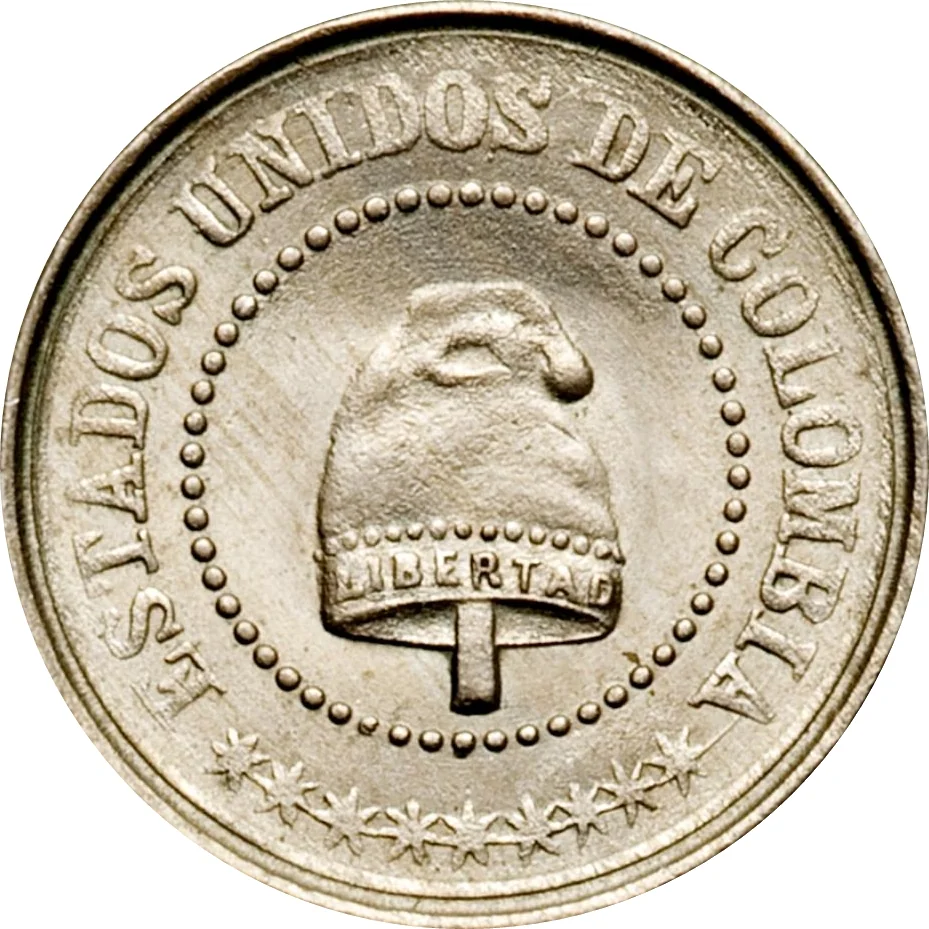
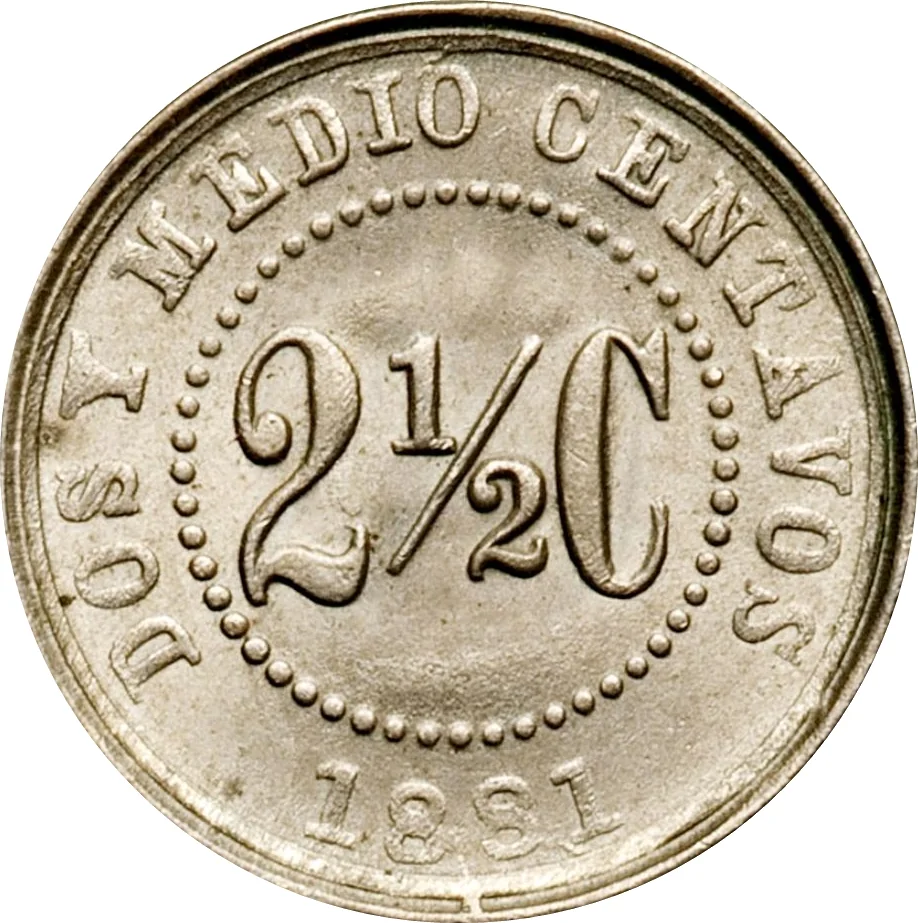
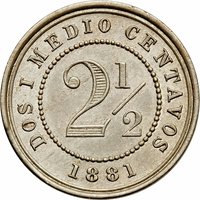
2½ centavos – Colombia
Add to wishlist
Colombia
Context
Year: 1881
Issuer: Colombia
Period:
(1863—1886)
Currency:
(since 1847)
Demonetized: Yes
Total mintage: 24,000,000
Material
Diameter: 14.3 mm
Weight: 1.2 g
Thickness: 1 mm
Shape: Round
Composition: Copper-nickel
Technique: Milled
Alignment: Coin alignment
flip
References
KM: #
Numista: #7527
Value
Exchange value: 0.025 COP
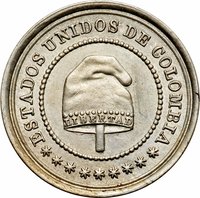
Obverse
Reverse
Edge
Plain
Categories
| Symbol> Phrygian cap |
Mints
| Name | Mark |
|---|---|
| Scovill Manufacturing Company | — |
Mintings
| Year | Mint Mark | Mintage | Quality | Collection |
|---|---|---|---|---|
| 1881 | — | 24,000,000 |
Historical background
In 1881, Colombia was navigating a complex and fragmented currency landscape, a direct legacy of its post-independence political instability and regionalism. Following the dissolution of Gran Colombia, the nation had struggled to establish a unified monetary system. The result was a chaotic mix of circulating mediums: foreign coins (particularly British sovereigns, French francs, and U.S. gold dollars), privately issued banknotes from numerous regional banks, and worn or debased coinage from the colonial era. This lack of a strong, central currency severely hampered national commerce, credit, and economic integration, as exchange rates fluctuated wildly between regions and different forms of money.
The federalist constitution of the United States of Colombia (1863-1886) exacerbated this issue by granting significant monetary powers to the individual states. Many states chartered their own banks, which issued paper money with varying degrees of convertibility and security, leading to frequent inflation and loss of public confidence. The central government's attempts to introduce a national currency, like the peso or condor, competed unsuccessfully with this decentralized system. By 1881, the monetary chaos was widely recognized as a major obstacle to foreign investment, federal authority, and modern economic development.
Consequently, 1881 fell within a critical period of monetary reform. The government, under President Rafael Núñez, was actively seeking solutions to centralize and standardize the currency as part of a broader political project known as the "Regeneration." This culminated in the Banking Law of 1881, which sought to impose order by restricting note-issuing privileges and promoting the use of gold-backed currency. While full stabilization would take more time and further legislation, 1881 marked a pivotal year in Colombia's transition from a fragmented monetary free-for-all toward a more unified, state-controlled currency system.
The federalist constitution of the United States of Colombia (1863-1886) exacerbated this issue by granting significant monetary powers to the individual states. Many states chartered their own banks, which issued paper money with varying degrees of convertibility and security, leading to frequent inflation and loss of public confidence. The central government's attempts to introduce a national currency, like the peso or condor, competed unsuccessfully with this decentralized system. By 1881, the monetary chaos was widely recognized as a major obstacle to foreign investment, federal authority, and modern economic development.
Consequently, 1881 fell within a critical period of monetary reform. The government, under President Rafael Núñez, was actively seeking solutions to centralize and standardize the currency as part of a broader political project known as the "Regeneration." This culminated in the Banking Law of 1881, which sought to impose order by restricting note-issuing privileges and promoting the use of gold-backed currency. While full stabilization would take more time and further legislation, 1881 marked a pivotal year in Colombia's transition from a fragmented monetary free-for-all toward a more unified, state-controlled currency system.
🌱 Common