

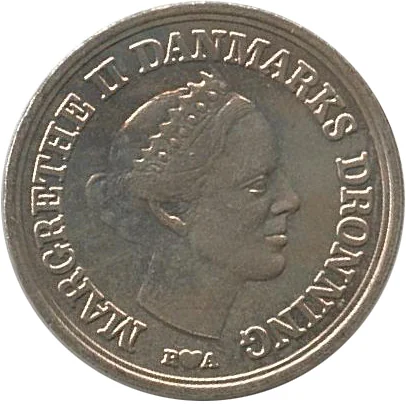
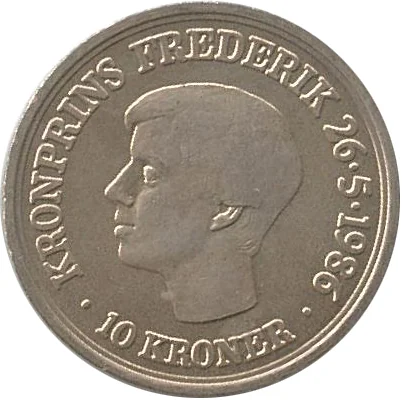
10 kroner (Crown Prince Frederik) – Denmark
Add to wishlist
Circulating commemorative coins
Commemoration: 18th Birthday of Crown prince Frederik
Denmark
Context
Material
Diameter: 28 mm
Weight: 12.5 g
Thickness: 2.5 mm
Shape: Round
Composition: Copper-nickel
Technique: Milled
Alignment: Medal alignment
flip
References
KM: #
Numista: #11294
Value
Exchange value: 10 DKK
Inflation-adjusted value: 23.40 DKK
Obverse
Reverse
Description:
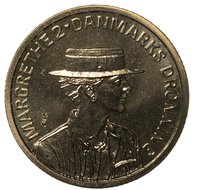
Crown Prince Frederik in profile.
Inscription:
KRONPRINS FREDERIK 26 · 5 · 1986
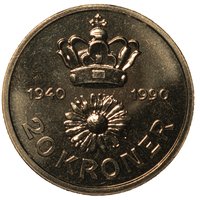
· 10 KRONER ·
· 10 KRONER ·
Script: Latin
Edge
Plain
Categories
| Event> Birth anniversary |
Mints
| Name | Mark |
|---|---|
| Royal Danish Mint | — |
Mintings
| Year | Mint Mark | Mintage | Quality | Collection |
|---|---|---|---|---|
| 1986 | R♥A | 1,090,351 | ||
| 1986 | R♥A | 2,000 | Proof |
Historical background
In 1986, Denmark's currency situation was defined by its participation in the European Monetary System's (EMS) Exchange Rate Mechanism (ERM), which it had joined at the system's inception in 1979. The primary objective was to maintain stability by pegging the Danish krone (DKK) to a basket of European currencies, with a central focus on the Deutsche Mark (DEM). This "hard currency" policy was a cornerstone of economic management, aimed at curbing inflation and providing a stable framework for trade and investment by tethering the krone to the monetary discipline of the Bundesbank.
However, maintaining this fixed exchange rate regime required significant and continuous intervention by Danmarks Nationalbank. The year 1986 followed a period of strain, including a major EMS realignment in 1983 where the krone was devalued by 5%. While the immediate pressure had eased, the policy demanded high domestic interest rates to defend the peg, often out of sync with Denmark's domestic economic cycle. This created a persistent tension between the external goal of currency stability and internal needs, such as stimulating growth and employment.
The broader context was Denmark's complex relationship with European integration. The fixed exchange rate was seen as a preparatory step for deeper European monetary cooperation, even as political debate about sovereignty and the future European single currency intensified. Thus, in 1986, the krone was stable but maintained at a cost, symbolizing a national commitment to European monetary discipline while highlighting the challenges of subordinating domestic monetary policy to an external anchor.
However, maintaining this fixed exchange rate regime required significant and continuous intervention by Danmarks Nationalbank. The year 1986 followed a period of strain, including a major EMS realignment in 1983 where the krone was devalued by 5%. While the immediate pressure had eased, the policy demanded high domestic interest rates to defend the peg, often out of sync with Denmark's domestic economic cycle. This created a persistent tension between the external goal of currency stability and internal needs, such as stimulating growth and employment.
The broader context was Denmark's complex relationship with European integration. The fixed exchange rate was seen as a preparatory step for deeper European monetary cooperation, even as political debate about sovereignty and the future European single currency intensified. Thus, in 1986, the krone was stable but maintained at a cost, symbolizing a national commitment to European monetary discipline while highlighting the challenges of subordinating domestic monetary policy to an external anchor.
🌱 Fairly Common