

25 centimes – Belgium
Add to wishlist
Belgium
Context
Years: 1938–1939
Issuer: Belgium
Ruler: Leopold III
Currency:
(1832—2001)
Demonetization: 1 March 1968
Total mintage: 14,932,000
Material
Diameter: 26 mm
Weight: 6.5 g
Thickness: 1.6 mm
Shape: Round with a round hole
Magnetic: No
Technique: Milled
Alignment: Coin alignment
flip
References
KM: #
Numista: #749
Value
Exchange value: 0.25 BEF
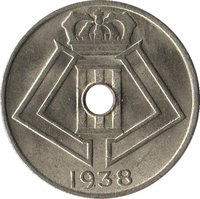
Obverse
Description:
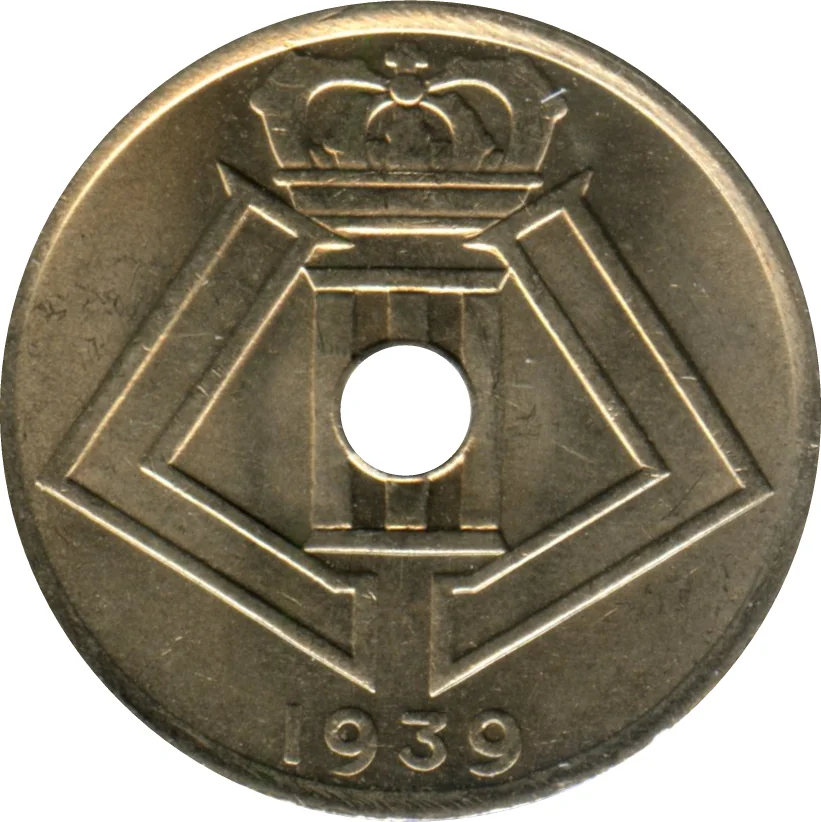
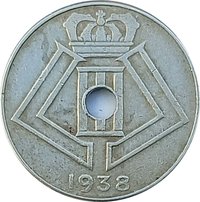
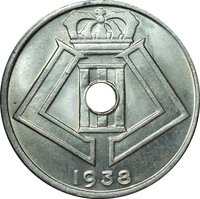
Monogram of Léopold III, date below.
Inscription:
1938
Script: Latin
Engraver: Oscar Jespers
Reverse
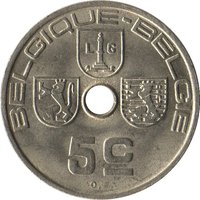
Description:
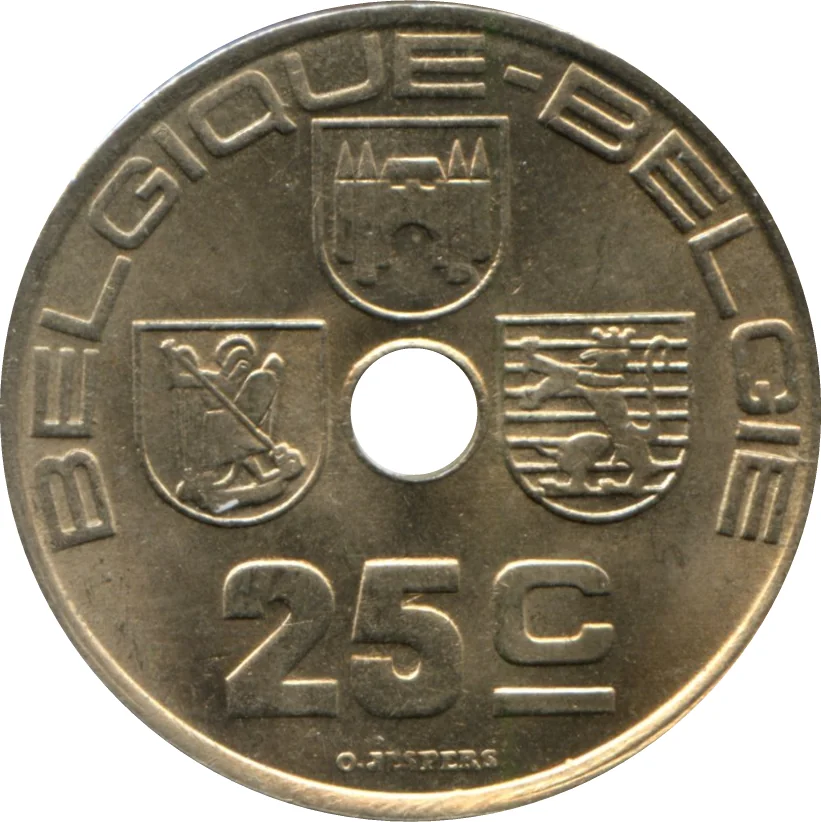
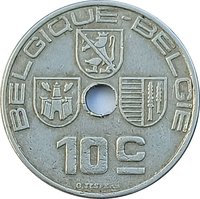
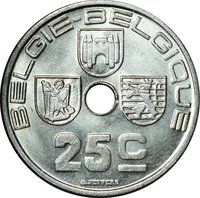
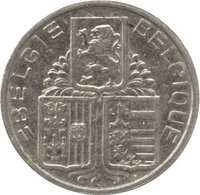
Brussels, Mons, and Bruges coats of arms above bilingual legends, with value and designer below.
Inscription:
BELGIQUE-BELGIE
25c
O.JESPERS
25c
O.JESPERS
Translation:
Belgium
25 centimes
O. Jespers
25 centimes
O. Jespers
Script: Latin
Designer: Oscar Jespers
Edge
Plain
Categories
| Symbols> Coat of Arms |
| Symbols> Monogram |
Mints
| Name | Mark |
|---|---|
| Royal Mint of Belgium | — |
Mintings
| Year | Mint Mark | Mintage | Quality | Collection |
|---|---|---|---|---|
| 1938 | — | 7,200,000 | ||
| 1939 | — | 7,732,000 |
Historical background
In 1938, Belgium's currency situation was defined by its adherence to the "Belga" system, a unique and complex monetary framework established in the 1920s. The country operated on a dual-unit basis: the Belgian franc (BEF) was used for everyday transactions, while the Belga, valued at five Belgian francs, served as the official unit of account for financial markets, international trade, and government finance. This system was underpinned by Belgium's membership in the "Gold Bloc," a group of European nations (including France, the Netherlands, and Switzerland) that had stubbornly clung to the gold standard after Britain and others abandoned it in the early 1930s.
This commitment proved economically painful. While it aimed to ensure stability and confidence, the overvalued Belga made Belgian exports expensive and uncompetitive during the global Depression. The country suffered from deflation, high unemployment, and persistent capital flight as investors feared an inevitable devaluation. By 1938, the Gold Bloc had collapsed (Belgium itself had been forced to devalue the Belga by 28% in March 1935), but the shadow of this crisis still loomed. The economy remained fragile, and the currency system, though modified, was still recovering from the strain.
Consequently, as Europe moved toward war in 1938, the Belgian franc and the Belga were managed under a cautious and defensive monetary policy. The National Bank of Belgium prioritized maintaining exchange rate stability and building gold and foreign exchange reserves, anticipating future turbulence. The lingering effects of the Gold Bloc era left the country financially cautious, with authorities keen to avoid the shocks of the early 1930s while nervously watching the deteriorating geopolitical landscape, which threatened far greater disruptions to the monetary order.
This commitment proved economically painful. While it aimed to ensure stability and confidence, the overvalued Belga made Belgian exports expensive and uncompetitive during the global Depression. The country suffered from deflation, high unemployment, and persistent capital flight as investors feared an inevitable devaluation. By 1938, the Gold Bloc had collapsed (Belgium itself had been forced to devalue the Belga by 28% in March 1935), but the shadow of this crisis still loomed. The economy remained fragile, and the currency system, though modified, was still recovering from the strain.
Consequently, as Europe moved toward war in 1938, the Belgian franc and the Belga were managed under a cautious and defensive monetary policy. The National Bank of Belgium prioritized maintaining exchange rate stability and building gold and foreign exchange reserves, anticipating future turbulence. The lingering effects of the Gold Bloc era left the country financially cautious, with authorities keen to avoid the shocks of the early 1930s while nervously watching the deteriorating geopolitical landscape, which threatened far greater disruptions to the monetary order.
Series: 1938 Belgium circulation coins
🌱 Very Common