

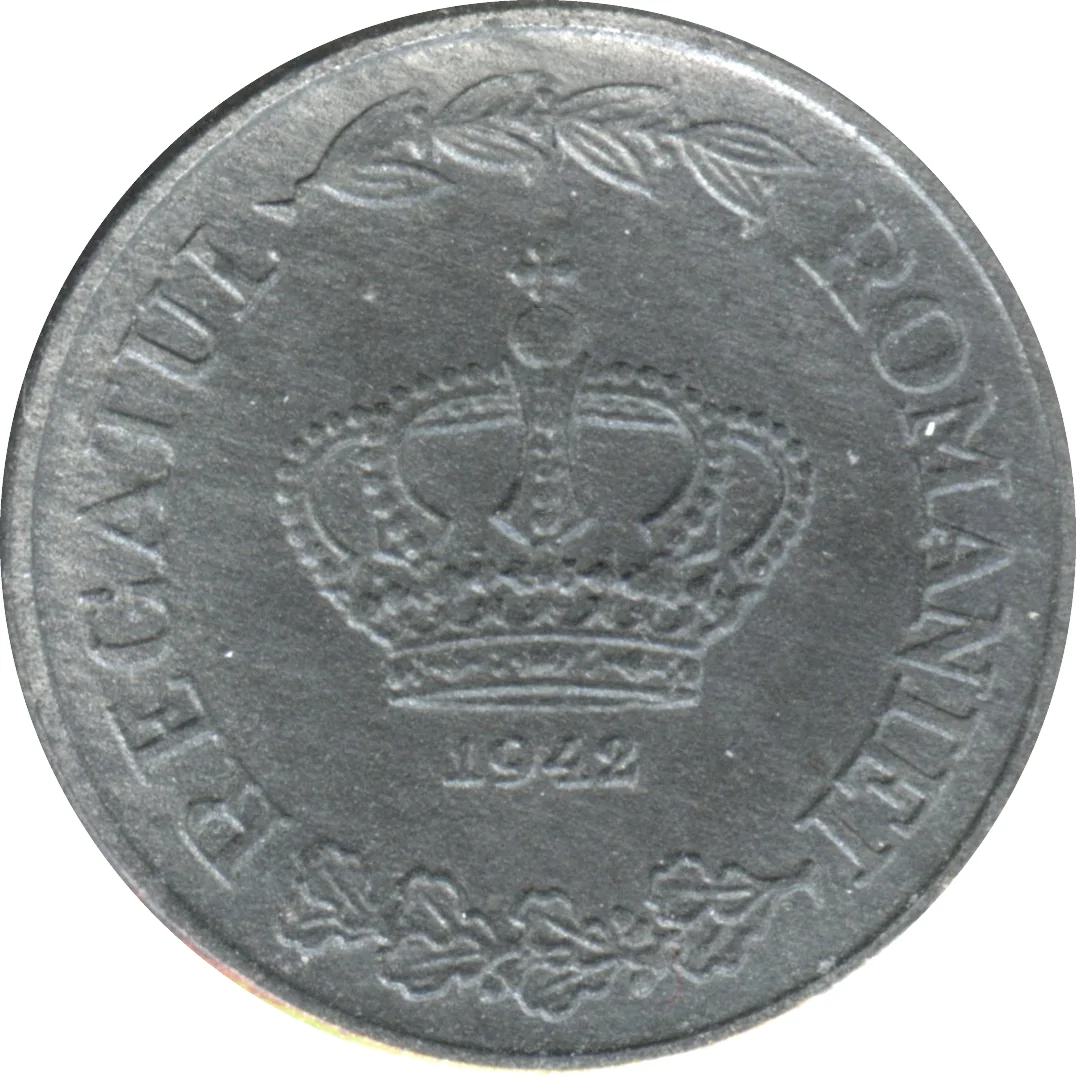
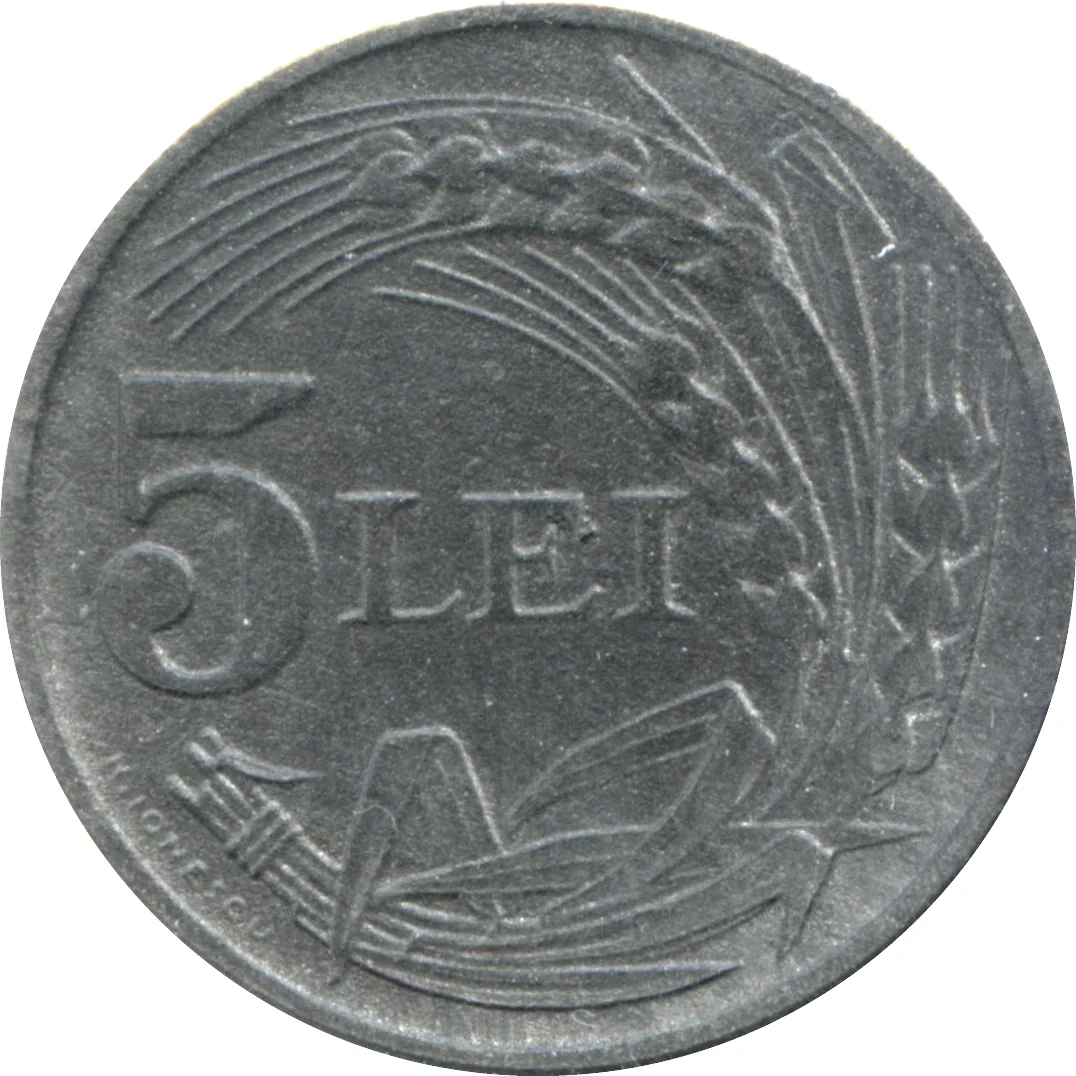

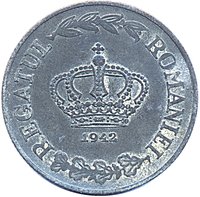
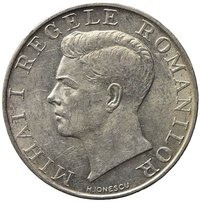
Obverse
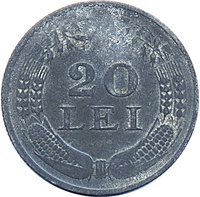
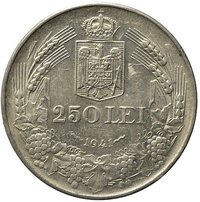
Reverse
Description:
Denomination left. Wheat swirl frames edges.
Inscription:
5 LEI
H. IONESCU
H. IONESCU
Script: Latin
Engraver: Haralambie Ionescu
Edge
Plain
Mints
| Name | Mark |
|---|---|
| Berlin | — |
Mintings
| Year | Mint Mark | Mintage | Quality | Collection |
|---|---|---|---|---|
| 1942 | — | 140,000,000 |
Historical background
In 1942, Romania’s currency situation was defined by the pressures of its deep involvement in World War II as an Axis ally. The National Bank of Romania (BNR) operated under the authoritarian regime of Marshal Ion Antonescu, with monetary policy subordinated to the exigencies of financing the war effort on the Eastern Front. This led to rampant money printing to cover massive state expenditures, particularly for the military, resulting in significant inflationary pressures. Price controls and rationing for essential goods were implemented in an attempt to contain the social impact, but a growing black market, with much higher prices, undermined the official economy.
The Romanian leu (ROL) was nominally pegged to the German Reichsmark at an official rate of 49.5 lei to 1 Reichsmark, as part of Romania’s economic integration into the Nazi sphere of influence. This peg, however, was artificial and unsustainable. The real value of the leu was eroding rapidly due to inflation, creating a wide gap between the official exchange rate and its actual purchasing power. Germany itself exploited this relationship through clearing agreements, acquiring Romanian oil, grain, and other critical resources while accumulating large, frozen debts in Reichsmarks, effectively financing the war at Romania's expense.
Domestically, the currency instability eroded living standards, placing severe hardship on the civilian population. While urban workers and military suppliers sometimes saw increased nominal wages, fixed-income earners and the peasantry suffered greatly. The government’s fiscal and monetary actions were primarily geared toward resource extraction for the war, not economic stability. Consequently, by 1942, the foundations for the severe hyperinflation that would cripple Romania in the postwar years were already firmly in place, with the leu’s value being steadily sacrificed to the demands of a protracted and costly conflict.
The Romanian leu (ROL) was nominally pegged to the German Reichsmark at an official rate of 49.5 lei to 1 Reichsmark, as part of Romania’s economic integration into the Nazi sphere of influence. This peg, however, was artificial and unsustainable. The real value of the leu was eroding rapidly due to inflation, creating a wide gap between the official exchange rate and its actual purchasing power. Germany itself exploited this relationship through clearing agreements, acquiring Romanian oil, grain, and other critical resources while accumulating large, frozen debts in Reichsmarks, effectively financing the war at Romania's expense.
Domestically, the currency instability eroded living standards, placing severe hardship on the civilian population. While urban workers and military suppliers sometimes saw increased nominal wages, fixed-income earners and the peasantry suffered greatly. The government’s fiscal and monetary actions were primarily geared toward resource extraction for the war, not economic stability. Consequently, by 1942, the foundations for the severe hyperinflation that would cripple Romania in the postwar years were already firmly in place, with the leu’s value being steadily sacrificed to the demands of a protracted and costly conflict.
🌱 Very Common