

3 cents – United States
Add to wishlist
United States
Context
Years: 1851–1853
Issuer: United States
Period:
(since 1776)
Currency:
(since 1785)
Total mintage: 36,230,900
Material
References
KM: #
Numista: #1129
Value
Exchange value: 0.03 USD = $0.03
Bullion value: $1.50
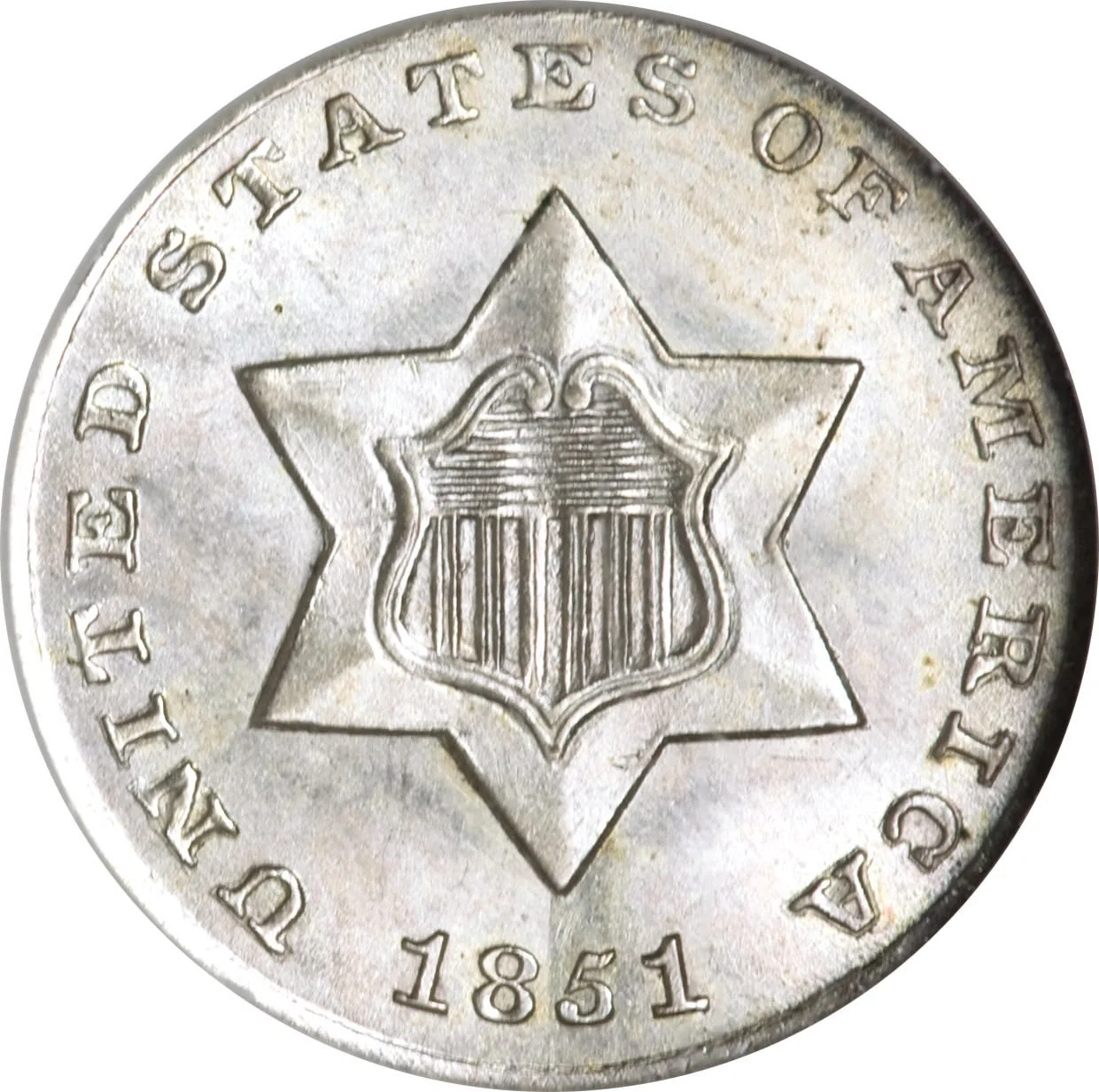
Obverse
Description:
Shield over hexagram.
Inscription:
UNITED STATES OF AMERICA
1851
1851
Script: Latin
Designer and engraver: James Barton Longacre
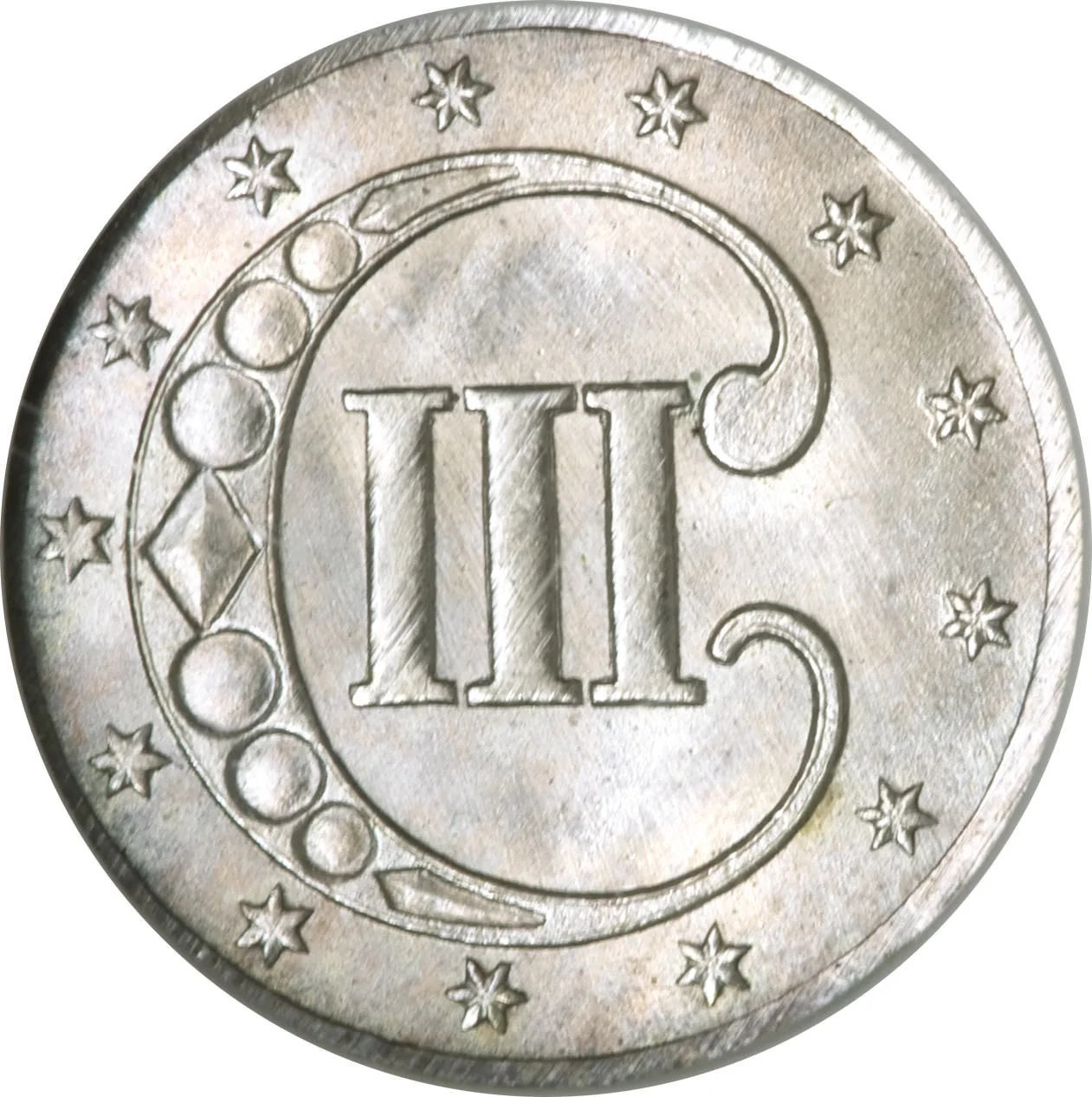
Reverse
Description:
III within a stylized C
Inscription:
III
Translation:
Three
Script: Latin
Language: Latin
Designer and engraver: James Barton Longacre
Edge
Plain
Mintings
| Year | Mint Mark | Mintage | Quality | Collection |
|---|---|---|---|---|
| 1851 | — | 5,447,400 | ||
| 1851 | O | 720,000 | ||
| 1852 | — | 18,663,500 | ||
| 1853 | — | 11,400,000 |
Historical background
In 1851, the United States operated under a bimetallic standard, but its currency system was fragmented and unstable. Federal law established fixed exchange rates between gold and silver (at a 16:1 ratio), but global market prices frequently differed, causing the more undervalued metal to be exported abroad. This led to a practical shortage of specie (gold and silver coin) in circulation, as gold discoveries in California after 1848 made silver relatively more valuable on the world market, pulling it out of the country. Consequently, everyday commerce relied heavily on a bewildering array of privately issued banknotes from hundreds of state-chartered banks. These notes traded at varying discounts depending on the perceived soundness of the issuing bank, creating complexity and risk in ordinary transactions.
The era was also marked by significant political conflict over the nation's financial structure, centered on the expired charter of the Second Bank of the United States. Without a central bank to regulate credit or provide a uniform national currency, monetary control was diffuse. The Independent Treasury System, established in 1846, required federal government transactions to be conducted in specie, which further removed gold and silver from the broader economy. This policy often tightened the money supply, exacerbating economic volatility. The lack of a reliable federal paper currency was a major point of contention, with "hard money" advocates (often Democrats) favoring strict specie use, while "soft money" proponents (often Whigs and commercial interests) supported regulated bank credit and paper to fuel economic growth.
Within this turbulent context, 1851 saw specific legislative attempts to address coinage problems. The most direct action was the passage of the Coinage Act of 1851, which authorized the minting of a new, smaller silver three-cent piece. This "trime" was introduced primarily to facilitate the purchase of postage stamps (as the first-class letter rate had dropped to three cents) without using the scarce large silver coins. More importantly, its silver content was slightly reduced below its face value, making it intentionally unattractive for export and ensuring it would remain in domestic circulation. This small coin was a pragmatic, if limited, response to the acute shortage of small-change specie, highlighting the government's struggle to maintain a functional circulating medium within a flawed and politically charged monetary framework.
The era was also marked by significant political conflict over the nation's financial structure, centered on the expired charter of the Second Bank of the United States. Without a central bank to regulate credit or provide a uniform national currency, monetary control was diffuse. The Independent Treasury System, established in 1846, required federal government transactions to be conducted in specie, which further removed gold and silver from the broader economy. This policy often tightened the money supply, exacerbating economic volatility. The lack of a reliable federal paper currency was a major point of contention, with "hard money" advocates (often Democrats) favoring strict specie use, while "soft money" proponents (often Whigs and commercial interests) supported regulated bank credit and paper to fuel economic growth.
Within this turbulent context, 1851 saw specific legislative attempts to address coinage problems. The most direct action was the passage of the Coinage Act of 1851, which authorized the minting of a new, smaller silver three-cent piece. This "trime" was introduced primarily to facilitate the purchase of postage stamps (as the first-class letter rate had dropped to three cents) without using the scarce large silver coins. More importantly, its silver content was slightly reduced below its face value, making it intentionally unattractive for export and ensuring it would remain in domestic circulation. This small coin was a pragmatic, if limited, response to the acute shortage of small-change specie, highlighting the government's struggle to maintain a functional circulating medium within a flawed and politically charged monetary framework.
🌱 Common