

5 pennia – Finland
Add to wishlist
Finland
Context
Years: 1896–1917
Issuer: Finland
Ruler: Nicholas II
Currency:
(1860—1963)
Demonetized: Yes
Total mintage: 22,080,000
Material
References
KM: #
Numista: #7455
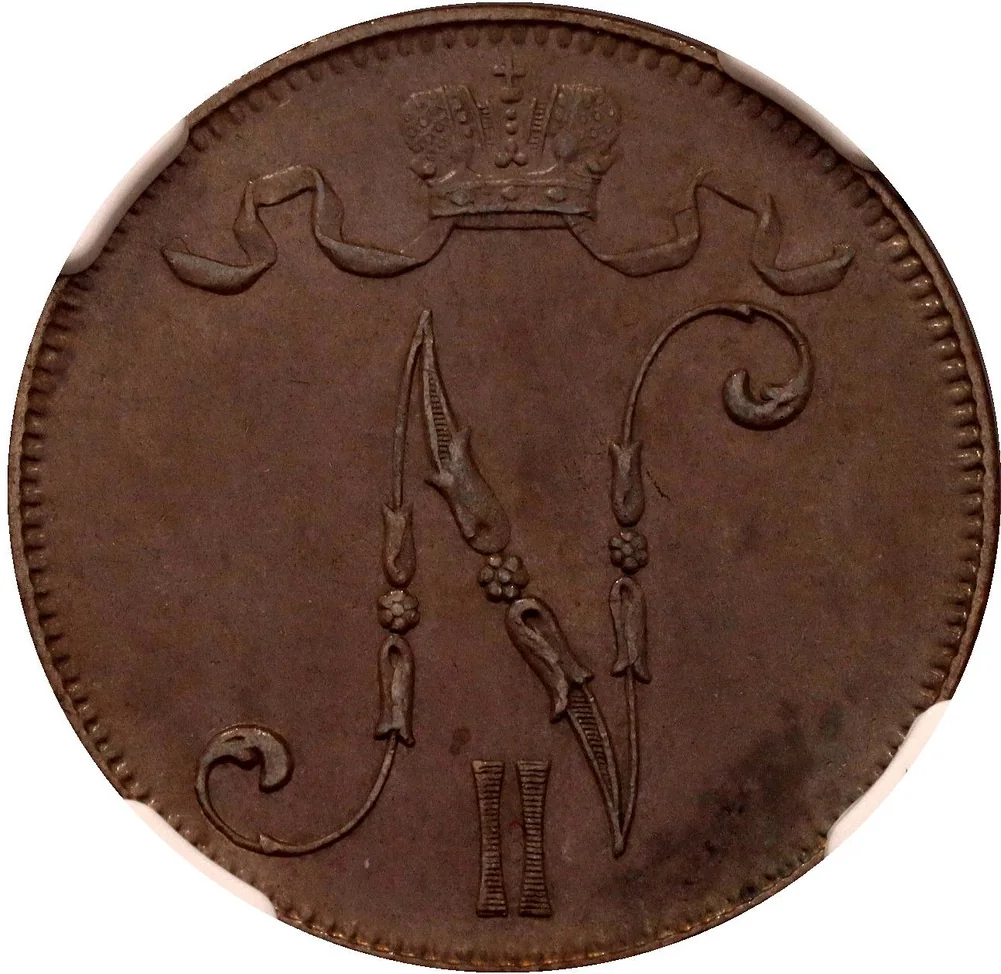
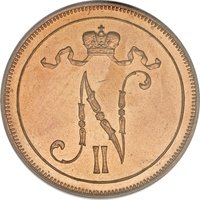
Obverse
Description:
Crowned monogram of Nicholas II.
Inscription:
N II
Script: Latin
Engraver: Aleksander Fadejev
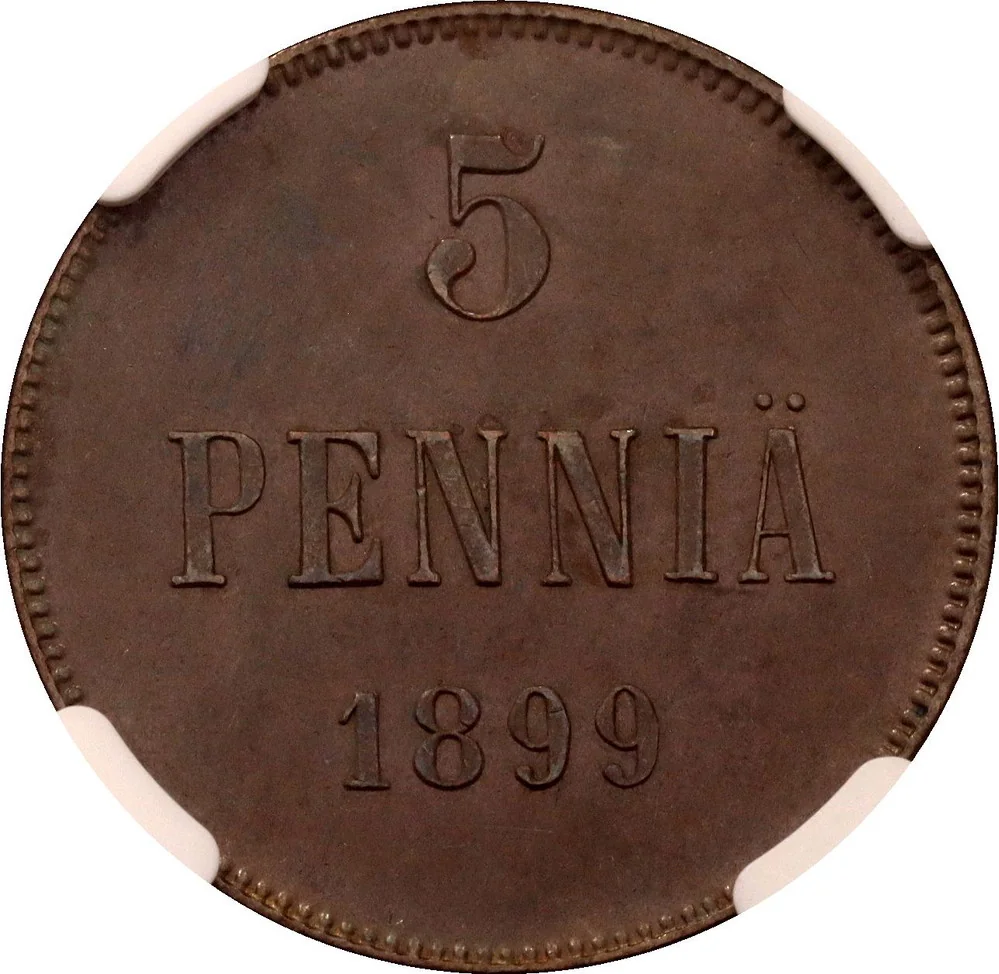
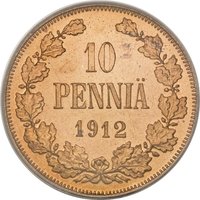
Reverse
Description:
Date above denomination.
Inscription:
5
PENNIÄ
1915
PENNIÄ
1915
Translation:
FIVE PENNIES
1915
1915
Script: Latin
Language: Finnish
Engraver: Aleksander Fadejev
Edge
Plain
Mints
| Name | Mark |
|---|---|
| Mint of Finland | — |
Mintings
| Year | Mint Mark | Mintage | Quality | Collection |
|---|---|---|---|---|
| 1896 | — | 410,000 | ||
| 1897 | — | 590,000 | ||
| 1898 | — | 1,150,000 | ||
| 1899 | — | 860,000 | ||
| 1901 | — | 990,000 | ||
| 1905 | — | 620,000 | ||
| 1906 | — | 960,000 | ||
| 1907 | — | 770,000 | ||
| 1908 | — | 1,660,000 | ||
| 1910 | — | 60,000 | ||
| 1911 | — | 1,050,000 | ||
| 1912 | — | 460,000 | ||
| 1913 | — | 1,060,000 | ||
| 1914 | — | 820,000 | ||
| 1915 | — | 2,080,000 | ||
| 1916 | — | 4,470,000 | ||
| 1917 | — | 4,070,000 |
Historical background
In 1896, Finland, as an autonomous Grand Duchy within the Russian Empire, operated under a distinct monetary system. The official currency was the Finnish markka (or mark), which had been introduced in 1860 to replace the Russian ruble and solidify Finland's economic autonomy. The markka was pegged to silver, adhering to the silver standard, which provided stability but also tied the currency's value to international silver markets. This system was managed by the Bank of Finland, which held the exclusive right to issue banknotes and coins.
However, the global financial landscape was shifting. The late 19th century saw many nations, including Russia and the major European powers, moving towards the gold standard. This created practical and political pressures for Finland. Trade with its imperial ruler, Russia, and other key partners became more complex due to differing monetary bases. Furthermore, fluctuations in the value of silver relative to gold introduced uncertainty for Finnish foreign trade and investment. Internally, the system functioned well, but externally, it was becoming increasingly isolated.
Consequently, 1896 fell within a period of active debate and preparation for a major monetary reform. Discussions among Finnish officials, economists, and the Estates of the realm were already underway, focusing on the necessity and timing of adopting the gold standard. This transition was seen as crucial for modernizing the economy and ensuring smoother integration with international finance and Russia's own gold-based ruble. The reform would ultimately come to fruition a few years later, in 1877, when Finland formally adopted the gold standard, fixing the value of the markka to gold and aligning its currency with the prevailing global system.
However, the global financial landscape was shifting. The late 19th century saw many nations, including Russia and the major European powers, moving towards the gold standard. This created practical and political pressures for Finland. Trade with its imperial ruler, Russia, and other key partners became more complex due to differing monetary bases. Furthermore, fluctuations in the value of silver relative to gold introduced uncertainty for Finnish foreign trade and investment. Internally, the system functioned well, but externally, it was becoming increasingly isolated.
Consequently, 1896 fell within a period of active debate and preparation for a major monetary reform. Discussions among Finnish officials, economists, and the Estates of the realm were already underway, focusing on the necessity and timing of adopting the gold standard. This transition was seen as crucial for modernizing the economy and ensuring smoother integration with international finance and Russia's own gold-based ruble. The reform would ultimately come to fruition a few years later, in 1877, when Finland formally adopted the gold standard, fixing the value of the markka to gold and aligning its currency with the prevailing global system.
🌱 Very Common