

10 Cents – Newfoundland
Canada
Context
Years: 1945–1947
Country: Canada 
Issuer: Newfoundland
Ruler: George VI
Currency:
(1865—1949)
Total mintage: 276,221
Material
References
KM: #Click to copy to clipboard20a
Numista: #7452
Value
Exchange value: 0.10 NFD
Bullion value: $5.17
Inflation-adjusted value: 1.78 NFD
Obverse
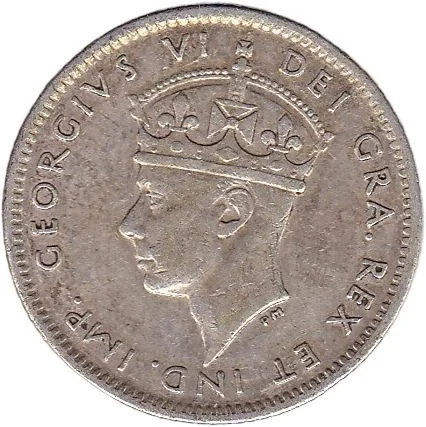
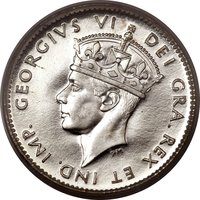
Description:
King George VI, crowned.
Inscription:
GEORGIUS VI DEI GRA. REX ET IND. IMP.
PM
PM
Translation:
George VI by the Grace of God King and Emperor of India.
Script: Latin
Language: Latin
Engraver: Percy Metcalfe
Reverse
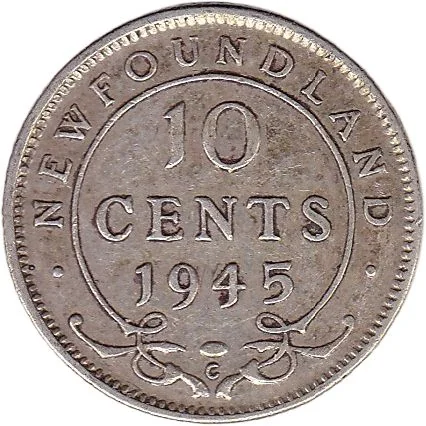
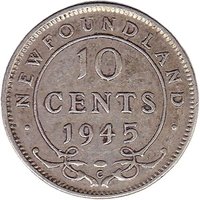
Description:
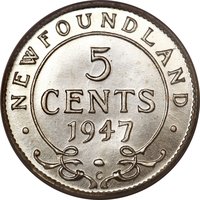
"Newfoundland" arched above value, date below.
Inscription:
NEWFOUNDLAND 10 CENTS 1942 C
Script: Latin
Engraver: George William de Saulles
Edge
Reeded
Mints
| Name | Mark |
|---|---|
| Royal Canadian Mint of Ottawa | C |
Historical background
In 1945, Newfoundland was not a province of Canada but a British Dominion under a unique and precarious financial administration. The Great Depression and the collapse of its primary export markets had driven the island to bankruptcy in 1934, leading to the suspension of self-government and the establishment of a Commission of Government appointed by Britain. This unelected body managed all affairs, including currency, with the primary goal of restoring fiscal solvency. The official currency was the Newfoundland dollar, pegged at par with the Canadian dollar, but the economy was heavily dependent on and integrated with its larger neighbour.
The wartime economy of the 1940s, fueled by Allied spending on bases and personnel, brought unprecedented income and erased the public debt. However, this boom was artificial and masked deeper questions about Newfoundland's long-term viability. The Canadian dollar circulated widely alongside the local currency, and Newfoundland's banking system was essentially a branch of Canada's. This monetary integration reflected a practical reality: over 90% of Newfoundland's trade was with Canada, making the Canadian dollar the de facto currency for major transactions and highlighting the island's economic absorption into the Canadian sphere.
Against this backdrop, 1945 was a pivotal year of decision. With the war ending, the Commission's mandate was nearing its end, and the future constitutional status had to be determined. The currency situation became a tangible symbol of the larger choice: return to independence with its own vulnerable currency, or join Confederation with Canada and adopt the stronger Canadian dollar. The National Convention, convened in 1946 to examine options, would intensely debate this economic dependency, with the stability and security of the Canadian monetary system becoming a powerful argument in favour of union, which was ultimately achieved in 1949.
The wartime economy of the 1940s, fueled by Allied spending on bases and personnel, brought unprecedented income and erased the public debt. However, this boom was artificial and masked deeper questions about Newfoundland's long-term viability. The Canadian dollar circulated widely alongside the local currency, and Newfoundland's banking system was essentially a branch of Canada's. This monetary integration reflected a practical reality: over 90% of Newfoundland's trade was with Canada, making the Canadian dollar the de facto currency for major transactions and highlighting the island's economic absorption into the Canadian sphere.
Against this backdrop, 1945 was a pivotal year of decision. With the war ending, the Commission's mandate was nearing its end, and the future constitutional status had to be determined. The currency situation became a tangible symbol of the larger choice: return to independence with its own vulnerable currency, or join Confederation with Canada and adopt the stronger Canadian dollar. The National Convention, convened in 1946 to examine options, would intensely debate this economic dependency, with the stability and security of the Canadian monetary system becoming a powerful argument in favour of union, which was ultimately achieved in 1949.
🌱 Fairly Common