

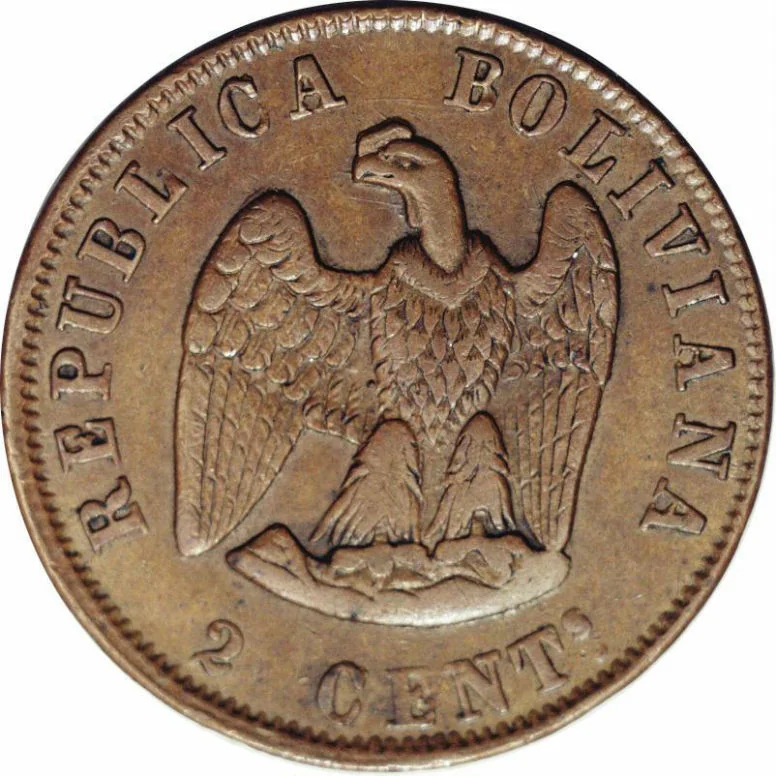
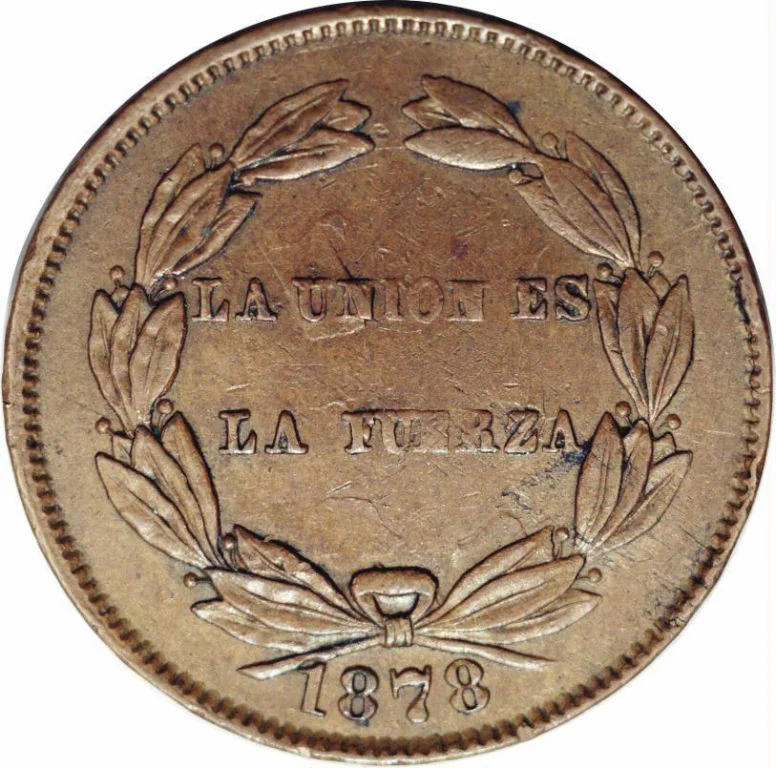
2 centavos – Bolivia
Add to wishlist
Bolivia
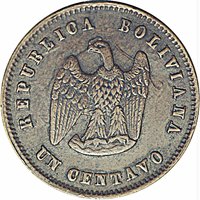
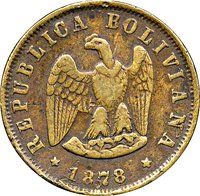
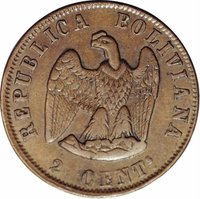
Obverse
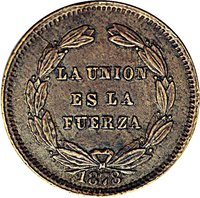
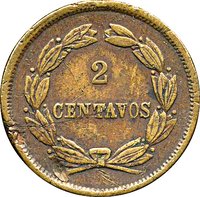
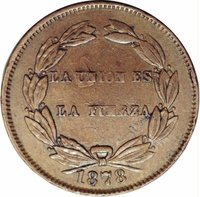
Reverse
Edge
Mintings
| Year | Mint Mark | Mintage | Quality | Collection |
|---|---|---|---|---|
| 1878 | — | — |
Historical background
In 1878, Bolivia's currency system was in a precarious and transitional state, dominated by the enduring legacy of the colonial "peso boliviano" or "boliviano." This silver coin, theoretically aligned with the Latin Monetary Union's 5-franc standard, was the official unit. However, the national treasury was severely depleted following a period of economic stagnation and political instability. The country's monetary reality was fragmented, with a chronic shortage of minted specie in circulation, leading to widespread use of debased and worn coinage, as well as foreign currencies like the Peruvian sol and Chilean peso in border regions, which further complicated commerce and state finances.
This fragile monetary environment existed under the looming shadow of a severe fiscal crisis. The government, led by President Hilarión Daza, was grappling with massive external debt and empty coffers. In a desperate attempt to raise revenue, Daza's administration had controversially imposed a new tax of 10 centavos per quintal of nitrate exported by the Chilean-owned Compañía de Salitres y Ferrocarril de Antofagasta, which operated in the Bolivian coastal territory. This decision directly violated the 1874 treaty with Chile, which had fixed taxes on Chilean companies for 25 years, and set the nation on an irreversible collision course.
Thus, the currency situation of 1878 cannot be separated from the geopolitical crisis it helped fuel. The attempt to shore up fiscal—and by extension, monetary—stability through the nitrate tax was the immediate catalyst for the outbreak of the War of the Pacific in 1879. The war would ultimately prove catastrophic for Bolivia, resulting in the loss of its entire coastal territory and its valuable nitrate fields, a defeat that would plunge the nation into deeper economic hardship and delay genuine monetary and financial stability for decades. The currency weakness of 1878 was, therefore, both a symptom of deeper economic maladies and a direct cause of national disaster.
This fragile monetary environment existed under the looming shadow of a severe fiscal crisis. The government, led by President Hilarión Daza, was grappling with massive external debt and empty coffers. In a desperate attempt to raise revenue, Daza's administration had controversially imposed a new tax of 10 centavos per quintal of nitrate exported by the Chilean-owned Compañía de Salitres y Ferrocarril de Antofagasta, which operated in the Bolivian coastal territory. This decision directly violated the 1874 treaty with Chile, which had fixed taxes on Chilean companies for 25 years, and set the nation on an irreversible collision course.
Thus, the currency situation of 1878 cannot be separated from the geopolitical crisis it helped fuel. The attempt to shore up fiscal—and by extension, monetary—stability through the nitrate tax was the immediate catalyst for the outbreak of the War of the Pacific in 1879. The war would ultimately prove catastrophic for Bolivia, resulting in the loss of its entire coastal territory and its valuable nitrate fields, a defeat that would plunge the nation into deeper economic hardship and delay genuine monetary and financial stability for decades. The currency weakness of 1878 was, therefore, both a symptom of deeper economic maladies and a direct cause of national disaster.
Series: 1878 Bolivia circulation coins
✨ Legendary