

2 Centavos – Peru
Peru
Context
Material
References
KM: #Click to copy to clipboard228
Numista: #7431
Value
Exchange value: 0.02 PEH
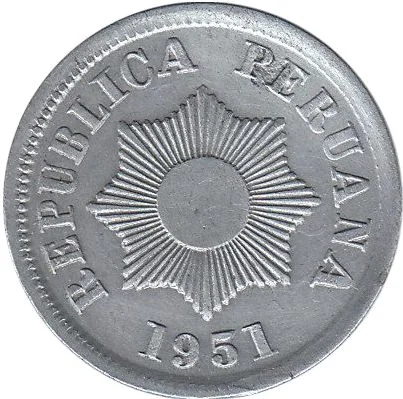
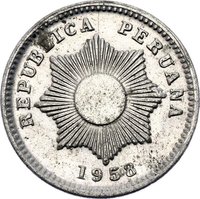
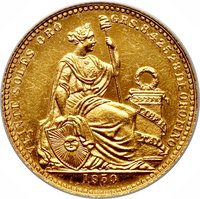
Obverse
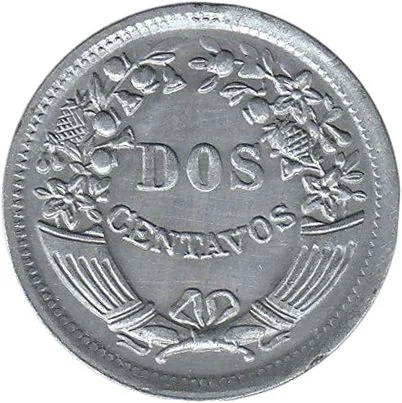
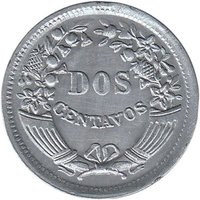
Reverse
Edge
Plain
Mints
| Name | Mark |
|---|---|
| Lima | — |
Mintings
| Year | Mint Mark | Mintage | Quality | Collection |
|---|---|---|---|---|
| 1950 | — | 1,702,000 | ||
| 1951 | — | 3,289,000 | ||
| 1952 | — | 1,155,000 | ||
| 1953 | — | 1,150,000 | ||
| 1954 | — | — | ||
| 1955 | — | 1,185,000 | ||
| 1956 | — | 400,000 | ||
| 1957 | — | 520,000 | ||
| 1958 | — | 200,000 |
Historical background
In 1950, Peru's currency situation was characterized by the sol de oro, which had been the official currency since 1931, replacing the heavily devalued Peruvian pound. However, the sol itself was under significant pressure. The post-World War II period saw a global realignment of currencies and economic policies, and Peru, like many primary goods exporters, faced fluctuating terms of trade. While not in a state of hyperinflation, the country experienced persistent inflationary trends and a growing disparity between the official exchange rate and market realities, reflecting underlying economic strains.
Economically, Peru's currency stability was heavily tied to its export earnings, primarily from minerals (copper, silver, lead) and agricultural products like cotton and sugar. The Korean War (beginning in June 1950) provided a temporary boom for these exports, injecting dollars into the economy and offering a short-term respite for the sol. Nonetheless, the economy remained vulnerable to volatile commodity prices. The government and the Central Reserve Bank of Peru operated a system of exchange controls, managing multiple rates to prioritize essential imports and conserve foreign reserves, a common practice in Latin America at the time.
The monetary policy of the period was conservative in principle, with the sol theoretically backed by gold and foreign exchange reserves. However, fiscal deficits and the expansion of credit to support development and urban growth began to erode this stability. The 1950s would later see increasing devaluation pressures, culminating in a major devaluation in 1958. Thus, the currency situation in 1950 represented a calm before growing storms, with a controlled but fragile sol operating within a managed system that would prove increasingly difficult to sustain throughout the decade.
Economically, Peru's currency stability was heavily tied to its export earnings, primarily from minerals (copper, silver, lead) and agricultural products like cotton and sugar. The Korean War (beginning in June 1950) provided a temporary boom for these exports, injecting dollars into the economy and offering a short-term respite for the sol. Nonetheless, the economy remained vulnerable to volatile commodity prices. The government and the Central Reserve Bank of Peru operated a system of exchange controls, managing multiple rates to prioritize essential imports and conserve foreign reserves, a common practice in Latin America at the time.
The monetary policy of the period was conservative in principle, with the sol theoretically backed by gold and foreign exchange reserves. However, fiscal deficits and the expansion of credit to support development and urban growth began to erode this stability. The 1950s would later see increasing devaluation pressures, culminating in a major devaluation in 1958. Thus, the currency situation in 1950 represented a calm before growing storms, with a controlled but fragile sol operating within a managed system that would prove increasingly difficult to sustain throughout the decade.
🌱 Common