

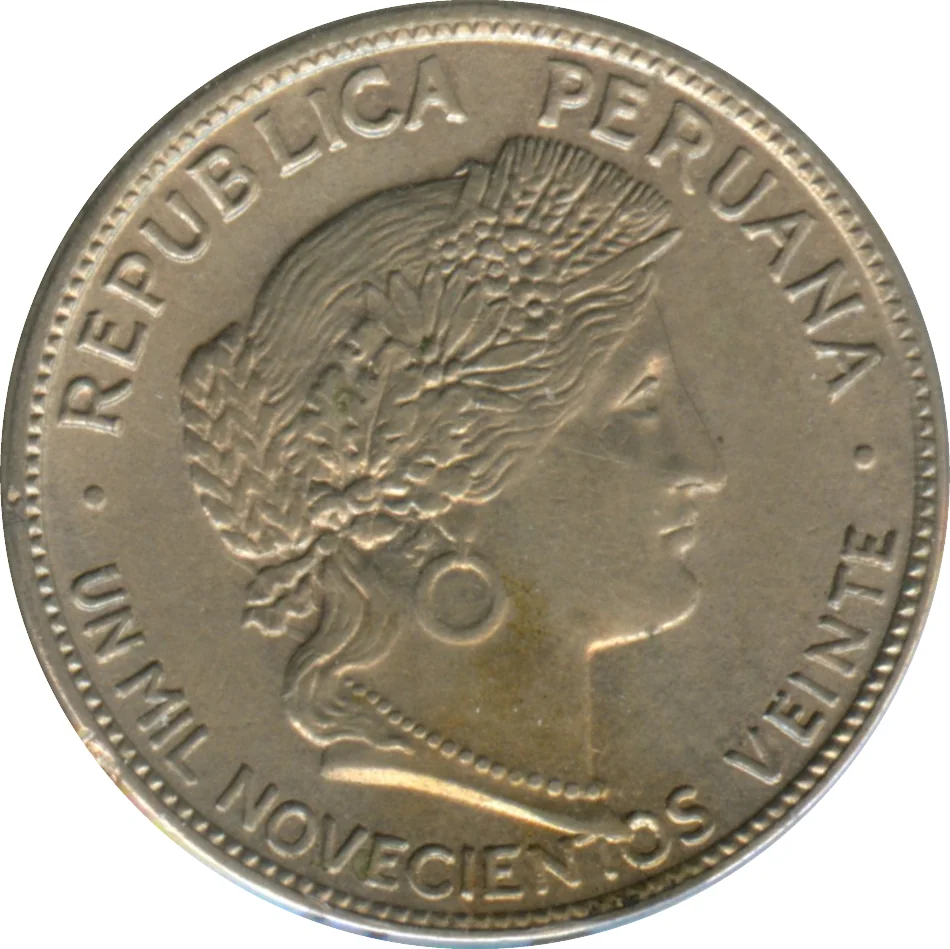
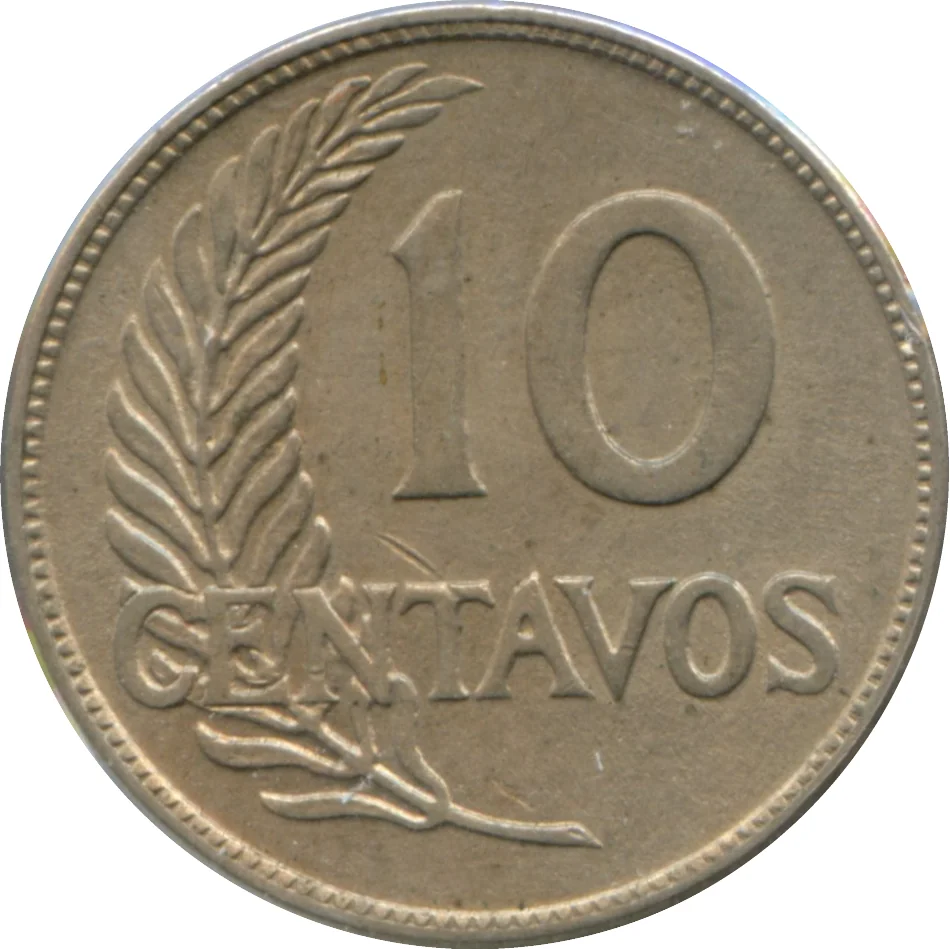
10 Centavos – Peru
Peru

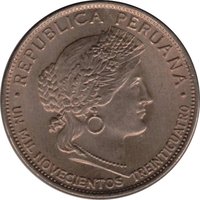
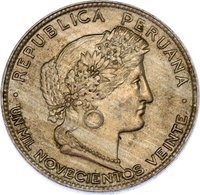
Obverse
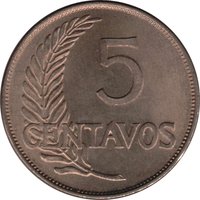
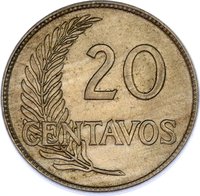
Reverse
Edge
Plain
Mints
| Name | Mark |
|---|---|
| Royal Mint (Tower Hill) | — |
| United States Mint of Philadelphia | — |
Mintings
| Year | Mint Mark | Mintage | Quality | Collection |
|---|---|---|---|---|
| 1918 | — | 3,000,000 | ||
| 1919 | — | 2,500,000 | ||
| 1920 | — | 3,080,000 | ||
| 1921 | — | 6,920,000 | ||
| 1926 | — | 3,000,000 | ||
| 1935 | — | — | Proof | |
| 1935 | — | 1,000,000 | ||
| 1937 | — | 1,000,000 | ||
| 1937 | — | — | Proof | |
| 1939 | — | 2,000,000 | ||
| 1939 | — | — | Proof | |
| 1940 | — | 2,000,000 | ||
| 1940 | — | — | Proof | |
| 1941 | — | 2,000,000 | ||
| 1941 | — | — | Proof |
Historical background
In 1918, Peru's currency situation was characterized by the dominance of the Libra Peruana de Oro (Peruvian Gold Pound), a sterling-backed currency established in 1901. This system had brought a period of monetary stability and was crucial for a primary-export economy reliant on foreign investment and trade, particularly in commodities like copper, cotton, and sugar. However, the First World War (1914-1918) profoundly disrupted this stability. International gold shipments became hazardous, straining the gold standard's convertibility, while wartime demand initially drove a export boom and an influx of foreign currency.
This influx created a complex scenario. While export revenues rose, the global scarcity of gold and goods led to inflationary pressures. The Peruvian government, facing fiscal challenges, began to increasingly issue billetes fiscales (fiscal notes), which were fiduciary paper money not fully convertible to gold. This marked a subtle but significant shift away from the pure gold standard, increasing the domestic money supply. Furthermore, the pre-war practice of private banks issuing their own banknotes continued, adding another layer to the monetary base, though these were also theoretically convertible.
Consequently, by the end of 1918, Peru's currency system was in a transitional and strained state. The formal structure of the gold standard remained, but its practical operation was weakened. The concurrent circulation of gold-backed currency, expanding government paper money, and private banknotes created underlying vulnerabilities. The post-war collapse of export prices would soon expose these weaknesses, leading to severe depreciation and a full monetary crisis in the early 1920s, forcing a complete restructuring of the system.
This influx created a complex scenario. While export revenues rose, the global scarcity of gold and goods led to inflationary pressures. The Peruvian government, facing fiscal challenges, began to increasingly issue billetes fiscales (fiscal notes), which were fiduciary paper money not fully convertible to gold. This marked a subtle but significant shift away from the pure gold standard, increasing the domestic money supply. Furthermore, the pre-war practice of private banks issuing their own banknotes continued, adding another layer to the monetary base, though these were also theoretically convertible.
Consequently, by the end of 1918, Peru's currency system was in a transitional and strained state. The formal structure of the gold standard remained, but its practical operation was weakened. The concurrent circulation of gold-backed currency, expanding government paper money, and private banknotes created underlying vulnerabilities. The post-war collapse of export prices would soon expose these weaknesses, leading to severe depreciation and a full monetary crisis in the early 1920s, forcing a complete restructuring of the system.
Series: 1918 Peru circulation coins
🌱 Common