

Peru
Context
Years: 2007–2018
Issuer: Peru 
Issuing organization: Central Reserve Bank of Peru
Period:
(since 1822)
Demonetization: 1 January 2019
Total mintage: 301,450,000
Material
References
KM: #Click to copy to clipboard304.4a
Numista: #7423
Value
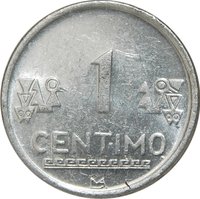
Exchange value: 0.05 PEN
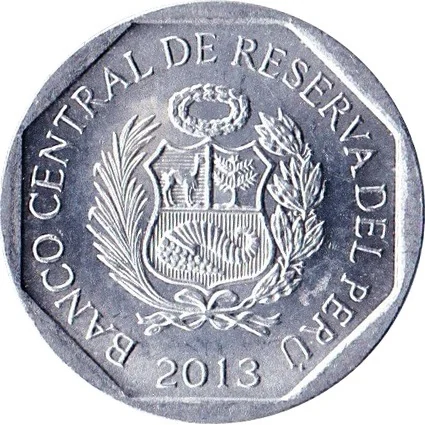
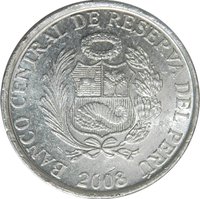
Obverse
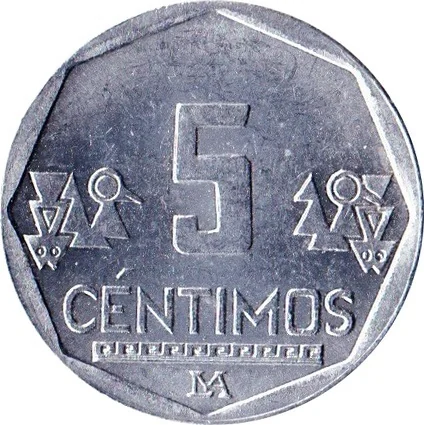
Reverse
Edge
Plain
Categories
| Symbols> Coat of Arms |
Mints
| Name | Mark |
|---|---|
| Lima | LIMA |
Mintings
Historical background
In 2007, Peru's currency situation was characterized by a period of significant appreciation of the Peruvian Nuevo Sol (PEN) against the US dollar, driven by strong macroeconomic fundamentals. The country was experiencing robust economic growth, fueled by high global prices for its key mineral exports like copper, gold, and zinc. This surge in export revenues, combined with substantial foreign direct investment in the mining sector, led to a large influx of US dollars into the economy. Consequently, the Nuevo Sol strengthened considerably, appreciating approximately 6% against the dollar over the course of the year, which continued a trend that began earlier in the decade.
This appreciation presented a complex policy challenge for the Central Reserve Bank of Peru (BCRP). On one hand, a stronger currency helped to curb imported inflation, contributing to price stability. On the other hand, it threatened the competitiveness of Peruvian non-traditional exports and local industries by making their goods more expensive on the international market. In response, the BCRP actively intervened in the foreign exchange market through heavy dollar purchases, building up international reserves to a record $27.7 billion by year's end. These interventions aimed to moderate the pace of appreciation and mitigate volatility, rather than to reverse the trend.
The government of President Alan García largely supported this accumulation of reserves as a buffer against external shocks, viewing it as a sign of economic strength. However, the currency dynamics also sparked debate. Exporters and some manufacturers expressed concerns over "Dutch disease," while policymakers balanced these worries against the benefits of low inflation and the need to maintain financial stability. Overall, the 2007 currency environment reflected Peru's successful integration into the global economy, but also highlighted the ongoing challenges of managing commodity-driven capital flows in an emerging market.
This appreciation presented a complex policy challenge for the Central Reserve Bank of Peru (BCRP). On one hand, a stronger currency helped to curb imported inflation, contributing to price stability. On the other hand, it threatened the competitiveness of Peruvian non-traditional exports and local industries by making their goods more expensive on the international market. In response, the BCRP actively intervened in the foreign exchange market through heavy dollar purchases, building up international reserves to a record $27.7 billion by year's end. These interventions aimed to moderate the pace of appreciation and mitigate volatility, rather than to reverse the trend.
The government of President Alan García largely supported this accumulation of reserves as a buffer against external shocks, viewing it as a sign of economic strength. However, the currency dynamics also sparked debate. Exporters and some manufacturers expressed concerns over "Dutch disease," while policymakers balanced these worries against the benefits of low inflation and the need to maintain financial stability. Overall, the 2007 currency environment reflected Peru's successful integration into the global economy, but also highlighted the ongoing challenges of managing commodity-driven capital flows in an emerging market.
🌱 Very Common