

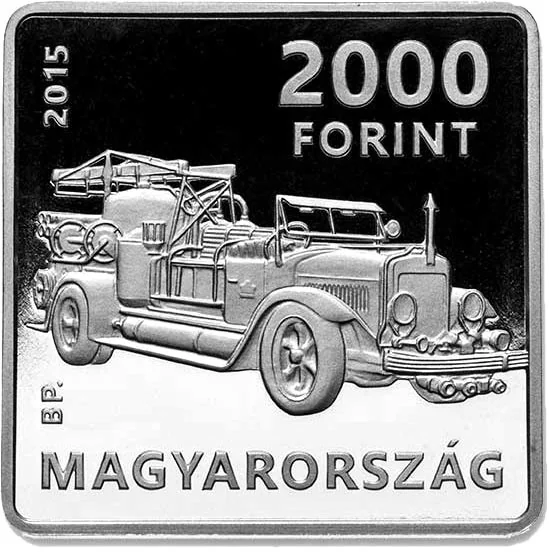
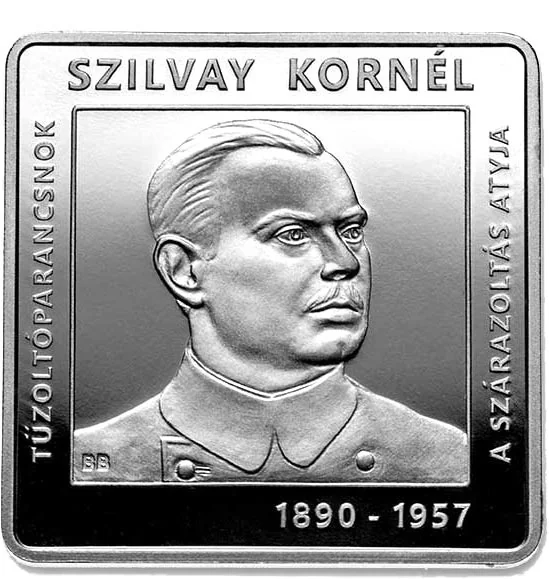
2000 forint – Hungary
Add to wishlist
Non-circulating coins
Commemoration: 12th. series - Szilvay Kornél
Hungary
Context
Year: 2015
Issuer: Hungary
Issuing organization: Magyar Pénzverő
Period:
(since 1989)
Currency:
(since 1946)
Total mintage: 10,000
Material
Weight: 14 g
Shape: Square with rounded corners
Composition: Copper-nickel
Technique: Milled
Alignment: Medal alignment
flip
References
KM: #
Numista: #74229
Value
Exchange value: 2000 HUF
Inflation-adjusted value: 3396.76 HUF
Obverse
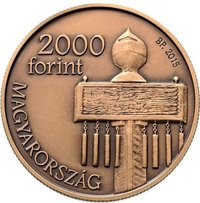
Inscription:
2015
2000
FORINT
BP.
MAGYARORSZÁG
2000
FORINT
BP.
MAGYARORSZÁG
Translation:
2015
2000
FORINT
Budapest
Hungary
2000
FORINT
Budapest
Hungary
Script: Latin
Designer: Balázs Bitó
Reverse
Inscription:
SZILVAY KORNÉL
TŰZOLTÓPARANCSNOK
A SZÁRAZOLTÁS ATYJA
1890-1957
TŰZOLTÓPARANCSNOK
A SZÁRAZOLTÁS ATYJA
1890-1957
Translation:
SZILVAY KORNÉL
FIRE CHIEF
THE FATHER OF DRAINAGE
1890-1957
FIRE CHIEF
THE FATHER OF DRAINAGE
1890-1957
Script: Latin
Language: Hungarian
Designer: Balázs Bitó
Edge
Categories
| Event> Birth anniversary |
| Transportation> Car |
Mints
| Name | Mark |
|---|---|
| Hungarian mint | BP. |
Historical background
In 2015, Hungary's currency situation was characterized by a period of deliberate devaluation and unconventional monetary policy under the National Bank of Hungary (MNB), led by Governor György Matolcsy. The central bank's primary tool was a series of interest rate cuts and a unique "funding for growth" scheme, which aimed to boost lending to small and medium-sized enterprises (SMEs) by providing cheap credit using bank reserves. This expansive policy, while stimulating domestic demand, placed sustained downward pressure on the Hungarian forint (HUF) throughout much of the year. The forint weakened significantly against the euro, reaching historic lows beyond 315 HUF/EUR in the first half of 2015, a deliberate move to enhance export competitiveness and reduce the burden of foreign-currency household debt.
This weak currency policy existed within a complex economic context. Hungary had successfully exited its IMF/EU financial assistance program in 2013, but the government maintained a focus on reducing public debt and achieving economic sovereignty. The forint's depreciation helped economic growth, which was robust at nearly 3% in 2015, but it also imported inflation and increased the cost of servicing the government's own foreign-denominated debt. Furthermore, the MNB's policies, particularly the use of bank reserves for targeted lending, drew criticism from some analysts and the European Central Bank for blurring the lines between monetary and fiscal policy and potentially undermining central bank independence.
By the latter part of 2015, external factors began to shift the dynamic. The anticipation and eventual announcement of quantitative easing (QE) by the European Central Bank weakened the euro globally, which paradoxically allowed the forint to stabilize and even recover some strength to around 310 HUF/EUR by year-end. This shift, combined with low global oil prices keeping inflation in check, provided the MNB room to continue its loose monetary stance. Thus, 2015 closed with a currency that had weathered deliberate weakness but was finding a fragile equilibrium, setting the stage for a gradual normalization of policy in the following years.
This weak currency policy existed within a complex economic context. Hungary had successfully exited its IMF/EU financial assistance program in 2013, but the government maintained a focus on reducing public debt and achieving economic sovereignty. The forint's depreciation helped economic growth, which was robust at nearly 3% in 2015, but it also imported inflation and increased the cost of servicing the government's own foreign-denominated debt. Furthermore, the MNB's policies, particularly the use of bank reserves for targeted lending, drew criticism from some analysts and the European Central Bank for blurring the lines between monetary and fiscal policy and potentially undermining central bank independence.
By the latter part of 2015, external factors began to shift the dynamic. The anticipation and eventual announcement of quantitative easing (QE) by the European Central Bank weakened the euro globally, which paradoxically allowed the forint to stabilize and even recover some strength to around 310 HUF/EUR by year-end. This shift, combined with low global oil prices keeping inflation in check, provided the MNB room to continue its loose monetary stance. Thus, 2015 closed with a currency that had weathered deliberate weakness but was finding a fragile equilibrium, setting the stage for a gradual normalization of policy in the following years.
⭐ Rare