

5 Centavos (La Casa de Moneda) – Peru
Circulating commemorative coins
Commemoration: 400th Anniversary of the Foundation of La Casa de Moneda
Peru
Context

Material
References
KM: #Click to copy to clipboard290
Numista: #7415
Value
Exchange value: 0.05 PEH
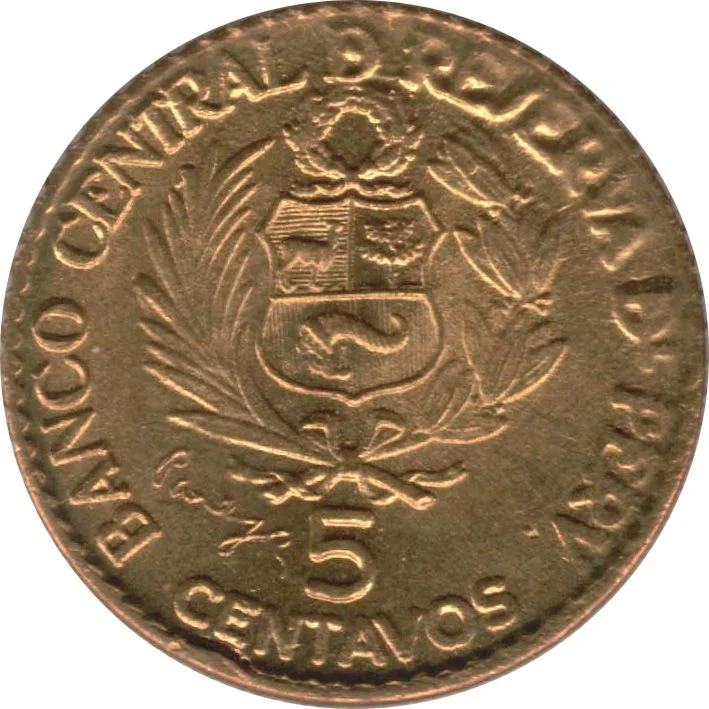
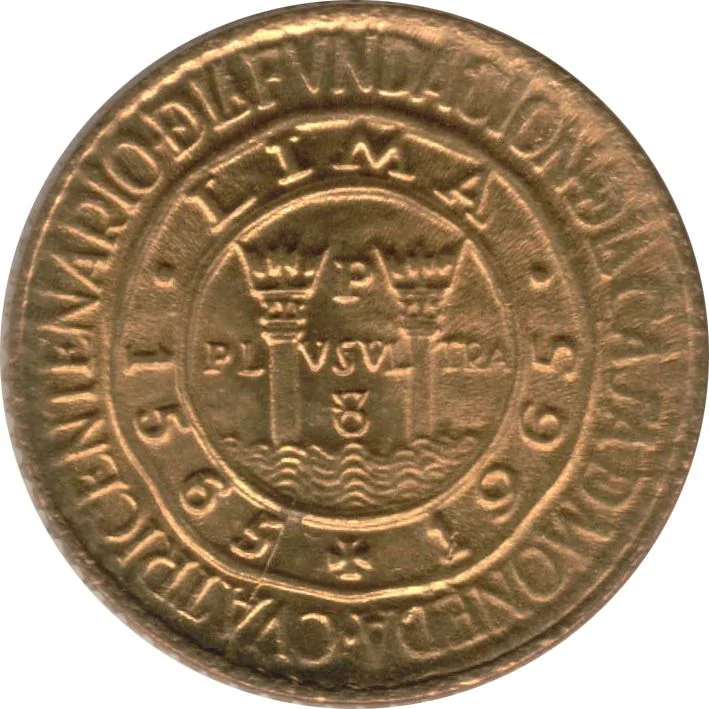
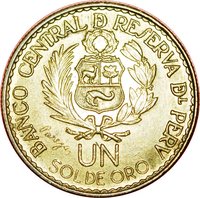
Obverse
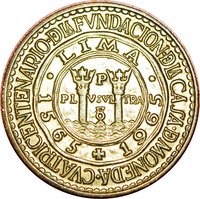
Reverse
Edge
Reeded
Categories
| Symbols> Coat of Arms |
| Symbol> Wreath |
Mintings
| Year | Mint Mark | Mintage | Quality | Collection |
|---|---|---|---|---|
| 1965 | — | 712,000 | ||
| 1965 | — | — | Proof |
Historical background
In 1965, Peru's currency situation was characterized by relative stability under the managed exchange rate regime of the Sol de Oro, but this stability masked underlying economic pressures and growing imbalances. The country operated under a fixed exchange rate system, pegged to the U.S. dollar, which provided predictability for foreign trade and investment. This period fell within the moderate economic expansion of the 1960s, fueled by export-led growth in sectors like mining, fishing, and agriculture. However, the fixed parity required careful management by the Central Reserve Bank of Peru to maintain international reserves and defend the currency's value.
Beneath the surface, structural weaknesses were accumulating. Government spending, particularly on infrastructure and state-led industrialization under President Fernando Belaúnde Terry, was rising, contributing to fiscal deficits. Inflation, though moderate by later standards, began to creep upward, eroding the sol's real value. Most critically, the country's dependence on primary commodity exports made it vulnerable to fluctuations in global prices. While not yet in crisis, these factors—fiscal pressures, inflationary trends, and external vulnerability—were straining the fixed exchange rate system.
The currency stability of 1965 proved to be a calm before a significant storm. Within a few years, these pressures would intensify dramatically. A balance of payments crisis emerged, exacerbated by a severe devaluation of the Peruvian sol in 1967 and the collapse of the anchovy fishery, a key export earner. The economic turmoil contributed to political instability, culminating in a military coup in 1968. Thus, the currency situation in 1965 represents the tail end of a period of managed stability, just prior to a profound economic and monetary upheaval that would redefine Peru's financial landscape in the late 1960s and 1970s.
Beneath the surface, structural weaknesses were accumulating. Government spending, particularly on infrastructure and state-led industrialization under President Fernando Belaúnde Terry, was rising, contributing to fiscal deficits. Inflation, though moderate by later standards, began to creep upward, eroding the sol's real value. Most critically, the country's dependence on primary commodity exports made it vulnerable to fluctuations in global prices. While not yet in crisis, these factors—fiscal pressures, inflationary trends, and external vulnerability—were straining the fixed exchange rate system.
The currency stability of 1965 proved to be a calm before a significant storm. Within a few years, these pressures would intensify dramatically. A balance of payments crisis emerged, exacerbated by a severe devaluation of the Peruvian sol in 1967 and the collapse of the anchovy fishery, a key export earner. The economic turmoil contributed to political instability, culminating in a military coup in 1968. Thus, the currency situation in 1965 represents the tail end of a period of managed stability, just prior to a profound economic and monetary upheaval that would redefine Peru's financial landscape in the late 1960s and 1970s.
🌱 Common