

5 Soles (Independence) – Peru
Circulating commemorative coins
Commemoration: 150th Anniversary of Independence
Peru
Context

Material
Diameter: 25.7 mm
Weight: 7.8 g
Shape: Round
Composition: Copper-nickel
Standard: Silver quarter ounce
Technique: Milled
Alignment: Coin alignment
flip
References
KM: #Click to copy to clipboard254
Numista: #5595
Value
Exchange value: 5 PEH
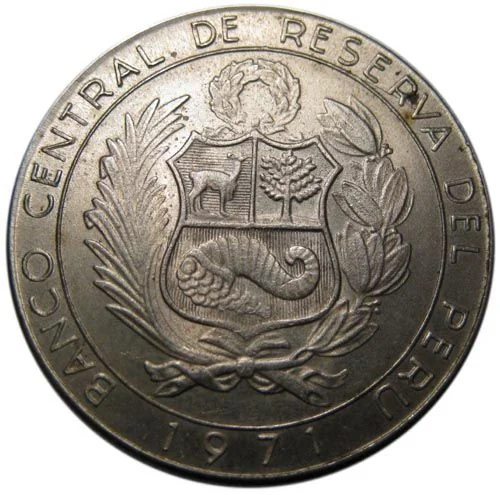
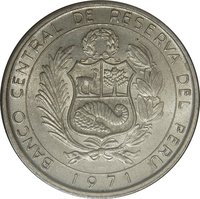
Obverse
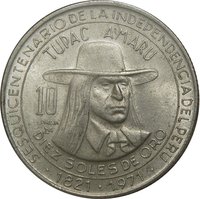
Reverse
Description:
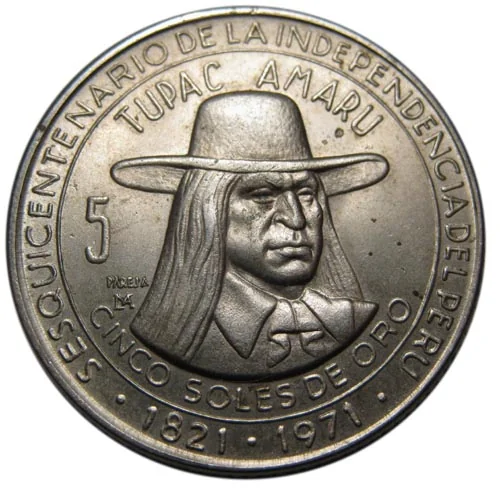
Tupac Amaru, an 18th-century Indigenous leader, led a major rebellion against Spanish rule in Peru.
Inscription:
SESQUICENTENARIO DE LA INDEPENDENCIA DEL PERU
TUPAC AMARU
5 PAREJA LIMA
CINCO SOLES DE ORO
1821 - 1971
TUPAC AMARU
5 PAREJA LIMA
CINCO SOLES DE ORO
1821 - 1971
Translation:
SESQUICENTENNIAL OF THE INDEPENDENCE OF PERU
TUPAC AMARU
5 PAIR LIMA
FIVE GOLD SOLES
1821 - 1971
TUPAC AMARU
5 PAIR LIMA
FIVE GOLD SOLES
1821 - 1971
Script: Latin
Language: Spanish
Edge
Reeded
Categories
| Symbols> Coat of Arms |
| Symbol> Wreath |
| Animal> Camel |
| Person> Politician |
| Symbol> Cornucopia |
Mints
| Name | Mark |
|---|---|
| Lima | LIMA |
Mintings
| Year | Mint Mark | Mintage | Quality | Collection |
|---|---|---|---|---|
| 1971 | LIMA | 3,480,000 |
Historical background
In 1971, Peru's currency situation was characterized by a period of relative stability and controlled management under the left-leaning military government of General Juan Velasco Alvarado, who had seized power in 1968. The official currency, the sol, was maintained under a fixed exchange rate regime, pegged to the U.S. dollar at a rate of S/. 38.70 per dollar. This peg, established in 1960, provided a nominal anchor for the economy, but it was an overvalued currency, maintained through capital controls and strict regulation by the Central Reserve Bank of Peru. This overvaluation aimed to control inflation and reduce the cost of imported goods and machinery for the regime's ambitious state-led industrialization and agrarian reform programs.
However, this official stability masked underlying economic pressures. The overvalued sol discouraged Peruvian exports (like minerals, fishmeal, and cotton) by making them more expensive on the world market, while making imports artificially cheap. This contributed to a growing trade imbalance and persistent pressure on foreign exchange reserves. The government's expansive fiscal policies, funding large public sector projects and subsidies, were increasingly financed by money creation, planting the seeds for future inflationary problems. Furthermore, a parallel black market for dollars thrived, where the sol traded at a significant discount, reflecting the true market pressure against the official overvaluation.
Consequently, 1971 represents a calm before the storm in Peru's monetary history. The Velasco regime prioritized control and its development model over market-driven adjustment, using reserves and regulations to defend the peg in the short term. This approach deferred necessary economic corrections, accumulating distortions that would later contribute to severe balance of payments crises, devaluations, and the onset of high inflation in the latter half of the 1970s, ultimately leading to the replacement of the sol with the inti in 1985.
However, this official stability masked underlying economic pressures. The overvalued sol discouraged Peruvian exports (like minerals, fishmeal, and cotton) by making them more expensive on the world market, while making imports artificially cheap. This contributed to a growing trade imbalance and persistent pressure on foreign exchange reserves. The government's expansive fiscal policies, funding large public sector projects and subsidies, were increasingly financed by money creation, planting the seeds for future inflationary problems. Furthermore, a parallel black market for dollars thrived, where the sol traded at a significant discount, reflecting the true market pressure against the official overvaluation.
Consequently, 1971 represents a calm before the storm in Peru's monetary history. The Velasco regime prioritized control and its development model over market-driven adjustment, using reserves and regulations to defend the peg in the short term. This approach deferred necessary economic corrections, accumulating distortions that would later contribute to severe balance of payments crises, devaluations, and the onset of high inflation in the latter half of the 1970s, ultimately leading to the replacement of the sol with the inti in 1985.
🌱 Common