

50 Pence – Ireland
Ireland
Context
Years: 1970–2000
Issuer: Ireland 
Period:
(since 1937)
Currency:
(1971—2001)
Demonetization: 9 February 2002
Total mintage: 99,385,500
Material
Diameter: 30 mm
Weight: 13.5 g
Thickness: 2.4 mm
Shape: Equilateral curve heptagon
Technique: Milled
Alignment: Medal alignment
flip
References
KM: #Click to copy to clipboard24
Numista: #1128
Value
Exchange value: 0.50 IEP
Inflation-adjusted value: 8.81 IEP
Obverse
Description:
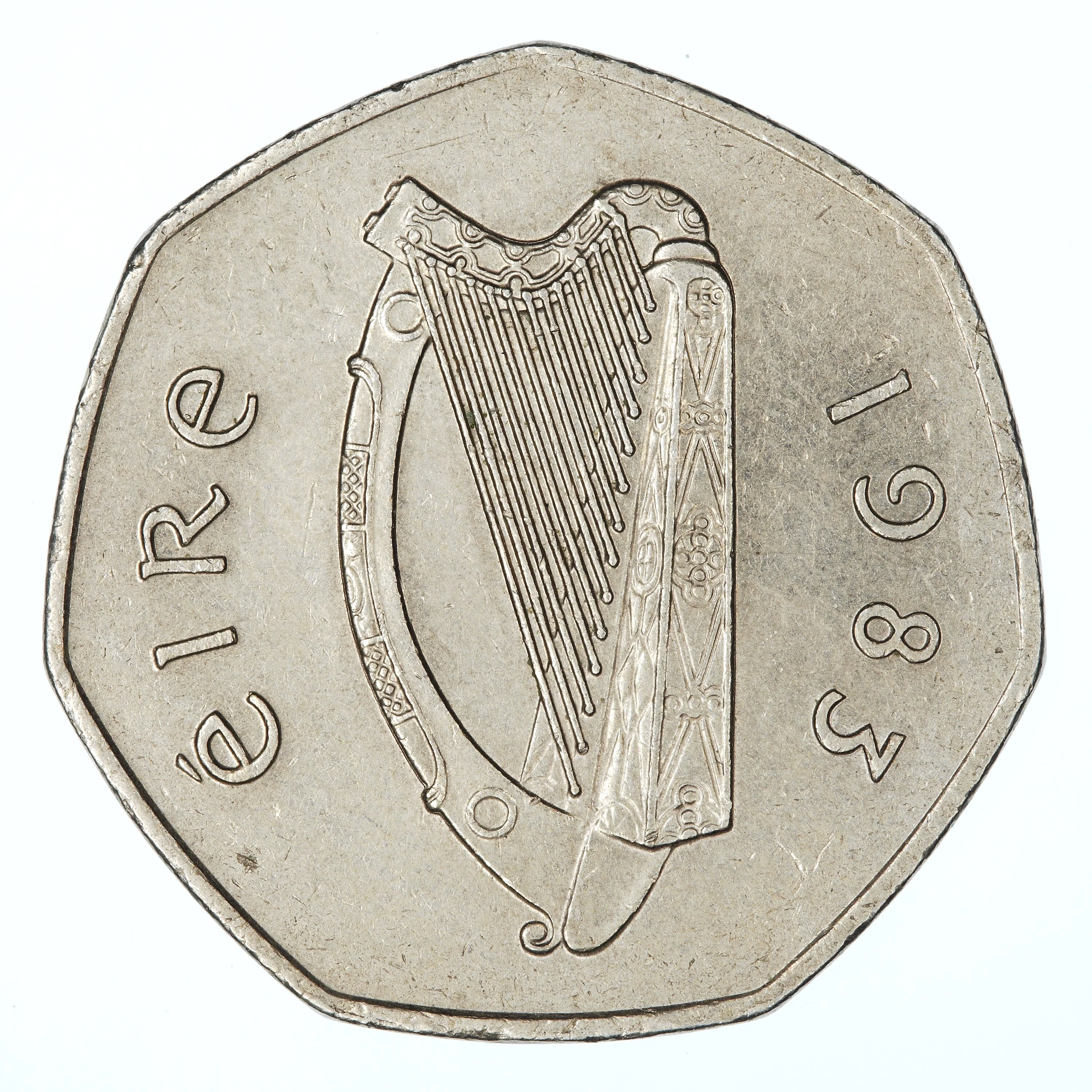
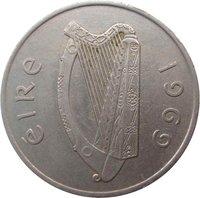
Irish harp, country name left, date right.
Inscription:
éIRe 1977
Translation:
Ireland 1977
Script: Latin (Gaelic)
Reverse
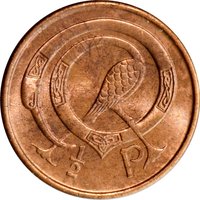
Description:
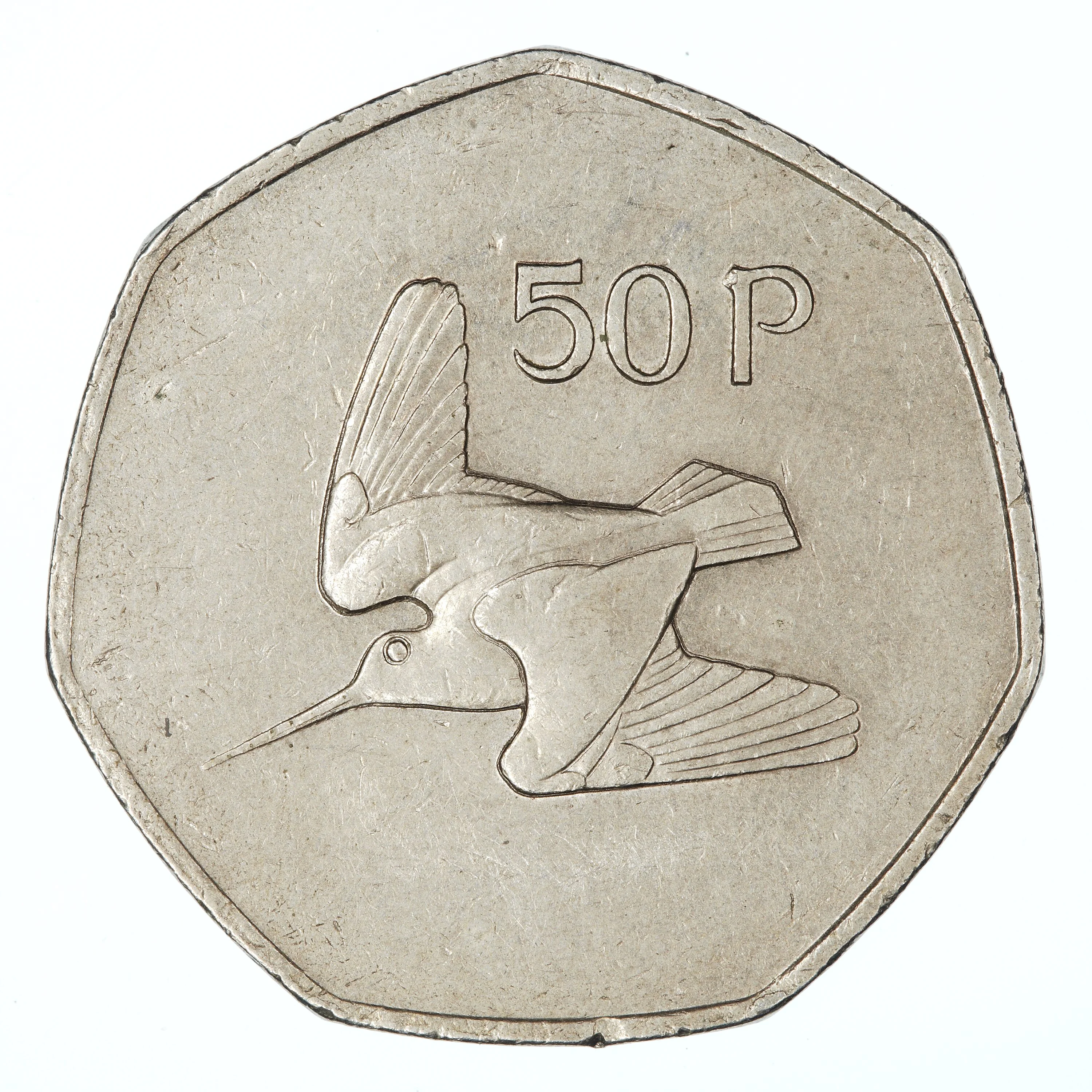
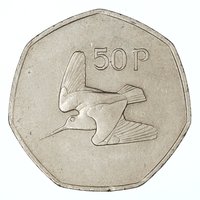
Wood bird left, value top.
Inscription:
50P
Translation:
Fifty Pence
Script: Latin (Gaelic)
Language: English
Engraver: Percy Metcalfe
Edge
Plain
Mints
| Name | Mark |
|---|---|
| Irish Mint | — |
| Royal Mint | — |
Mintings
| Year | Mint Mark | Mintage | Quality | Collection |
|---|---|---|---|---|
| 1970 | — | 9,000,000 | ||
| 1971 | — | 600,000 | ||
| 1971 | — | 50,000 | Proof | |
| 1974 | — | 1,000,000 | ||
| 1975 | — | 2,000,000 | ||
| 1976 | — | 3,000,000 | ||
| 1977 | — | 4,800,000 | ||
| 1978 | — | 4,500,000 | ||
| 1979 | — | 4,000,000 | ||
| 1981 | — | 6,000,000 | ||
| 1982 | — | 2,000,000 | ||
| 1983 | — | 7,000,000 | ||
| 1986 | — | 3,250 | ||
| 1986 | — | 6,750 | Proof | |
| 1988 | — | 7,000,500 | ||
| 1996 | — | 6,000,000 | ||
| 1997 | — | 6,000,000 | ||
| 1998 | — | 13,825,000 | ||
| 1999 | — | 7,000,000 | ||
| 2000 | — | 15,600,000 |
Historical background
In 1970, Ireland’s currency situation was defined by its membership in the Irish Pound (or Punt) area, which remained pegged to the British Pound Sterling. This was a legacy of Ireland's historical economic integration with the United Kingdom, and the Irish Pound maintained a one-to-one parity with Sterling. While Ireland had been politically independent since 1922 and issued its own banknotes, the currency was not fully independent in practice; its value was guaranteed by the British government and it operated effectively as a satellite of the Sterling system. This arrangement provided stability for trade, as the UK was overwhelmingly Ireland's largest trading partner.
However, this stability came at a cost of monetary sovereignty. Ireland’s central bank had limited scope to set independent interest rates or manage the currency to address domestic economic needs, as its monetary policy was essentially determined by the Bank of England. The late 1960s had seen growing pressure on the Sterling area globally, culminating in the devaluation of Sterling in 1967. Ireland was forced to follow suit, devaluing the Irish Pound in lockstep, which highlighted the vulnerability of this tied system. This event spurred serious debate within Irish political and economic circles about the need for greater monetary independence.
Consequently, by 1970, Ireland was at a crossroads. The government, under Taoiseach Jack Lynch, was actively preparing for a significant change. The Central Bank Act of 1971 was already in development, and it would come into force the following year, formally breaking the historic link to Sterling. The year 1970 thus represented the final phase of the old Sterling parity system, with policymakers laying the groundwork to redefine the Irish Pound as a separate, independently managed currency, albeit still within a broader framework of fixed exchange rates under the Bretton Woods system. This move was a crucial step toward the full economic sovereignty that would later facilitate Ireland's entry into the European Monetary System.
However, this stability came at a cost of monetary sovereignty. Ireland’s central bank had limited scope to set independent interest rates or manage the currency to address domestic economic needs, as its monetary policy was essentially determined by the Bank of England. The late 1960s had seen growing pressure on the Sterling area globally, culminating in the devaluation of Sterling in 1967. Ireland was forced to follow suit, devaluing the Irish Pound in lockstep, which highlighted the vulnerability of this tied system. This event spurred serious debate within Irish political and economic circles about the need for greater monetary independence.
Consequently, by 1970, Ireland was at a crossroads. The government, under Taoiseach Jack Lynch, was actively preparing for a significant change. The Central Bank Act of 1971 was already in development, and it would come into force the following year, formally breaking the historic link to Sterling. The year 1970 thus represented the final phase of the old Sterling parity system, with policymakers laying the groundwork to redefine the Irish Pound as a separate, independently managed currency, albeit still within a broader framework of fixed exchange rates under the Bretton Woods system. This move was a crucial step toward the full economic sovereignty that would later facilitate Ireland's entry into the European Monetary System.
🌱 Very Common