

5 centimos – Costa Rica
Add to wishlist
Costa Rica
Context
Year: 1979
Issuer: Costa Rica
Issuing organization: Central Bank of Costa Rica
Period:
(since 1948)
Currency:
(since 1896)
Demonetized: Yes
Total mintage: 3,060,000
Material
References
KM: #
Numista: #7404
Value
Exchange value: 0.05 CRC
Obverse
Description:
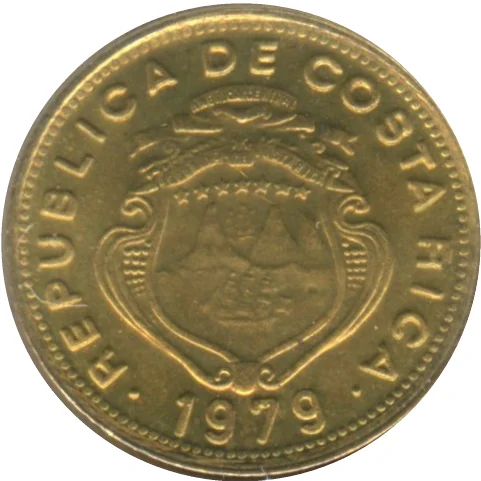
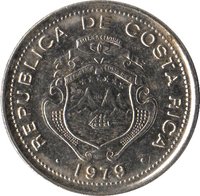
Costa Rica's coat of arms features seven stars for its provinces, three volcanoes for its mountain ranges, two ships for its position between oceans, and a sunrise.
Inscription:
REPUBLICA DE COSTA RICA
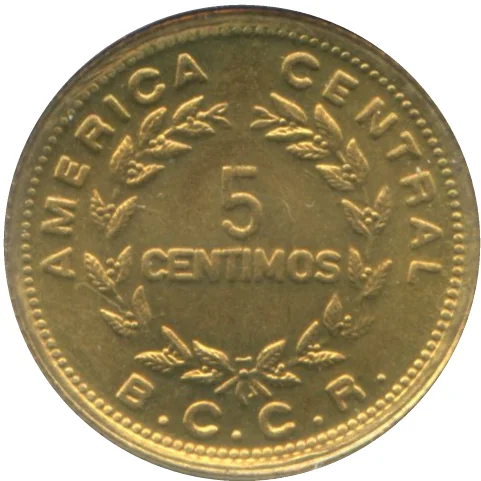
AMERICA CENTRAL
REPUBLICA DE COSTA RICA
1979
AMERICA CENTRAL
REPUBLICA DE COSTA RICA
1979
Translation:
REPUBLIC OF COSTA RICA
CENTRAL AMERICA
REPUBLIC OF COSTA RICA
1979
CENTRAL AMERICA
REPUBLIC OF COSTA RICA
1979
Script: Latin
Language: Spanish
Reverse
Edge
Reeded
Categories
| Symbols> Coat of Arms |
| Symbol> Wreath |
Mints
| Name | Mark |
|---|---|
| Casa de Moneda de Guatemala | — |
Mintings
| Year | Mint Mark | Mintage | Quality | Collection |
|---|---|---|---|---|
| 1979 | — | 3,060,000 |
Historical background
In 1979, Costa Rica's currency situation was characterized by significant instability and mounting pressure on the colón, driven by a combination of internal economic mismanagement and external shocks. The country was grappling with the consequences of expansive public spending, a large and inefficient state sector, and high global oil prices following the 1979 oil crisis. This led to substantial fiscal deficits, which were increasingly financed by money creation from the Central Bank, fueling inflation and eroding the currency's value. While the government maintained an official fixed exchange rate, a thriving parallel black market for U.S. dollars emerged, with a widening gap that signaled a loss of confidence in the colón.
The regional political turmoil of the period, particularly the Sandinista Revolution in neighboring Nicaragua, also had a direct economic impact. It disrupted Central American trade, spurred capital flight as investors sought safer havens, and increased military spending pressures in Costa Rica, which further strained public finances. By the end of 1979, foreign exchange reserves were dwindling rapidly, and the country was entering a severe balance of payments crisis. The overvalued official exchange rate made exports less competitive and encouraged imports, worsening the trade deficit.
This precarious currency and economic environment set the stage for the profound crisis that would fully erupt in the early 1980s. The unsustainable policies of 1979 forced Costa Rica to confront its economic realities, leading to a major devaluation of the colón in 1980-1981 and eventually necessitating an International Monetary Fund (IMF) stabilization program. Thus, 1979 represents the pivotal year of building pressures that culminated in Costa Rica's worst economic recession of the post-World War II era.
The regional political turmoil of the period, particularly the Sandinista Revolution in neighboring Nicaragua, also had a direct economic impact. It disrupted Central American trade, spurred capital flight as investors sought safer havens, and increased military spending pressures in Costa Rica, which further strained public finances. By the end of 1979, foreign exchange reserves were dwindling rapidly, and the country was entering a severe balance of payments crisis. The overvalued official exchange rate made exports less competitive and encouraged imports, worsening the trade deficit.
This precarious currency and economic environment set the stage for the profound crisis that would fully erupt in the early 1980s. The unsustainable policies of 1979 forced Costa Rica to confront its economic realities, leading to a major devaluation of the colón in 1980-1981 and eventually necessitating an International Monetary Fund (IMF) stabilization program. Thus, 1979 represents the pivotal year of building pressures that culminated in Costa Rica's worst economic recession of the post-World War II era.
🌱 Common