

2 kronor (Gustaf Vasa's Liberation War) – Sweden
Add to wishlist
Circulating commemorative coins
Commemoration: 400th Anniversary of Gustaf Vasa's Liberation War
Sweden
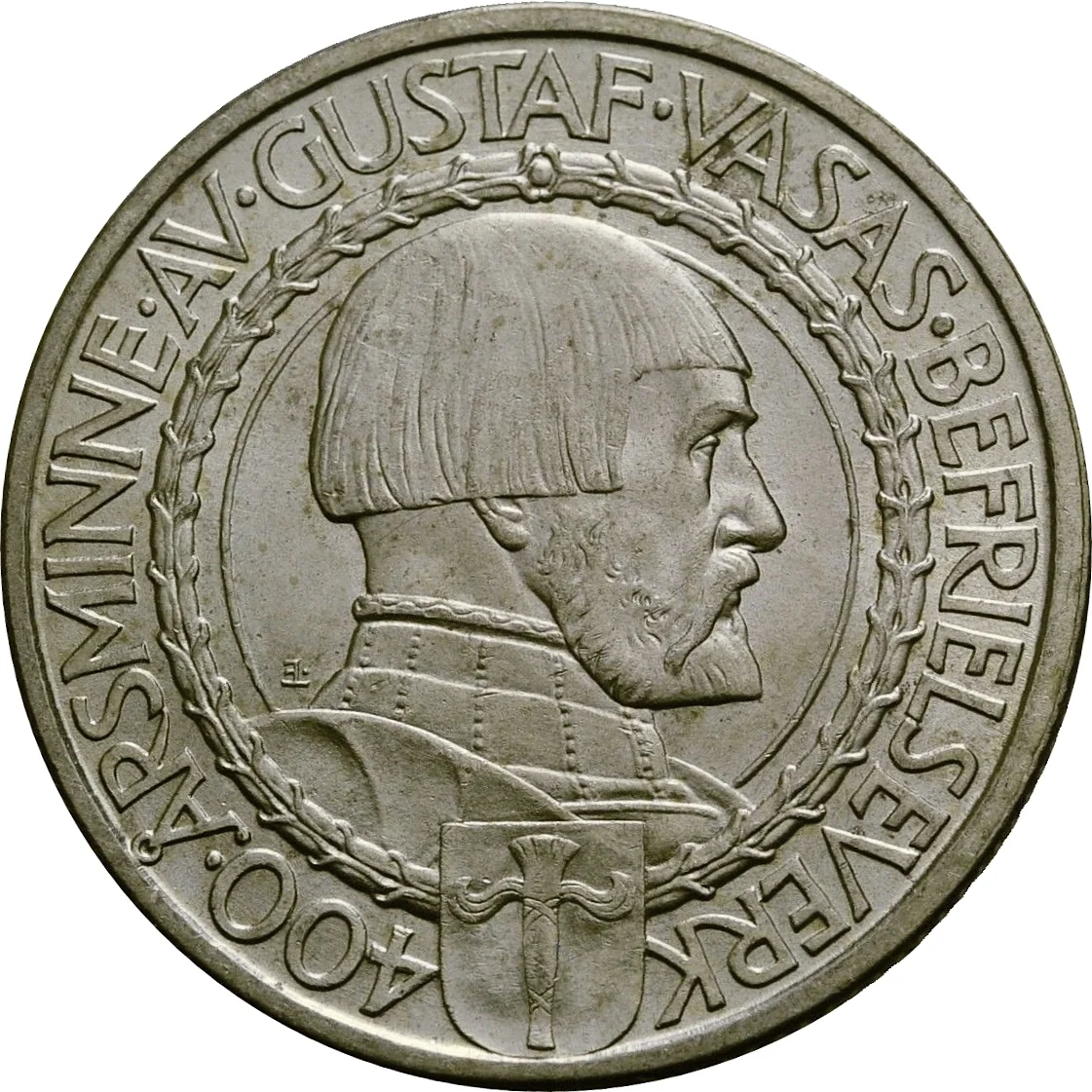
Obverse
Description:
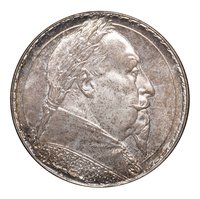
Portrait of King Gustaf Vasa facing right within a laurel circle, with his coat of arms below.
Inscription:
400·ÅRSMINNE·AV·GUSTAF·VASAS·BEFRIELSEVERK
EL.
EL.
Translation:
400th Anniversary of Gustav Vasa's Liberation Work
Script: Latin
Language: Swedish
Engraver: Erik Lindberg
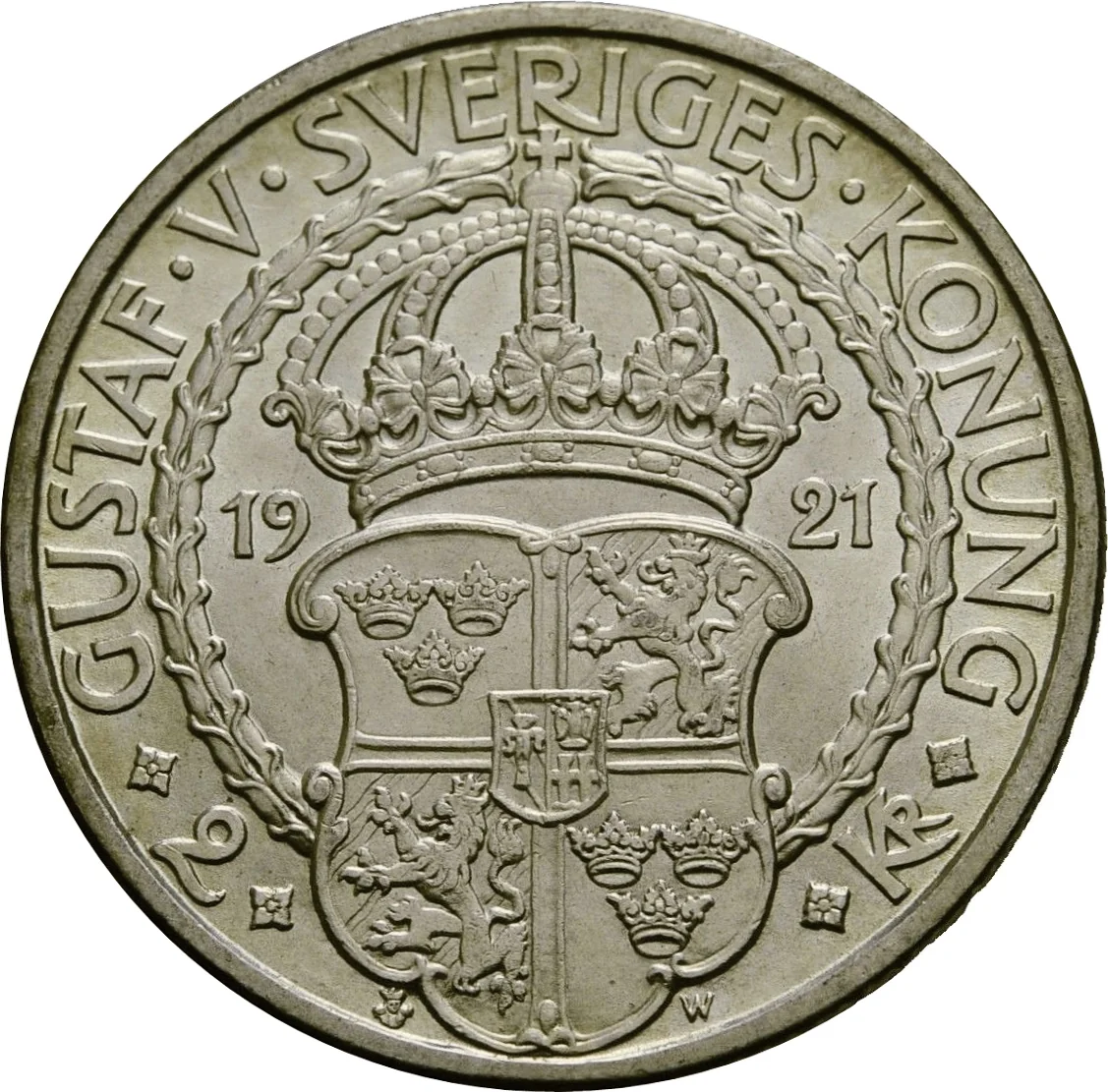
Reverse
Description:
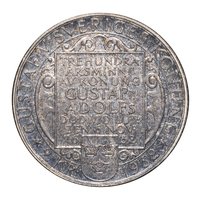
Crowned Swedish arms in laurel wreath divides date. Value below, flanked by Stockholm mintmark and Governor’s initial.
Inscription:
GUSTAF·V·SVERIGES·KONUNG
19 21
2 Kr
W
19 21
2 Kr
W
Translation:
Gustaf V Sweden's King
1921
2 Crowns
1921
2 Crowns
Script: Latin
Language: Swedish
Engraver: Erik Lindberg
Edge
Reeded
Mints
| Name | Mark |
|---|---|
| Kungliga Myntet | — |
Mintings
| Year | Mint Mark | Mintage | Quality | Collection |
|---|---|---|---|---|
| 1921 | — | 265,943 |
Historical background
In 1921, Sweden was grappling with the complex economic aftermath of the First World War. Although officially neutral, the war had profoundly disrupted its economy through trade blockades, inflation, and high government spending. Like many nations, Sweden had suspended the gold standard in 1914, leading to a period of significant currency depreciation and price instability. By the early 1920s, the primary economic challenge was managing the transition from a wartime "paper currency" regime back to stable, pre-war monetary norms, with intense debate over whether and how to return to the gold standard at the pre-war parity.
The year itself was a pivotal point of decision. A government commission, the 1920 års penningvärdeskommitté, had delivered its report, advocating for a return to the gold standard but cautioning against an immediate restoration of the pre-war krona's value, as this would require severe deflation. The Riksbank, however, under Governor Victor Moll, was determined to pursue a rapid deflationary policy to restore the krona's pre-war gold parity. This policy involved maintaining high interest rates to increase the currency's value, a painful process that suppressed economic growth and increased unemployment, causing considerable social and political tension.
Consequently, the currency situation in 1921 was characterized by a deliberate but harsh deflationary squeeze. The krona's exchange rate was rising due to tight monetary policy, but domestic prices and wages were slow to adjust downward, leading to a recession. This period set the stage for Sweden's eventual successful return to the gold standard at the old parity in 1922, an achievement that came at a significant short-term cost to the Swedish economy and workforce, and which would later influence the country's approach to the economic crises of the 1930s.
The year itself was a pivotal point of decision. A government commission, the 1920 års penningvärdeskommitté, had delivered its report, advocating for a return to the gold standard but cautioning against an immediate restoration of the pre-war krona's value, as this would require severe deflation. The Riksbank, however, under Governor Victor Moll, was determined to pursue a rapid deflationary policy to restore the krona's pre-war gold parity. This policy involved maintaining high interest rates to increase the currency's value, a painful process that suppressed economic growth and increased unemployment, causing considerable social and political tension.
Consequently, the currency situation in 1921 was characterized by a deliberate but harsh deflationary squeeze. The krona's exchange rate was rising due to tight monetary policy, but domestic prices and wages were slow to adjust downward, leading to a recession. This period set the stage for Sweden's eventual successful return to the gold standard at the old parity in 1922, an achievement that came at a significant short-term cost to the Swedish economy and workforce, and which would later influence the country's approach to the economic crises of the 1930s.
🌱 Common