

10 rupiah – Indonesia
Add to wishlist
Circulating commemorative coins
Commemoration: FAO - National Saving Program
Indonesia
Context
Material
References
KM: #
Numista: #7389
Value
Exchange value: 10 IDR
Inflation-adjusted value: 1031.86 IDR
Obverse
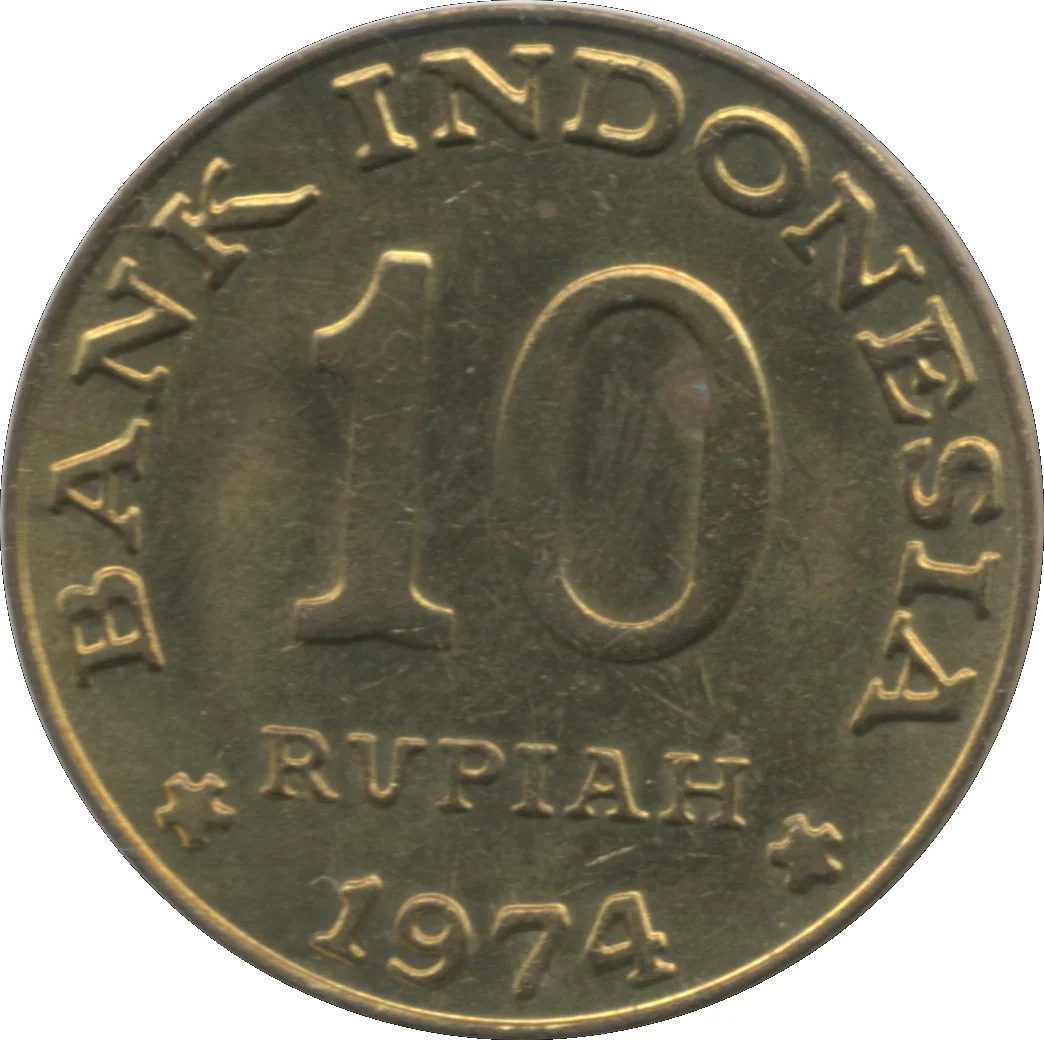
Description:
Stars beside date under value.
Inscription:
BANK INDONESIA
10
RUPIAH
1974
10
RUPIAH
1974
Translation:
BANK INDONESIA
10
RUPIAH
1974
10
RUPIAH
1974
Script: Latin
Languages: Indonesian, English
Reverse
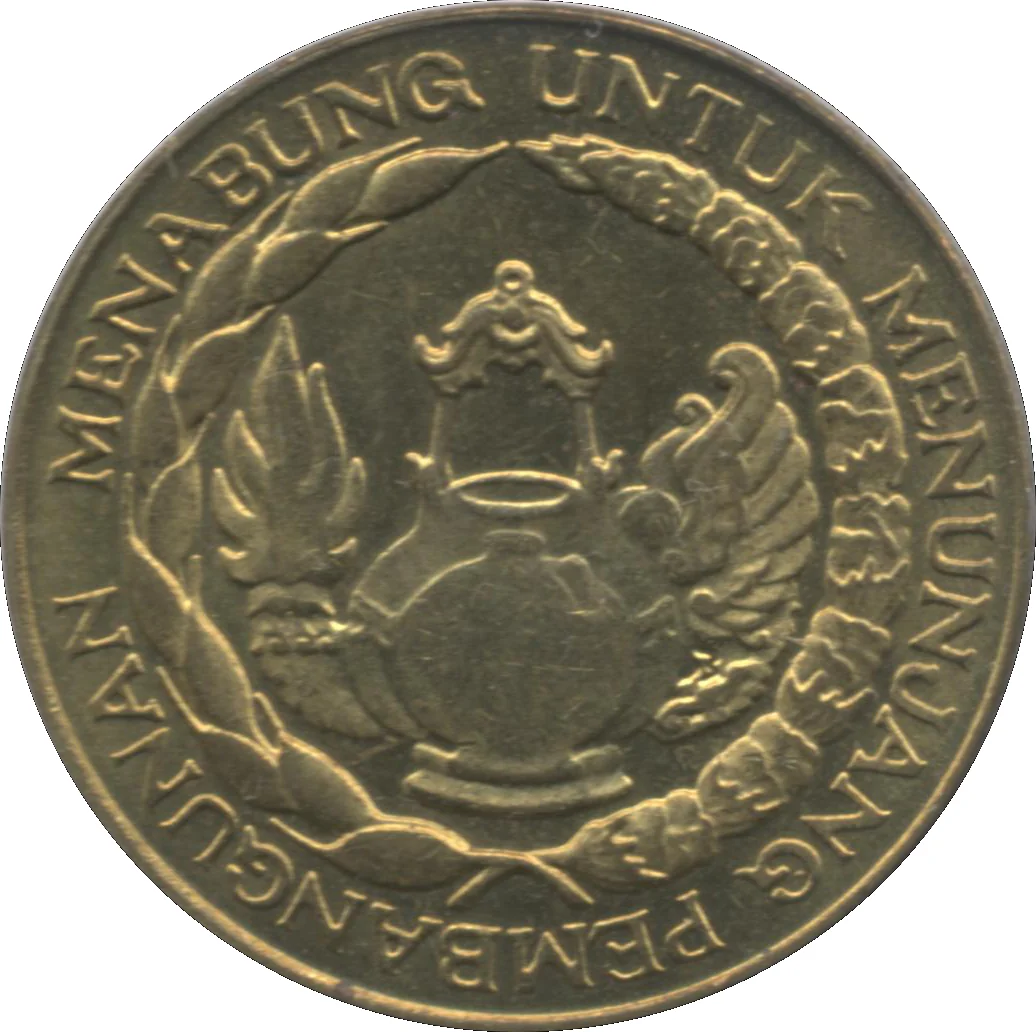
Description:
Legends of a winged purse.
Inscription:
MENABUNG UNTUK MENUNJANG PEMBANGUNAN
Translation:
Saving to Support Development
Script: Latin
Language: Indonesian
Edge
Plain
Categories
| Organization> FAO |
Mints
| Name | Mark |
|---|---|
| Perum Peruri | — |
Mintings
| Year | Mint Mark | Mintage | Quality | Collection |
|---|---|---|---|---|
| 1974 | — | 222,910,000 |
Historical background
In 1974, Indonesia was navigating a complex economic landscape under President Suharto's New Order regime. The country was experiencing the mixed effects of an oil boom, which provided significant revenue but also fueled inflation and exposed structural weaknesses. The rupiah, officially fixed to the US dollar, was under growing pressure as the economic windfall led to increased government spending, imports, and monetary expansion, creating a classic "Dutch disease" scenario where other export sectors became less competitive.
This period culminated in the Malari incident (Malapetaka Januari or January Disaster) of January 1974, which began as student protests against corruption and the overwhelming presence of foreign (particularly Japanese) investment during Prime Minister Tanaka's visit. The protests escalated into riots, revealing deep public discontent with economic inequality and the perceived negative impacts of rapid modernization. While not a direct currency crisis, Malari was a profound socio-political shock rooted in economic grievances, forcing the government to reassess its development policies.
In response, the government introduced a package of stabilization measures in 1974. This included a modest devaluation of the rupiah by 7% in November, aimed at improving the trade balance by making non-oil exports cheaper and imports more expensive. More broadly, the regime attempted to cool the overheated economy, tighten credit, and launched initiatives to strengthen pribumi (indigenous Indonesian) businesses. Thus, 1974 was a pivotal year where currency adjustment was one tool used to address the inflationary pressures and social tensions unleashed by the oil boom.
This period culminated in the Malari incident (Malapetaka Januari or January Disaster) of January 1974, which began as student protests against corruption and the overwhelming presence of foreign (particularly Japanese) investment during Prime Minister Tanaka's visit. The protests escalated into riots, revealing deep public discontent with economic inequality and the perceived negative impacts of rapid modernization. While not a direct currency crisis, Malari was a profound socio-political shock rooted in economic grievances, forcing the government to reassess its development policies.
In response, the government introduced a package of stabilization measures in 1974. This included a modest devaluation of the rupiah by 7% in November, aimed at improving the trade balance by making non-oil exports cheaper and imports more expensive. More broadly, the regime attempted to cool the overheated economy, tighten credit, and launched initiatives to strengthen pribumi (indigenous Indonesian) businesses. Thus, 1974 was a pivotal year where currency adjustment was one tool used to address the inflationary pressures and social tensions unleashed by the oil boom.
🌱 Very Common