

100 rupiah – Indonesia
Add to wishlist
Circulating commemorative coins
Commemoration: Forestry for prosperity
Indonesia
Context
Years: 1978–1990
Year:: 1978
Issuer: Indonesia
Issuing organization: Bank Indonesia
Period:
(since 1950)
Currency:
(since 1965)
Demonetization: 26 June 2002
Total mintage: 907,773,000
Material
Diameter: 28.5 mm
Weight: 7 g
Thickness: 1.4 mm
Shape: Round
Composition: Copper-nickel
Technique: Milled
Alignment: Medal alignment
flip

References
KM: #
Numista: #3294
Value
Exchange value: 100 IDR
Inflation-adjusted value: 4631.53 IDR
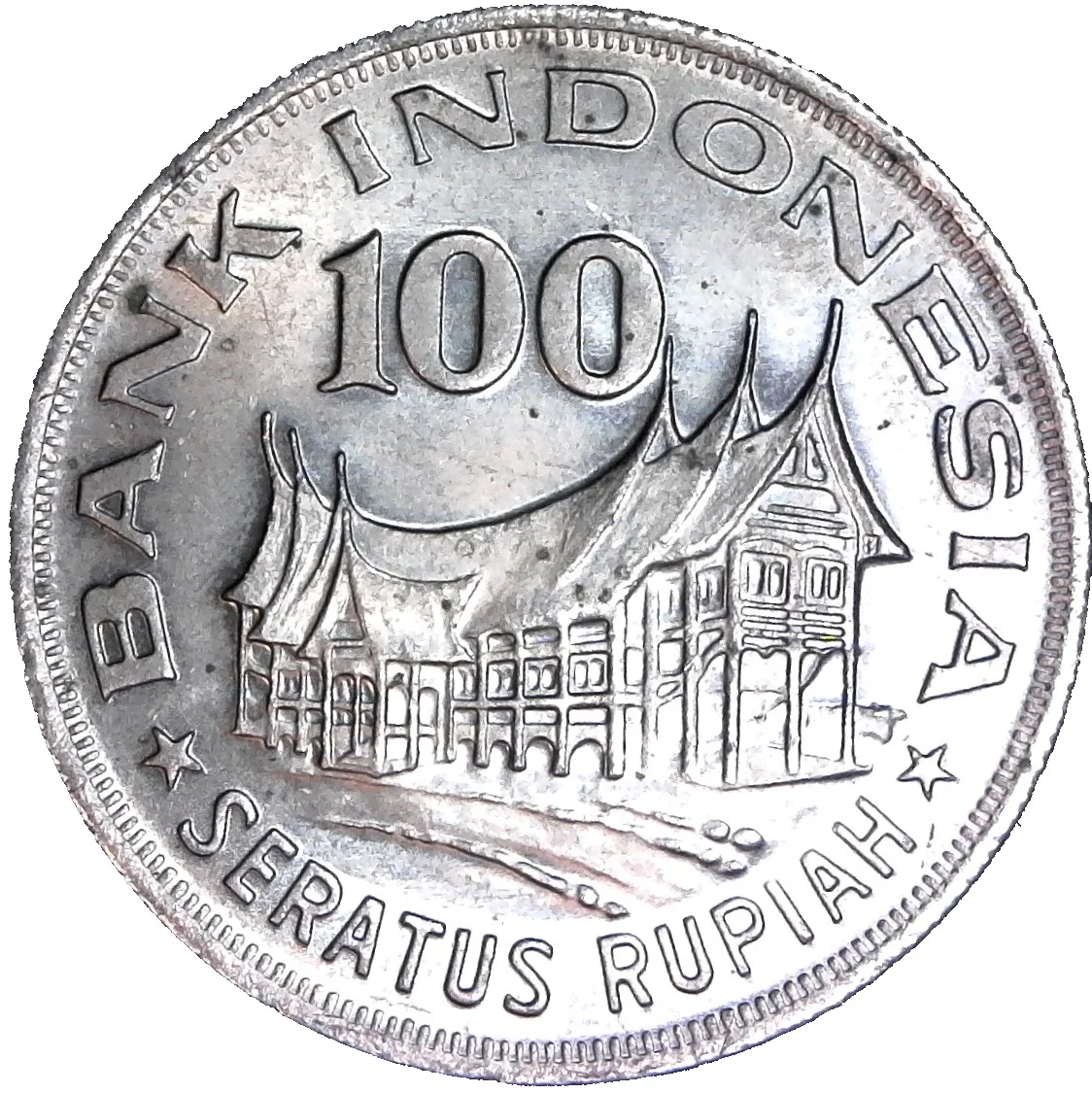
Obverse
Description:
Minangkabau traditional house in West Sumatra (Rumah Gadang).
Inscription:
BANK INDONESIA
SERATUS RUPIAH
100
SERATUS RUPIAH
100
Translation:
Bank Indonesia
One Hundred Rupiah
100
One Hundred Rupiah
100
Script: Latin
Language: Indonesian
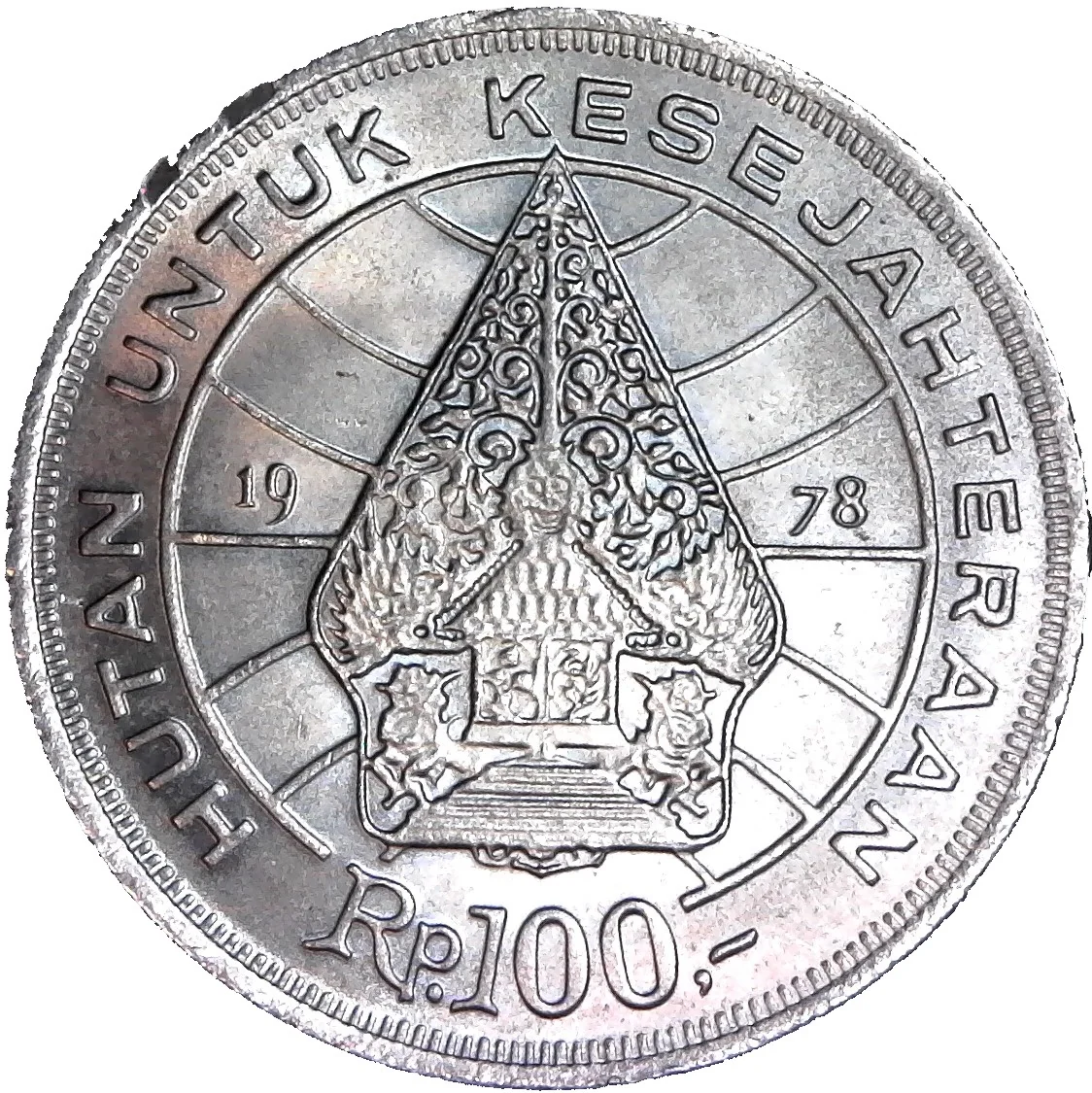
Reverse
Description:
Batang Garing: the legendary Tree of Life.
Inscription:
HUTAN UNTUK KESEJAHTERAAN
RP. 100
RP. 100
Translation:
Forest for Welfare
Rp. 100
Rp. 100
Script: Latin
Language: Indonesian
Edge
Reeded
Categories
| Organization> FAO |
Mints
| Name | Mark |
|---|---|
| Perum Peruri | — |
Mintings
| Year | Mint Mark | Mintage | Quality | Collection |
|---|---|---|---|---|
| 1978 | — | — | ||
| 1978 | 1978-1990 | 907,773,000 |
Historical background
In 1978, Indonesia faced a critical juncture in its economic management, culminating in the dramatic devaluation of the rupiah on November 15. This policy, known as Sanering and enacted by President Suharto's New Order government, slashed the currency's value by 33.6% against the US dollar. The primary trigger was a sharp decline in global oil prices, which severely threatened Indonesia's main source of export revenue and government income. This external shock exposed underlying vulnerabilities, including a growing current account deficit and rising inflation, which a fixed exchange rate regime could no longer sustain.
The devaluation was a strategic, albeit painful, corrective measure championed by the economic technocrats known as the "Berkeley Mafia." Their aim was to restore international competitiveness by making non-oil exports like timber, rubber, and textiles cheaper abroad, while discouraging costly imports. This shift was essential to diversify the economy away from its over-reliance on oil and gas. The move was also a precondition for securing continued financial support from the International Monetary Fund (IMF) and other international creditors, who advocated for market-oriented adjustments.
The 1978 devaluation marked a definitive turn in Indonesia's macroeconomic policy, moving from a rigidly fixed exchange rate to a managed float system with periodic adjustments. While it initially spurred inflation and public anxiety, the policy ultimately succeeded in boosting non-oil exports and setting a precedent for future economic reforms. It is remembered as a watershed moment that underscored the country's vulnerability to commodity price swings and demonstrated the government's willingness to implement decisive, technocrat-led measures to maintain economic stability and growth.
The devaluation was a strategic, albeit painful, corrective measure championed by the economic technocrats known as the "Berkeley Mafia." Their aim was to restore international competitiveness by making non-oil exports like timber, rubber, and textiles cheaper abroad, while discouraging costly imports. This shift was essential to diversify the economy away from its over-reliance on oil and gas. The move was also a precondition for securing continued financial support from the International Monetary Fund (IMF) and other international creditors, who advocated for market-oriented adjustments.
The 1978 devaluation marked a definitive turn in Indonesia's macroeconomic policy, moving from a rigidly fixed exchange rate to a managed float system with periodic adjustments. While it initially spurred inflation and public anxiety, the policy ultimately succeeded in boosting non-oil exports and setting a precedent for future economic reforms. It is remembered as a watershed moment that underscored the country's vulnerability to commodity price swings and demonstrated the government's willingness to implement decisive, technocrat-led measures to maintain economic stability and growth.


🌱 Very Common