

20 schilling (Anton Bruckner) – Austria
Add to wishlist
Circulating commemorative coins
Commemoration: 100th anniversary of the death of Anton Bruckner
Austria
Obverse
Description:
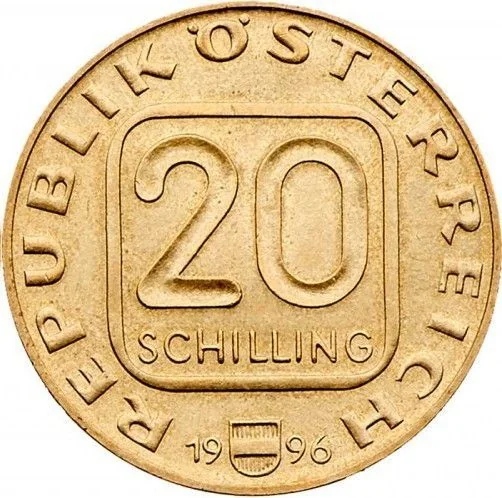
Austrian shield above date in rounded square frame.
Inscription:
REPUBLIK ÖSTERREICH
20 SCHILLING
19 96
20 SCHILLING
19 96
Translation:
REPUBLIC OF AUSTRIA
20 SCHILLING
19 96
20 SCHILLING
19 96
Script: Latin
Language: German
Engraver: Kurt Bodlak
Reverse
Description:
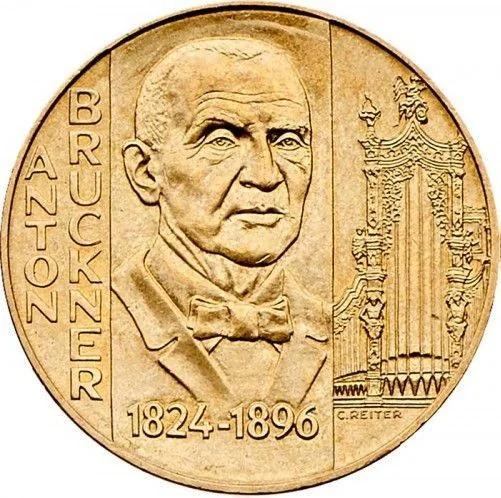
Portrait of Anton Bruckner, flanked by his name and his organ, with his lifetime dates below.
Inscription:
ANTON BRUCKNER
1824-1896
C. REITER
1824-1896
C. REITER
Script: Latin
Engraver: Christa Reiter
Edge
Plain
Categories
| Art> Music |
| Event> Death anniversary |
Mints
| Name | Mark |
|---|---|
| Münze Österreich | — |
Mintings
| Year | Mint Mark | Mintage | Quality | Collection |
|---|---|---|---|---|
| 1996 | — | 1,535,000 | ||
| 1996 | — | 25,000 | Proof |
Historical background
In 1996, Austria's currency situation was defined by its firm integration into the European Monetary System (EMS) and its strategic path toward adopting the future single European currency. The Austrian schilling (ATS) was a stable and strong currency, operating under a hard currency policy (Hartwährungspolitik) that had pegged it closely to the Deutsche Mark (DM) since the early 1970s. This deliberate policy, managed by the Austrian National Bank (OeNB), prioritized low inflation and exchange rate stability, effectively importing the credibility of the German Bundesbank and fostering a period of remarkable economic stability.
The year was pivotal within the broader context of European integration. Austria had joined the European Union in 1995, and in 1996 it was actively working to meet the strict convergence criteria (the Maastricht criteria) for Economic and Monetary Union (EMU). This involved maintaining price stability, sound public finances, stable exchange rates within the EMS, and converging interest rates. The schilling's existing stability made this transition smoother than for many other EU nations, as it was already operating within the required exchange rate mechanism (ERM II) bands de facto through its DM peg.
Consequently, the domestic economic debate in 1996 was less about currency volatility and more focused on the practical and political preparations for the inevitable replacement of the schilling. Public discussion centered on the timeline for introducing the euro, the conversion process, and ensuring a seamless changeover for businesses and citizens. The year was thus one of confident anticipation, with the stable schilling serving as a bridge to Austria's planned entry into the Eurozone, which would ultimately occur on January 1, 1999, for financial markets, with euro banknotes and coins following in 2002.
The year was pivotal within the broader context of European integration. Austria had joined the European Union in 1995, and in 1996 it was actively working to meet the strict convergence criteria (the Maastricht criteria) for Economic and Monetary Union (EMU). This involved maintaining price stability, sound public finances, stable exchange rates within the EMS, and converging interest rates. The schilling's existing stability made this transition smoother than for many other EU nations, as it was already operating within the required exchange rate mechanism (ERM II) bands de facto through its DM peg.
Consequently, the domestic economic debate in 1996 was less about currency volatility and more focused on the practical and political preparations for the inevitable replacement of the schilling. Public discussion centered on the timeline for introducing the euro, the conversion process, and ensuring a seamless changeover for businesses and citizens. The year was thus one of confident anticipation, with the stable schilling serving as a bridge to Austria's planned entry into the Eurozone, which would ultimately occur on January 1, 1999, for financial markets, with euro banknotes and coins following in 2002.
🌱 Fairly Common