

100 Schilling – Austria
Austria

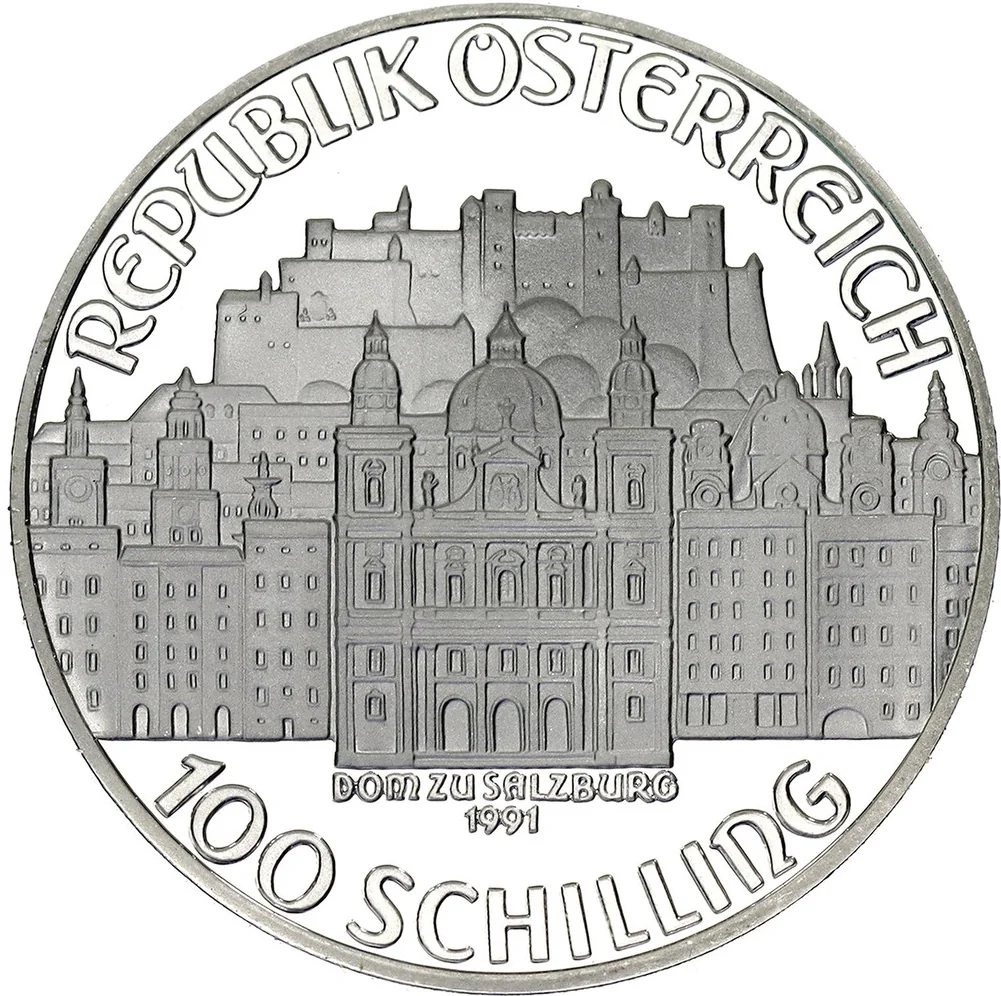
Obverse
Description:
Salzburg's architecture.
Inscription:
REPUBLIK ÖSTERREICH
100 SCHILLING
100 SCHILLING
Translation:
REPUBLIC OF AUSTRIA
100 SCHILLING
100 SCHILLING
Language: German
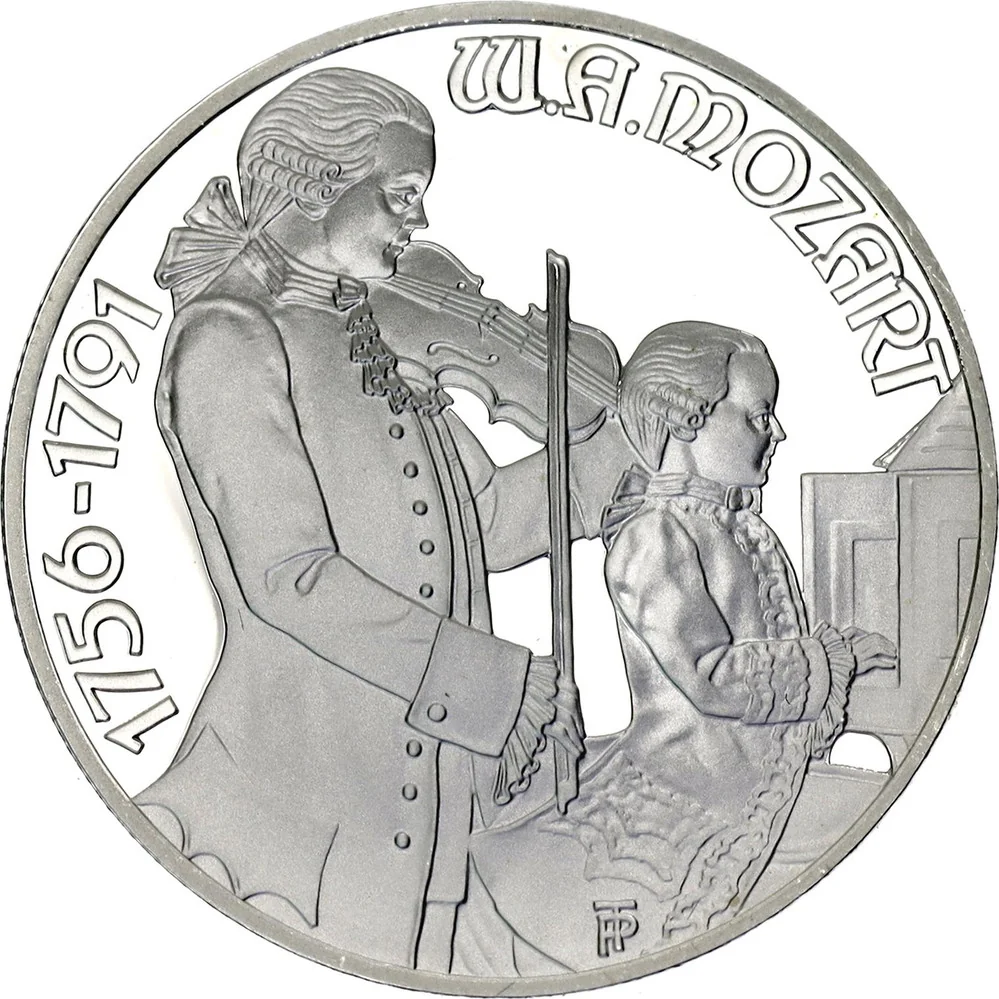
Reverse
Description:
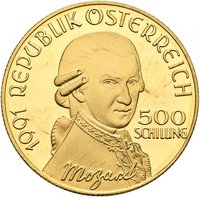
Young Mozart at the harpsichord, his father Léopold on violin.
Inscription:
1756-1791 W. A. MOZART
Engraver: Thomas Pesendorfer
Edge
Reeded
Mints
| Name | Mark |
|---|---|
| Münze Österreich | — |
Mintings
| Year | Mint Mark | Mintage | Quality | Collection |
|---|---|---|---|---|
| 1991 | — | 100,000 | Proof |
Historical background
In 1991, Austria's currency situation was defined by its firm integration into the European monetary system and its longstanding, successful policy of a hard currency (Hartwährungspolitik). This policy, formally initiated in the 1970s, involved pegging the Austrian schilling (ATS) closely to the Deutsche Mark (DM). The primary objectives were to import the anti-inflationary credibility of the German Bundesbank and ensure stability for Austria's export-dependent economy, with Germany being its largest trading partner. By 1991, this asymmetric linkage was well-established, meaning Austrian monetary policy largely followed the lead of Frankfurt, effectively ceding national control over interest rates to maintain the stable exchange rate.
This arrangement proved highly successful for Austria in the early 1990s. While other European currencies faced turbulence following German reunification (1990) and the resulting high German interest rates, the schilling remained a bastion of stability. Inflation was kept low, and the economy experienced steady growth. The currency's strength and predictability bolstered investor confidence and facilitated trade. However, this stability came at a cost: Austria had little room for independent monetary policy to address domestic economic cycles, as interest rates were set primarily to defend the DM peg.
The broader context in 1991 was Austria's active pursuit of European Community (EC) membership, which it would achieve in 1995. The stable schilling and its de facto alignment with the core European currency were strategic assets in these accession negotiations, demonstrating Austria's readiness for deeper economic integration. Furthermore, the Maastricht Treaty, signed in 1992, would soon lay the blueprint for Economic and Monetary Union (EMU). Austria's existing hard currency policy and its convergence with German monetary standards positioned it perfectly to later adopt the euro in 1999 as a founding member, making 1991 a point of calm and confidence within a longer trajectory toward European monetary unification.
This arrangement proved highly successful for Austria in the early 1990s. While other European currencies faced turbulence following German reunification (1990) and the resulting high German interest rates, the schilling remained a bastion of stability. Inflation was kept low, and the economy experienced steady growth. The currency's strength and predictability bolstered investor confidence and facilitated trade. However, this stability came at a cost: Austria had little room for independent monetary policy to address domestic economic cycles, as interest rates were set primarily to defend the DM peg.
The broader context in 1991 was Austria's active pursuit of European Community (EC) membership, which it would achieve in 1995. The stable schilling and its de facto alignment with the core European currency were strategic assets in these accession negotiations, demonstrating Austria's readiness for deeper economic integration. Furthermore, the Maastricht Treaty, signed in 1992, would soon lay the blueprint for Economic and Monetary Union (EMU). Austria's existing hard currency policy and its convergence with German monetary standards positioned it perfectly to later adopt the euro in 1999 as a founding member, making 1991 a point of calm and confidence within a longer trajectory toward European monetary unification.
⭐ Somewhat Rare