

500 Schilling – Austria
Non-circulating coins
Commemoration: Oskar Kokoschka
Austria

Obverse
Description:
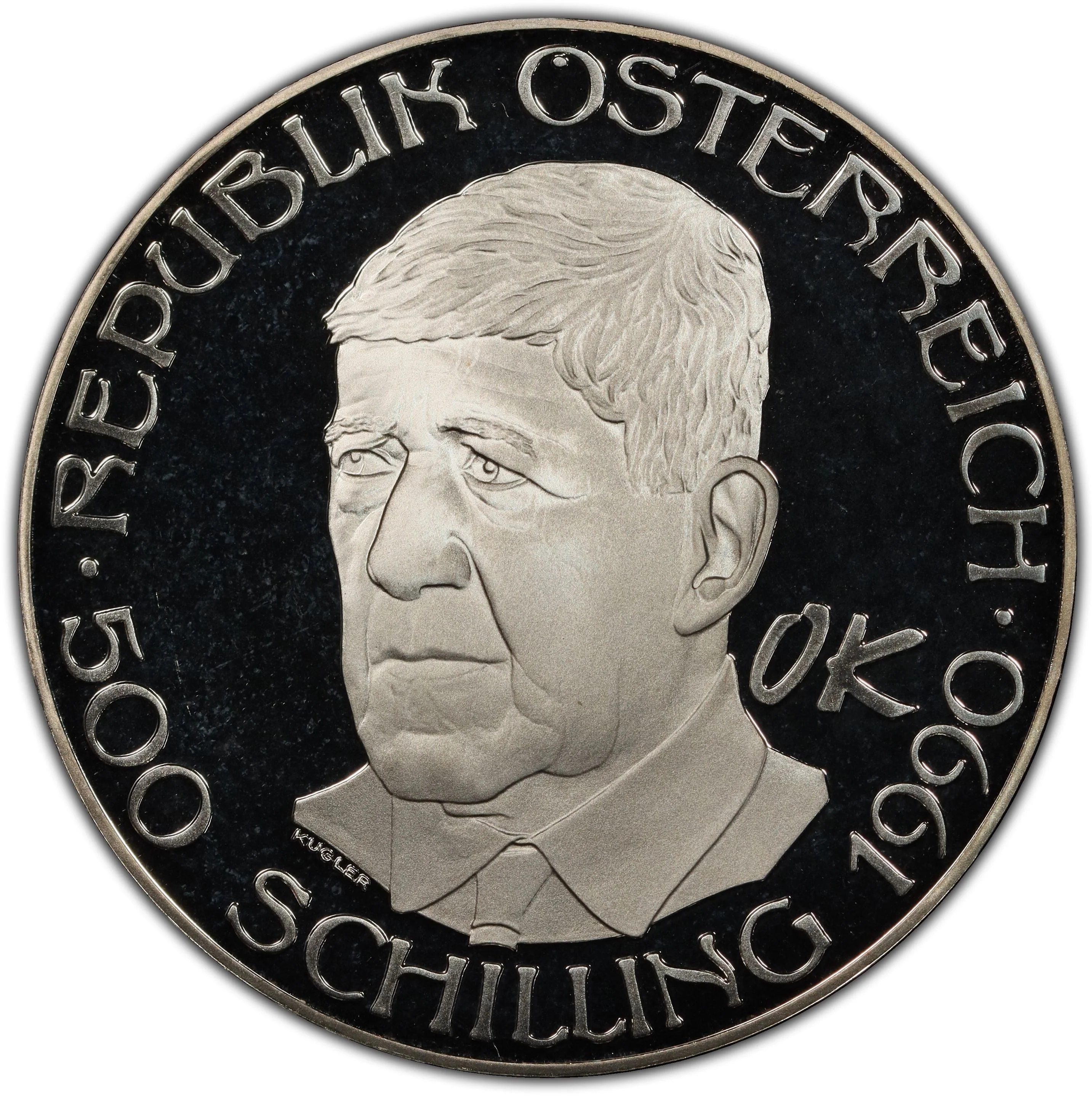
Oskar Kokoschka head, 3/4 left. Value below.
Inscription:
REPUBLIK OSTERREICH
500 SCHILLING 1990
OK
KUGLER
500 SCHILLING 1990
OK
KUGLER
Engraver: Werner Kugler
Reverse
Description:
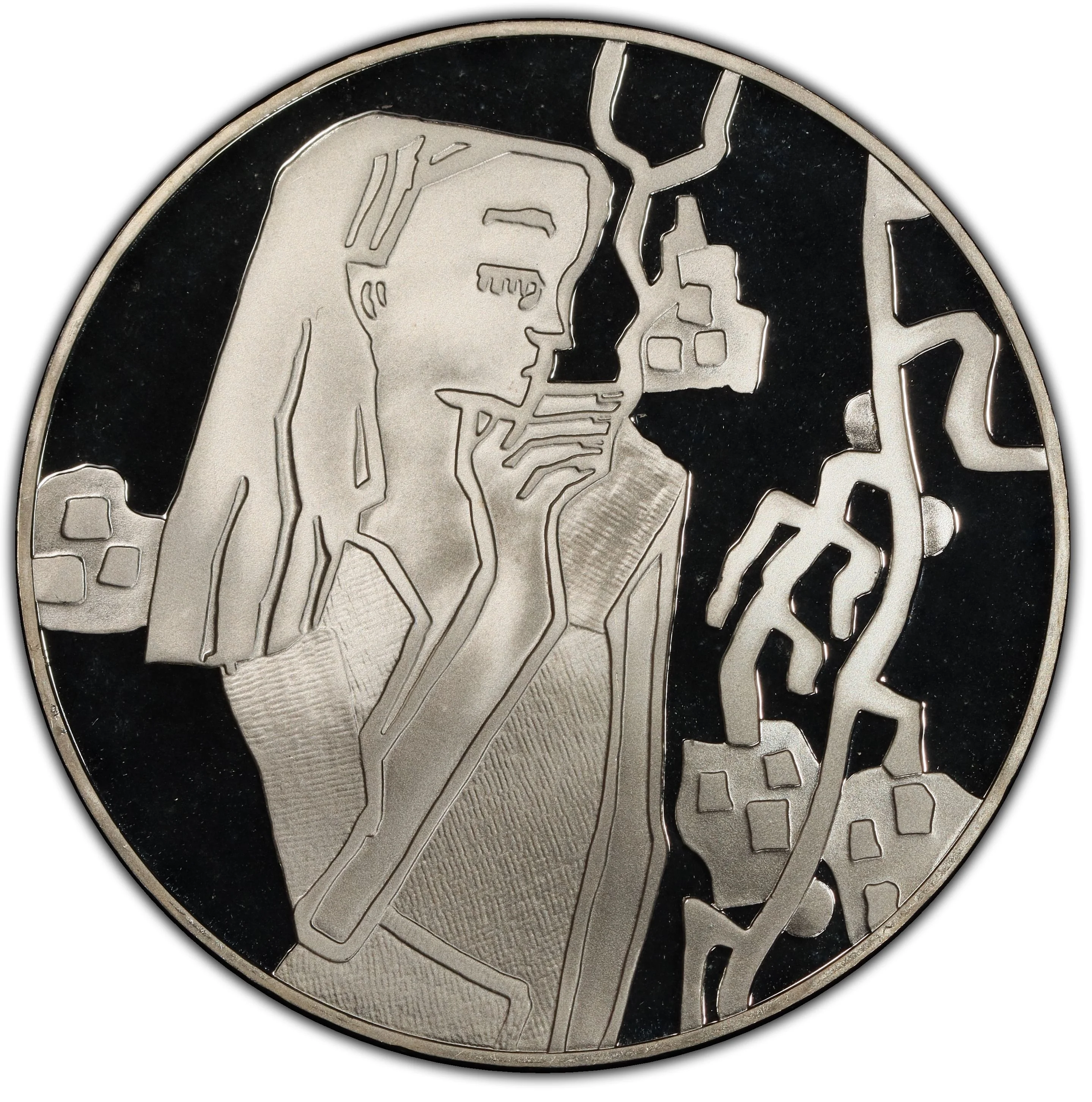
Expressionist woman facing right
Engraver: Werner Kugler
Edge
Mints
| Name | Mark |
|---|---|
| Münze Österreich | — |
Mintings
| Year | Mint Mark | Mintage | Quality | Collection |
|---|---|---|---|---|
| 1990 | — | 200,000 | ||
| 1990 | — | 81,000 | Proof |
Historical background
In 1990, Austria's currency situation was defined by the enduring strength and stability of the Austrian Schilling (ATS), which was firmly anchored within the European Monetary System (EMS). Having joined the EMS in 1979, Austria pursued a "hard currency policy," deliberately pegging the Schilling closely to the powerful Deutsche Mark (DM). This policy, championed by the central bank (Oesterreichische Nationalbank), was a cornerstone of economic strategy, successfully curbing inflation and fostering a climate of predictability for trade and investment, particularly with its largest trading partner, West Germany.
The year 1990, however, was one of profound geopolitical upheaval that presented new economic dimensions. The fall of the Iron Curtain and the opening of borders to the East transformed Austria from a peripheral Western nation into a central hub for trade and investment flowing into the former Eastern Bloc, especially into neighboring Hungary and Czechoslovakia. This sudden shift created new demands and opportunities for the Schilling, which gained prominence as a relatively stable and convertible currency in the region, though the core monetary policy remained fixated on DM stability.
Looking forward, the currency landscape of 1990 was already hinting at future European integration. While the Schilling was a symbol of national sovereignty, its tight linkage to the Deutsche Mark was a de facto alignment with the monetary core of what would become the European Union. The Maastricht Treaty, which would formally establish the path to the Euro, was just two years away. Therefore, Austria's currency situation in 1990 was one of successful domestic stability, adapting to new regional opportunities, and operating within a framework that was quietly paving the way for the eventual adoption of the Euro in 1999.
The year 1990, however, was one of profound geopolitical upheaval that presented new economic dimensions. The fall of the Iron Curtain and the opening of borders to the East transformed Austria from a peripheral Western nation into a central hub for trade and investment flowing into the former Eastern Bloc, especially into neighboring Hungary and Czechoslovakia. This sudden shift created new demands and opportunities for the Schilling, which gained prominence as a relatively stable and convertible currency in the region, though the core monetary policy remained fixated on DM stability.
Looking forward, the currency landscape of 1990 was already hinting at future European integration. While the Schilling was a symbol of national sovereignty, its tight linkage to the Deutsche Mark was a de facto alignment with the monetary core of what would become the European Union. The Maastricht Treaty, which would formally establish the path to the Euro, was just two years away. Therefore, Austria's currency situation in 1990 was one of successful domestic stability, adapting to new regional opportunities, and operating within a framework that was quietly paving the way for the eventual adoption of the Euro in 1999.
💎 Very Rare