

20 Centavos – Chile
Chile
Context

Material
References
KM: #Click to copy to clipboard151.1
Numista: #73608
Value
Bullion value: $9.49
Obverse
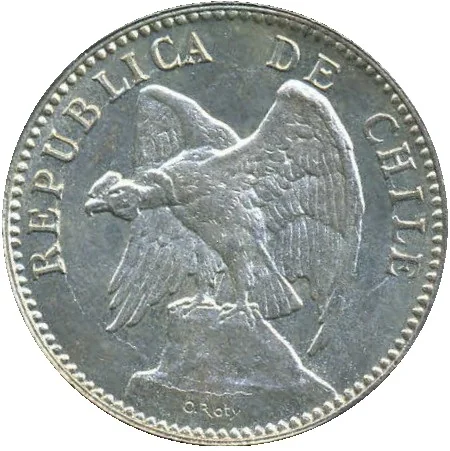
Description:
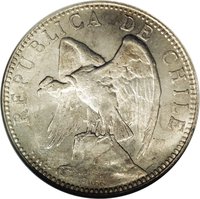
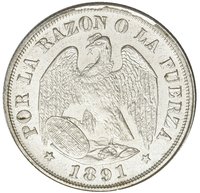
Defiant condor perched left.
Inscription:
REPUBLICA DE CHILE
O. Roty
O. Roty
Translation:
REPUBLIC OF CHILE
L. Roty
L. Roty
Script: Latin
Engraver: Louis-Oscar Roty
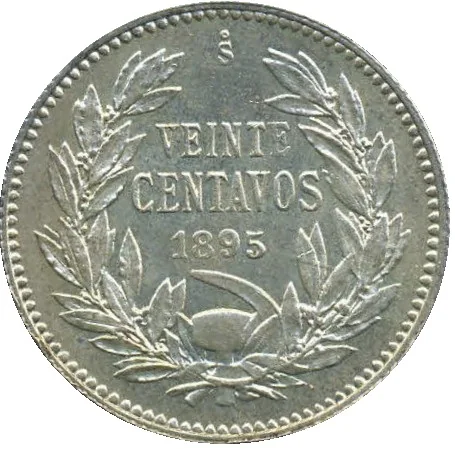
Reverse
Edge
Reeded
Mints
| Name | Mark |
|---|---|
| Casa de Moneda de Chile | (So) |
Mintings
| Year | Mint Mark | Mintage | Quality | Collection |
|---|---|---|---|---|
| 1895 | So | 146,000 |
Historical background
In 1895, Chile's currency situation was characterized by the coexistence of a devalued paper peso and a valuable gold peso, a system known as "bimetallism by force of circumstance." Following the War of the Pacific (1879–1883), the government had suspended the convertibility of paper money into gold to finance reconstruction, leading to significant inflation and a fluctuating exchange rate. By the mid-1890s, the paper peso (peso corriente) had lost roughly half its pre-war value against the gold peso (peso oro), creating a complex dual-price system for domestic and international transactions.
This monetary instability posed serious challenges for the export-oriented economy, which relied heavily on nitrate and copper sales priced in stable foreign currencies. Merchants and foreign investors faced constant exchange risk, while domestic price confusion hindered long-term planning. The government, under President Jorge Montt and his finance minister, Agustín Ross, recognized that a return to monetary orthodoxy and the gold standard was essential for restoring international credit, attracting foreign capital, and ensuring stable economic growth.
Consequently, the period around 1895 was one of active preparation for monetary reform. The state, benefiting from substantial nitrate export revenues, began accumulating a gold reserve to eventually guarantee convertibility. This groundwork culminated in the Law of Monetary Conversion of 1895, which formally prohibited further issuance of non-convertible paper money and committed the nation to a path toward a full gold standard. This set the stage for the successful reform finally enacted in 1898, which stabilized the currency and integrated Chile more firmly into the global financial system.
This monetary instability posed serious challenges for the export-oriented economy, which relied heavily on nitrate and copper sales priced in stable foreign currencies. Merchants and foreign investors faced constant exchange risk, while domestic price confusion hindered long-term planning. The government, under President Jorge Montt and his finance minister, Agustín Ross, recognized that a return to monetary orthodoxy and the gold standard was essential for restoring international credit, attracting foreign capital, and ensuring stable economic growth.
Consequently, the period around 1895 was one of active preparation for monetary reform. The state, benefiting from substantial nitrate export revenues, began accumulating a gold reserve to eventually guarantee convertibility. This groundwork culminated in the Law of Monetary Conversion of 1895, which formally prohibited further issuance of non-convertible paper money and committed the nation to a path toward a full gold standard. This set the stage for the successful reform finally enacted in 1898, which stabilized the currency and integrated Chile more firmly into the global financial system.
Series: 1895 Chile circulation coins
💎 Very Rare