

2 lire – Italy
Add to wishlist
Italy
Context
Years: 1914–1917
Issuer: Italy
Ruler: Vittorio Emanuele III
Currency:
(1861—2001)
Demonetized: Yes
Total mintage: 35,383,503
Material
References
KM: #
Numista: #7359
Value
Exchange value: 2 ITL
Bullion value: $20.92
Obverse
Description:
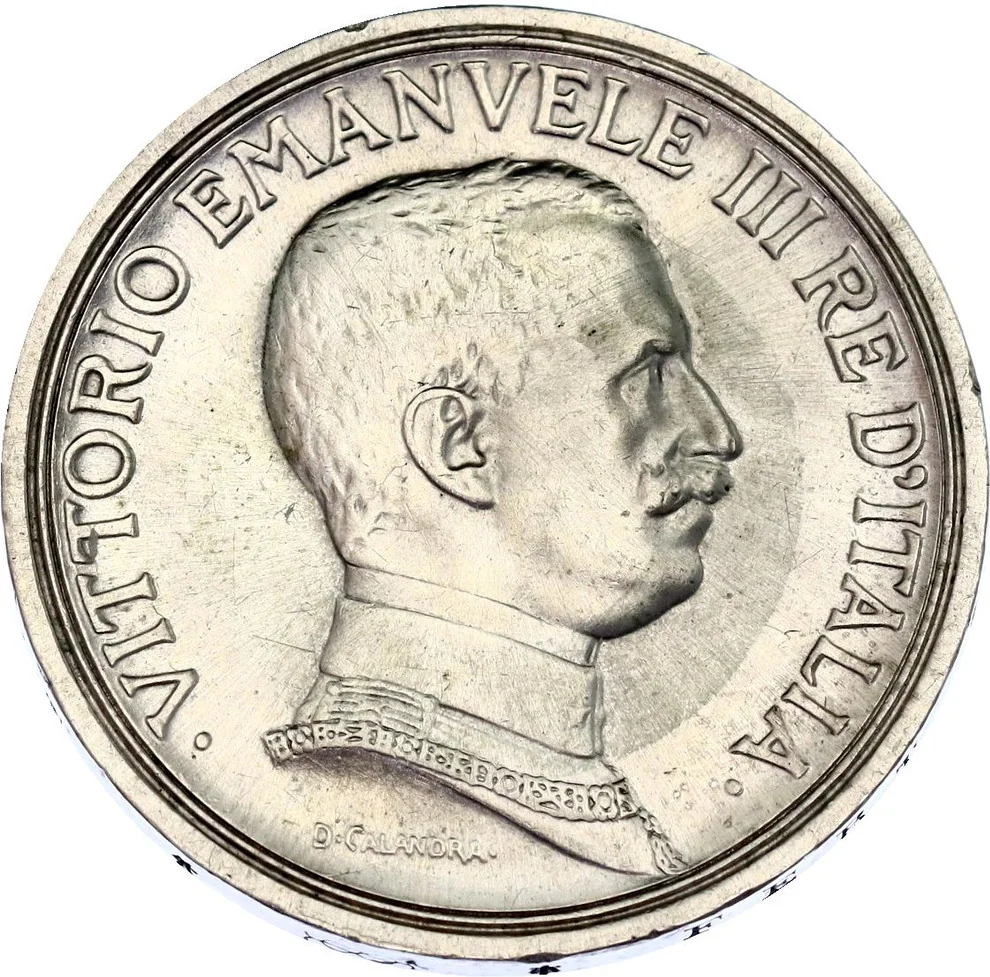
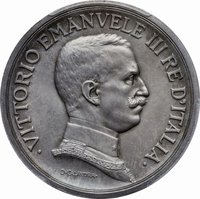
Bust of King Vittorio Emanuele III facing right; engraver's name below.
Inscription:
VITTORIO EMANUELE III RE D'ITALIA
D. CALANDRA
D. CALANDRA
Translation:
Victor Emmanuel III King of Italy
D. Calandra
D. Calandra
Script: Latin
Language: Italian
Engraver: Davide Calandra
Reverse
Description:
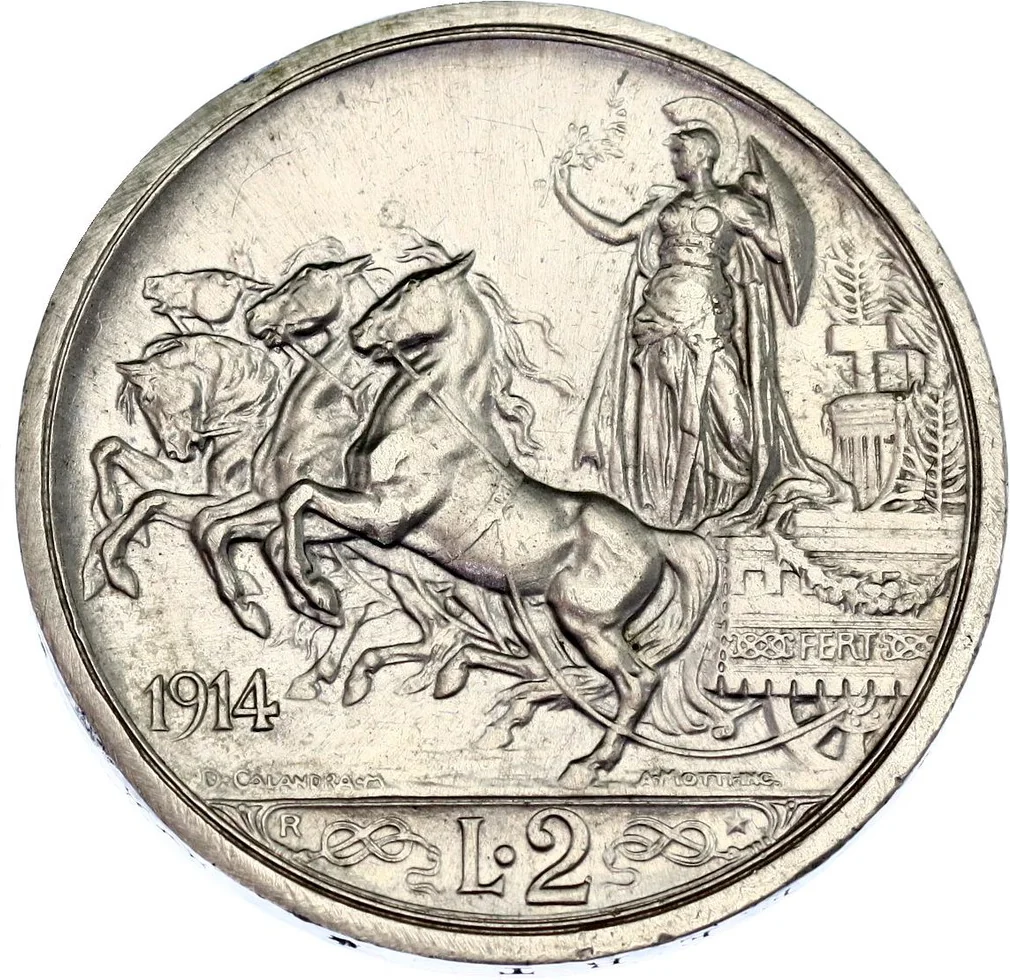
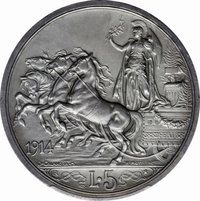
Italy’s female figure stands on a quadriga, holding a shield and olive branch. The date is below the horses’ legs. The exergue line shows the author and engraver’s names, with the value between two knots, the mintmark left, and the Star of Italy right.
Inscription:
1917
FERT
D·CALANDRA M· L·GIORGI INC·
R
L. 2
FERT
D·CALANDRA M· L·GIORGI INC·
R
L. 2
Translation:
1917
FERT
D. CALANDRA M. L. GIORGI INC.
R
Lire 2
FERT
D. CALANDRA M. L. GIORGI INC.
R
Lire 2
Script: Latin
Engraver: Attilio Silvio Motti
Edge
Smooth with inscription (the motto of the House of Savoy) between knots and stars
Legend:
FERT FERT FERT
Translation:
FERT FERT FERT
Language: Latin
Mints
| Name | Mark |
|---|---|
| Rome | R |
Mintings
Historical background
In 1914, Italy's currency situation was defined by its adherence to the Latin Monetary Union (LMU), a system it had helped found in 1865. The country was officially on a gold-standard bimetallic system, where the basic unit was the lira, theoretically convertible into either gold or silver at a fixed rate. However, Italy's fiscal position was chronically weak due to high public debt, costly colonial adventures, and persistent budget deficits. This had led to a suspension of gold convertibility for banknotes as early as 1866, creating a system known as "forced circulation" (corso forzoso), where paper currency was legal tender but not redeemable for specie. Consequently, while the lira's value was pegged internationally through the LMU, its domestic stability was underpinned more by government decree than by metallic reserves.
The period leading up to 1914 saw a fragile and managed stability. The government, particularly under Finance Minister Luigi Luzzatti, had worked to restore confidence and move toward a resumption of convertibility. By 1913, Italy had accumulated substantial gold reserves, and the lira traded close to its par value on foreign exchanges. This apparent strength was deceptive, however, as it relied heavily on remittances from Italian emigrants and inflows of foreign capital, rather than on a robust trade surplus or sound public finances. The banking system, dominated by mixed banks like the Banca Commerciale Italiana, was deeply intertwined with industrial financing, creating vulnerabilities.
When World War I began in August 1914, Italy declared neutrality, a decision that triggered an immediate financial crisis. Fearing economic disruption, there was a rush to convert banknotes into gold, forcing the Banca d'Italia to suspend gold payments just days after the war started, effectively ending the pretense of the gold standard. The government then instituted strict capital controls, prohibited gold exports, and began preparing for wartime finance. Thus, on the eve of Italy's eventual entry into the war in 1915, the pre-war currency framework was already abandoned, setting the stage for the inflationary deficit spending that would characterize the war years and profoundly devalue the lira.
The period leading up to 1914 saw a fragile and managed stability. The government, particularly under Finance Minister Luigi Luzzatti, had worked to restore confidence and move toward a resumption of convertibility. By 1913, Italy had accumulated substantial gold reserves, and the lira traded close to its par value on foreign exchanges. This apparent strength was deceptive, however, as it relied heavily on remittances from Italian emigrants and inflows of foreign capital, rather than on a robust trade surplus or sound public finances. The banking system, dominated by mixed banks like the Banca Commerciale Italiana, was deeply intertwined with industrial financing, creating vulnerabilities.
When World War I began in August 1914, Italy declared neutrality, a decision that triggered an immediate financial crisis. Fearing economic disruption, there was a rush to convert banknotes into gold, forcing the Banca d'Italia to suspend gold payments just days after the war started, effectively ending the pretense of the gold standard. The government then instituted strict capital controls, prohibited gold exports, and began preparing for wartime finance. Thus, on the eve of Italy's eventual entry into the war in 1915, the pre-war currency framework was already abandoned, setting the stage for the inflationary deficit spending that would characterize the war years and profoundly devalue the lira.
🌱 Common