

1 yuan – Yunnan Province
Add to wishlist
China
Context
Years: 1909–1911
Country: China
Issuer: Yunnan Province
Ruler: Xuantong
Currency:
(1908—1949)
Demonetized: Yes
Material
References
Y: #
Numista: #10366
Value
Bullion value: $60.27
Obverse
Description:
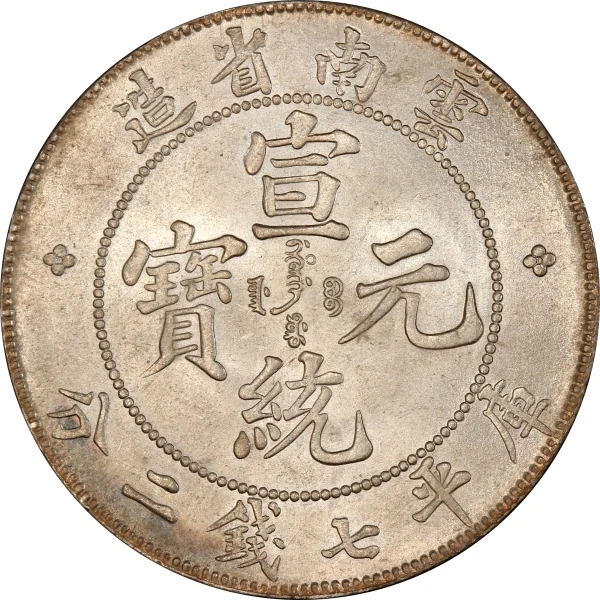
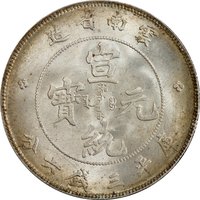
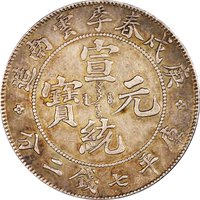
Four Chinese ideograms read top to bottom, right to left, with central Manchu text surrounded by more ideograms.
Inscription:
雲南省造
宣
ᡤᡝᡥᡠᠩᡤᡝ
寶 ᠶᡠᠸᠠᠨ ᠪᠣᠣ 元
ᠶᠣᠰᠣ
統
分二錢七平庫
宣
ᡤᡝᡥᡠᠩᡤᡝ
寶 ᠶᡠᠸᠠᠨ ᠪᠣᠣ 元
ᠶᠣᠰᠣ
統
分二錢七平庫
Translation:
Yunnan Province Made
Xuan
Gehungge
Treasure Yuan
Yoso
Tong
2 Mace and 7 Candareens, Treasury Standard
Xuan
Gehungge
Treasure Yuan
Yoso
Tong
2 Mace and 7 Candareens, Treasury Standard
Scripts: Chinese, Mongolian / Manchu
Reverse
Description:
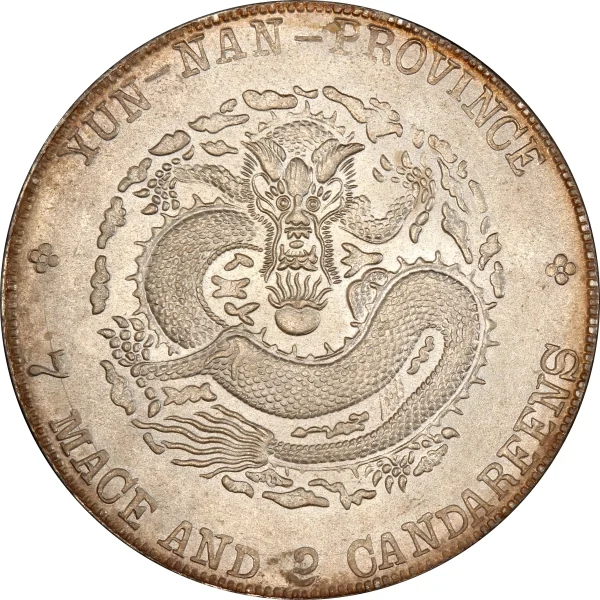
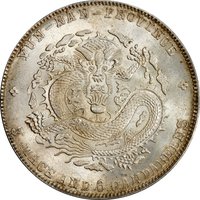
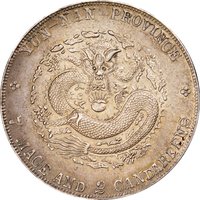
Dragon encircling a pearl, surrounded by English text.
Inscription:
YUN-NAN-PROVINCE
7 MACE AND 2 CANDAREENS
7 MACE AND 2 CANDAREENS
Script: Latin
Edge
Reeded.
Categories
| Mythology> Fantastic animal |
Mintings
| Year | Mint Mark | Mintage | Quality | Collection |
|---|---|---|---|---|
| — | — | — |
Historical background
In 1909, Yunnan Province existed within a complex and fragmented monetary system, a legacy of its remote geography, diverse economy, and position on the periphery of Qing central authority. The primary medium of exchange was the Yunnan silver tael (liang), but its weight and purity were not standardized, varying significantly between different prefectures and even major trade towns like Kunming and Dali. This created constant friction in commerce, as merchants required scales to weigh silver and assays to judge its fineness for every significant transaction. Concurrently, a vast quantity of debased copper cash coins (tongbao) circulated for daily small purchases, but their exchange rate against silver was highly volatile, often to the detriment of the common people.
This chaotic environment was exacerbated by a flood of foreign currencies, a direct result of Yunnan's status as a frontier zone. French Indochinese Piastres, known locally as Dayang, flowed in from the south, becoming the dominant currency in the southern trade corridors and around the French-controlled railway in Mengzi. From the north and west, Mexican Silver Dollars (carried by overland trade) and British Indian Rupees (from the Burma trade) also competed for acceptance. This effectively carved the province into informal monetary spheres of influence, undermining Qing sovereignty and complicating provincial finances, as tax revenues were collected in a bewildering array of metallic forms.
Recognizing the destabilizing effects of this system, the late Qing New Policies (Xinzheng) reforms included attempts at monetary unification. By 1909, the provincial mint in Kunming was actively producing new standard silver coins (Yunnan Dragon Dollars) and copper coins modeled on national standards, in an effort to displace both the variable tael and foreign currencies. However, these efforts faced severe public skepticism, limited minting capacity, and the entrenched habits of local markets. Thus, 1909 represents a pivotal but transitional moment: the old poly-metallic, multi-sovereign system remained firmly in place, even as the provincial government made its first concerted, though ultimately struggling, attempt to impose a modern, unified currency.
This chaotic environment was exacerbated by a flood of foreign currencies, a direct result of Yunnan's status as a frontier zone. French Indochinese Piastres, known locally as Dayang, flowed in from the south, becoming the dominant currency in the southern trade corridors and around the French-controlled railway in Mengzi. From the north and west, Mexican Silver Dollars (carried by overland trade) and British Indian Rupees (from the Burma trade) also competed for acceptance. This effectively carved the province into informal monetary spheres of influence, undermining Qing sovereignty and complicating provincial finances, as tax revenues were collected in a bewildering array of metallic forms.
Recognizing the destabilizing effects of this system, the late Qing New Policies (Xinzheng) reforms included attempts at monetary unification. By 1909, the provincial mint in Kunming was actively producing new standard silver coins (Yunnan Dragon Dollars) and copper coins modeled on national standards, in an effort to displace both the variable tael and foreign currencies. However, these efforts faced severe public skepticism, limited minting capacity, and the entrenched habits of local markets. Thus, 1909 represents a pivotal but transitional moment: the old poly-metallic, multi-sovereign system remained firmly in place, even as the provincial government made its first concerted, though ultimately struggling, attempt to impose a modern, unified currency.
💎 Extremely Rare