

1 yuan – Yunnan Province
Add to wishlist
China
Context
Year: 1910
Country: China
Issuer: Yunnan Province
Ruler: Xuantong
Currency:
(1908—1949)
Demonetized: Yes
Material
References
Y: #
Numista: #288368
Value
Bullion value: $60.68
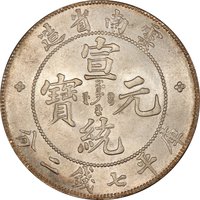
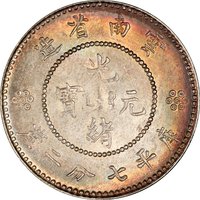
Obverse
Description:
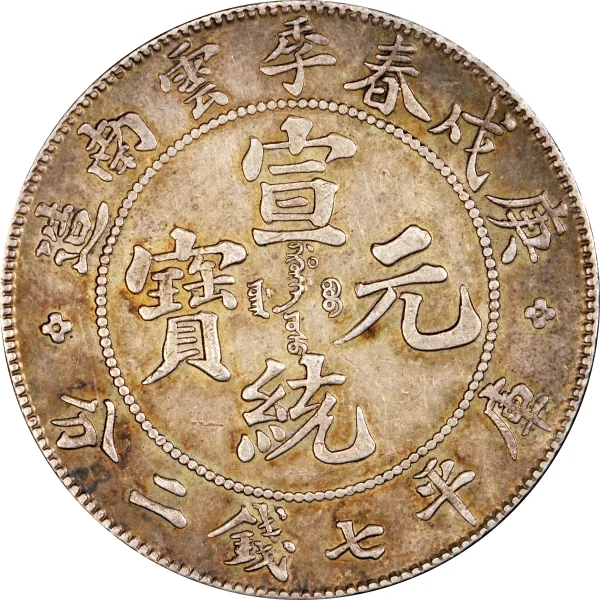
Four Chinese ideograms read top to bottom, right to left, with central Manchu text surrounded by more ideograms.
Inscription:
造南雲季春戌庚
宣
ᡤᡝᡥᡠᠩᡤᡝ
寶 ᠶᡠᠸᠠᠨ ᠪᠣᠣ 元
ᠶᠣᠰᠣ
統
分二錢七平庫
宣
ᡤᡝᡥᡠᠩᡤᡝ
寶 ᠶᡠᠸᠠᠨ ᠪᠣᠣ 元
ᠶᠣᠰᠣ
統
分二錢七平庫
Translation:
Made in Nanyun, Late Spring, Wuxu Year
Xuan
Gehungge Yuvan Boo
Yuan
Yoso
Tong
2 Fen, 7 Mace, Treasury Standard
Xuan
Gehungge Yuvan Boo
Yuan
Yoso
Tong
2 Fen, 7 Mace, Treasury Standard
Scripts: Chinese, Mongolian / Manchu
Languages: Manchu, Classical Chinese
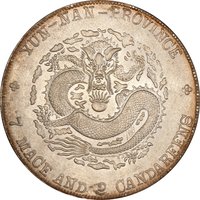
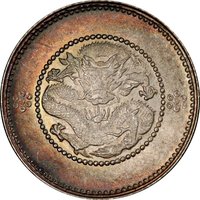
Reverse
Description:
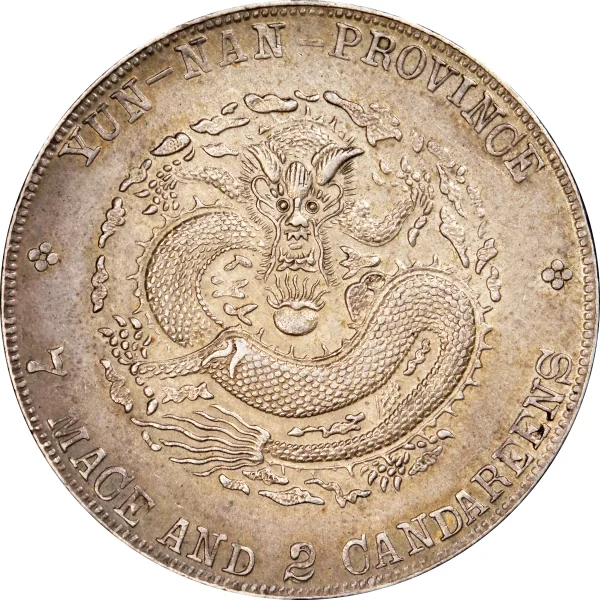
Dragon encircling a pearl, surrounded by English text.
Inscription:
YUN-NAN-PROVINCE
7 MACE AND 2 CANDAREENS
7 MACE AND 2 CANDAREENS
Script: Latin
Edge
Reeded.
Categories
| Mythology> Fantastic animal |
Mintings
| Year | Mint Mark | Mintage | Quality | Collection |
|---|---|---|---|---|
| 1910 | — | — |
Historical background
In 1910, Yunnan Province existed within a complex and fragmented monetary system, a direct reflection of its position at the crossroads of multiple empires and its rugged, decentralized geography. The primary circulating currency was the Yunnan silver dollar, a provincial coin minted in Kunming bearing local designs like a seated dragon. However, its value and acceptance were unstable, fluctuating against other major standards. Alongside this, a vast array of older Chinese silver sycees (shoe-shaped ingots), copper cash coins, and even French Indochinese piastres circulated, particularly in the southern trade routes toward Hanoi. This proliferation created a chaotic environment for commerce, where exchange rates varied by locality and transaction, hindering provincial economic integration.
This monetary disarray was exacerbated by the declining authority of the Qing Dynasty, which struggled to impose a unified national currency. While the central government had introduced new national silver coins (the "Dragon Dollars"), they competed with and were often distrusted against local Yunnan issues. Furthermore, the province was deeply affected by the global silver crisis. As the international price of silver fell sharply in the late 19th and early 20th centuries, the intrinsic metal value of Yunnan's silver coins dropped, causing inflation and economic strain. This external shock destabilized the already fragile local currency system.
The situation was further complicated by intense foreign influence, primarily from French Indochina. France, seeking economic dominance, promoted the use of its piastre in Yunnan, especially along the newly completed Kunming-Haiphong railway. British Indian rupees and Mexican silver dollars also entered through Burma and Tibet, respectively. Thus, by 1910, Yunnan was a monetary battleground. Its economy was strained by internal fragmentation, global silver depreciation, and competing imperial currencies, setting the stage for the monetary reforms and greater centralization that would be attempted after the 1911 Revolution.
This monetary disarray was exacerbated by the declining authority of the Qing Dynasty, which struggled to impose a unified national currency. While the central government had introduced new national silver coins (the "Dragon Dollars"), they competed with and were often distrusted against local Yunnan issues. Furthermore, the province was deeply affected by the global silver crisis. As the international price of silver fell sharply in the late 19th and early 20th centuries, the intrinsic metal value of Yunnan's silver coins dropped, causing inflation and economic strain. This external shock destabilized the already fragile local currency system.
The situation was further complicated by intense foreign influence, primarily from French Indochina. France, seeking economic dominance, promoted the use of its piastre in Yunnan, especially along the newly completed Kunming-Haiphong railway. British Indian rupees and Mexican silver dollars also entered through Burma and Tibet, respectively. Thus, by 1910, Yunnan was a monetary battleground. Its economy was strained by internal fragmentation, global silver depreciation, and competing imperial currencies, setting the stage for the monetary reforms and greater centralization that would be attempted after the 1911 Revolution.
💎 Extremely Rare