

1 cent – Netherlands
Add to wishlist
Netherlands
Context
Years: 1950–1980
Issuer: Netherlands
Ruler: Juliana
Currency:
(1817—2001)
Demonetization: 1987
Total mintage: 1,464,300,000
Material
References
KM: #
Numista: #733
Value
Exchange value: 0.01 NLG
Obverse
Description:
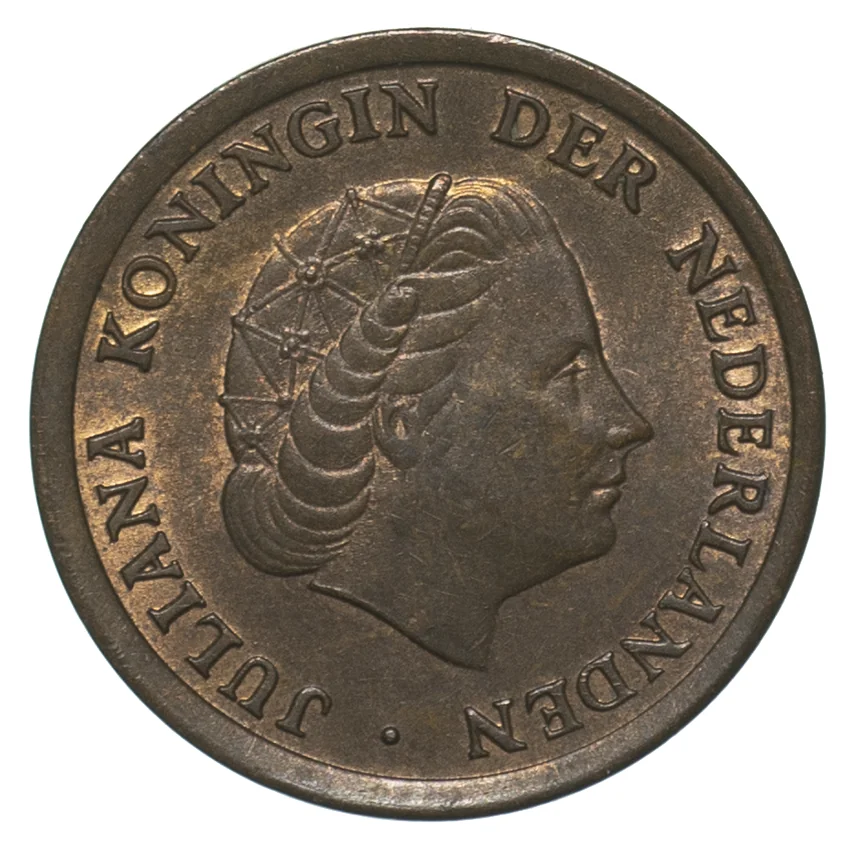
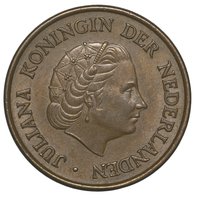
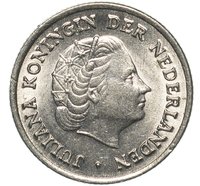
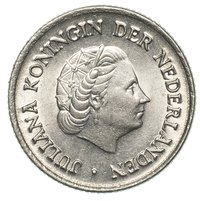
Queen Juliana, right-facing portrait.
Inscription:
JULIANA KONINGIN DER NEDERLANDEN
Translation:
Juliana Queen of the Netherlands
Script: Latin
Language: Dutch
Engraver: Ludwig Oswald Wenckebach
Reverse
Description:
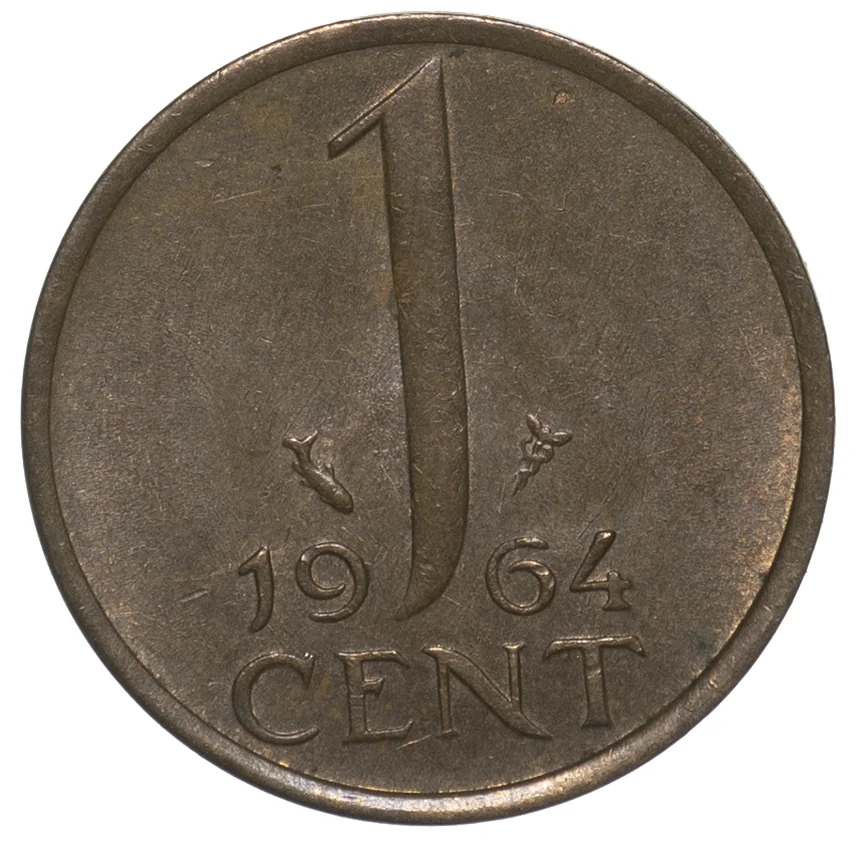
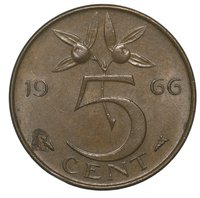
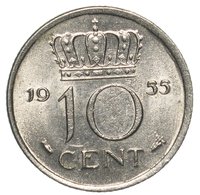
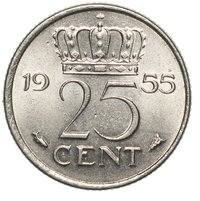
Face value and year centered.
Inscription:
1
1977
CENT
1977
CENT
Script: Latin
Engraver: Ludwig Oswald Wenckebach
Edge
Plain
Mints
| Name | Mark |
|---|---|
| Royal Dutch Mint | — |
Mintings
| Year | Mint Mark | Mintage | Quality | Collection |
|---|---|---|---|---|
| 1950 | — | 46,400,000 | ||
| 1951 | — | 45,800,000 | ||
| 1952 | — | 68,000,000 | ||
| 1953 | — | 54,000,000 | ||
| 1954 | — | 54,000,000 | ||
| 1955 | — | 52,000,000 | ||
| 1956 | — | 34,800,000 | ||
| 1957 | — | 48,000,000 | ||
| 1958 | — | 34,000,000 | ||
| 1959 | — | 36,000,000 | ||
| 1960 | — | 40,000,000 | ||
| 1961 | — | 52,000,000 | ||
| 1962 | — | 57,000,000 | ||
| 1963 | — | 70,000,000 | ||
| 1964 | — | 73,000,000 | ||
| 1965 | — | 91,000,000 | ||
| 1966 | — | — | ||
| 1967 | — | 140,000,000 | ||
| 1968 | — | 28,000,000 | ||
| 1969 | — | 50,000,000 | ||
| 1970 | — | 100,000,000 | ||
| 1971 | — | 70,000,000 | ||
| 1972 | — | 40,000,000 | ||
| 1973 | — | 34,000,000 | ||
| 1974 | — | 46,000,000 | ||
| 1975 | — | 25,000,000 | ||
| 1976 | — | 15,000,000 | ||
| 1977 | — | 15,000,000 | ||
| 1978 | — | 15,000,000 | ||
| 1979 | — | 15,000,000 | ||
| 1980 | — | 15,300,000 |
Historical background
In 1950, the Netherlands was operating under a managed monetary system heavily influenced by the aftermath of World War II and the launch of European economic cooperation. The national currency was the Dutch guilder (gulden), which was not freely convertible on international markets. Its value and exchange controls were strictly regulated by De Nederlandsche Bank (DNB) to conserve scarce foreign currency reserves, direct investment towards national reconstruction, and maintain monetary stability. This period of "financial reconstruction" followed the traumatic 1944-1949 German occupation and the costly war for Indonesian independence, which had left the economy vulnerable and in need of careful control.
The country's monetary policy was also deeply intertwined with the emerging framework for European recovery and integration. In 1948, the Netherlands had joined the Organisation for European Economic Co-operation (OEEC) to administer Marshall Plan aid, which required moves toward trade liberalization. More significantly, in 1950, the Netherlands became a founding member of the European Payments Union (EPU). This system was crucial as it allowed for the multilateral settlement of trade balances between European countries without using gold or dollars, effectively easing the strict bilateral trade and payment agreements that had hampered recovery. Participation in the EPU was a major step toward restoring the guilder's international functionality.
Domestically, the priority was on rebuilding the industrial base and infrastructure, with monetary policy geared toward suppressing inflation and supporting government-led investment. While rationing and price controls from the immediate post-war period were being gradually lifted, the economy in 1950 was still in a state of transition from a controlled to a more market-oriented system. The guilder's fixed exchange rate was a cornerstone of this stability, setting the stage for the robust economic growth and increasing liberalization that would characterize the Dutch "Golden Years" of the 1950s and 1960s.
The country's monetary policy was also deeply intertwined with the emerging framework for European recovery and integration. In 1948, the Netherlands had joined the Organisation for European Economic Co-operation (OEEC) to administer Marshall Plan aid, which required moves toward trade liberalization. More significantly, in 1950, the Netherlands became a founding member of the European Payments Union (EPU). This system was crucial as it allowed for the multilateral settlement of trade balances between European countries without using gold or dollars, effectively easing the strict bilateral trade and payment agreements that had hampered recovery. Participation in the EPU was a major step toward restoring the guilder's international functionality.
Domestically, the priority was on rebuilding the industrial base and infrastructure, with monetary policy geared toward suppressing inflation and supporting government-led investment. While rationing and price controls from the immediate post-war period were being gradually lifted, the economy in 1950 was still in a state of transition from a controlled to a more market-oriented system. The guilder's fixed exchange rate was a cornerstone of this stability, setting the stage for the robust economic growth and increasing liberalization that would characterize the Dutch "Golden Years" of the 1950s and 1960s.
🌱 Very Common