

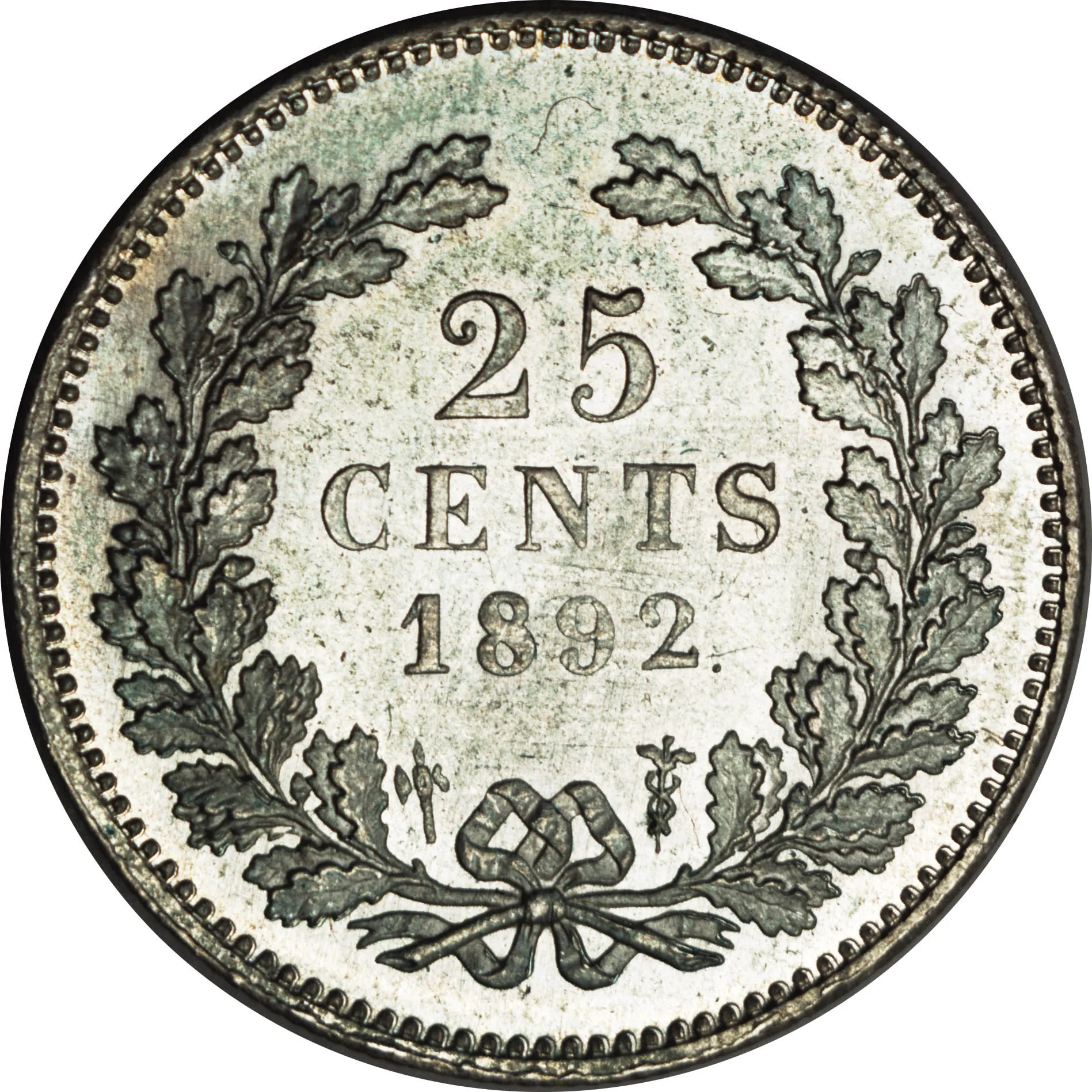
25 Cents – Netherlands
Netherlands
Context
Years: 1891–1897
Issuer: Netherlands 
Ruler: Wilhelmina
Currency:
(1817—2001)
Demonetized: Yes
Total mintage: 6,300,002
Material
References
KM: #Click to copy to clipboard115
Numista: #7324
Value
Exchange value: 0.25 NLG
Bullion value: $6.65
Obverse
Description:
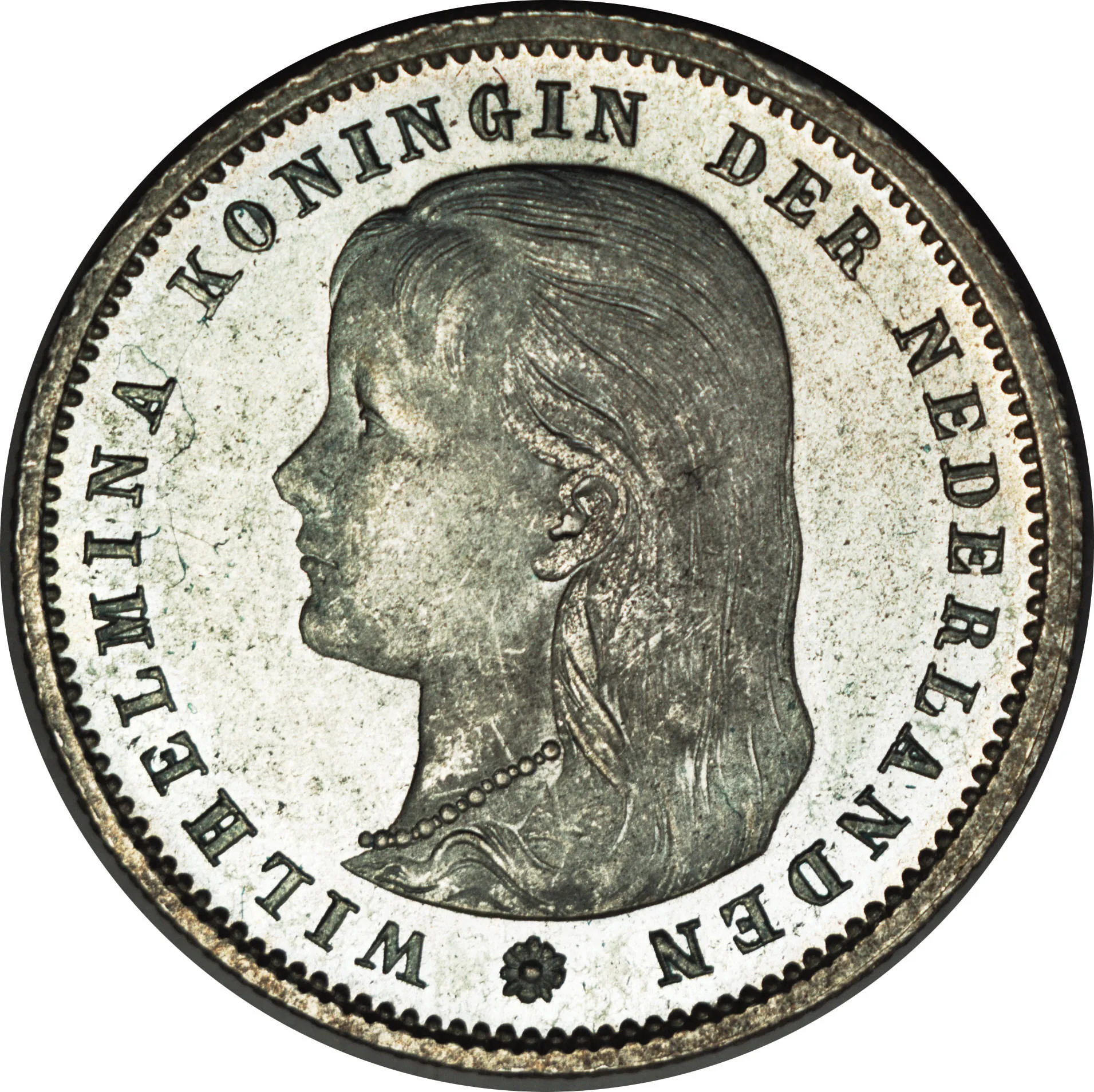
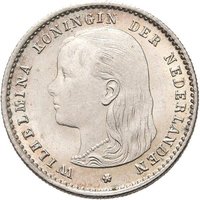
Bust of Queen Wilhelmina, facing left, with loose hair and pearls.
Inscription:
WILHELMINA KONINIGIN DER NEDERLANDEN 🏵
Translation:
Wilhelmina Queen of the Netherlands
Script: Latin
Language: Dutch
Designer: Ludwig Jünger
Reverse
Edge
Plain
Mints
| Name | Mark |
|---|---|
| Royal Dutch Mint | — |
Mintings
| Year | Mint Mark | Mintage | Quality | Collection |
|---|---|---|---|---|
| 1891 | — | 2 | ||
| 1892 | — | 800,000 | ||
| 1893 | — | 800,000 | ||
| 1894 | — | 1,000,000 | ||
| 1895 | — | — | ||
| 1896 | — | 600,000 | ||
| 1897 | — | 3,100,000 |
Historical background
In 1891, the Netherlands operated under a bimetallic system in law but a de facto gold standard in practice. The Guilder was legally defined in terms of both gold and silver, but the fixed ratio between the two metals had become disconnected from their fluctuating market values. This discrepancy, a common problem with bimetallism, led to the effective disappearance of full-value silver coinage from circulation, as it was more profitable to export or melt it. Consequently, the domestic economy relied heavily on a limited supply of gold coins and a flood of undervalued, worn silver and small change, creating chronic shortages of sound circulating currency for daily transactions.
This unstable monetary environment was a major concern for the Dutch government and the central bank, De Nederlandsche Bank. The situation was exacerbated by international trends, as many major trading partners, including neighbouring Germany, had firmly adopted the gold standard. This placed the Netherlands at a commercial and financial disadvantage, creating exchange rate uncertainties and hindering capital flows. The need for monetary modernization and alignment with the dominant European financial system was widely acknowledged by policymakers, bankers, and the business community.
Therefore, 1891 was a pivotal year of deliberation, immediately preceding decisive legislative action. A State Commission on Monetary Affairs had been actively studying the problem, and its work culminated in recommendations to abandon bimetallism entirely. The political and economic consensus was firmly in favour of reform, setting the stage for the Coin Act of 1892, which formally placed the Netherlands on the gold standard. Thus, the currency situation in 1891 is best understood as the final, strained year of an outdated system, with the nation poised on the brink of a definitive and necessary modernization of its monetary framework.
This unstable monetary environment was a major concern for the Dutch government and the central bank, De Nederlandsche Bank. The situation was exacerbated by international trends, as many major trading partners, including neighbouring Germany, had firmly adopted the gold standard. This placed the Netherlands at a commercial and financial disadvantage, creating exchange rate uncertainties and hindering capital flows. The need for monetary modernization and alignment with the dominant European financial system was widely acknowledged by policymakers, bankers, and the business community.
Therefore, 1891 was a pivotal year of deliberation, immediately preceding decisive legislative action. A State Commission on Monetary Affairs had been actively studying the problem, and its work culminated in recommendations to abandon bimetallism entirely. The political and economic consensus was firmly in favour of reform, setting the stage for the Coin Act of 1892, which formally placed the Netherlands on the gold standard. Thus, the currency situation in 1891 is best understood as the final, strained year of an outdated system, with the nation poised on the brink of a definitive and necessary modernization of its monetary framework.
🌱 Common