

50 cents – French Indochina
Add to wishlist
Context
Year: 1946
Issuer: French Indochina
Period:
(1946—1958)
Currency:
(1880—1952)
Demonetized: Yes
Total mintage: 32,292,000
Material
Diameter: 29 mm
Weight: 12.5 g
Thickness: 2 mm
Shape: Round
Composition: Copper-nickel
Technique: Milled
Alignment: Coin alignment
flip
References
KM: #
Numista: #7322
Value
Exchange value: 0.50 ICFP
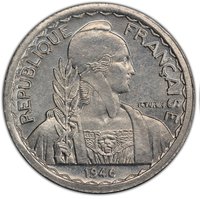
Obverse
Description:
Marianne seated left, holding fasces, date below.
Inscription:
REPUBLIQUE FRANÇAISE
1946
BARRE
1946
BARRE
Translation:
FRENCH REPUBLIC
1946
BARRE
1946
BARRE
Script: Latin
Language: French
Engraver: Jean-Auguste Barre
Reverse
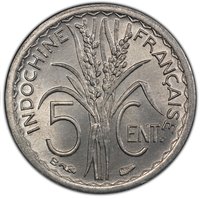
Description:
Wreath denomination
Inscription:
· INDO-CHINE FRANÇAISE ·
50
CENT.
BRONZE DE NICKEL
50
CENT.
BRONZE DE NICKEL
Translation:
FRENCH INDO-CHINA
50
CENTS
NICKEL BRONZE
50
CENTS
NICKEL BRONZE
Script: Latin
Language: French
Engraver: Jean-Auguste Barre
Edge
Reeded
Mints
| Name | Mark |
|---|---|
| Monnaie de Paris | — |
Mintings
| Year | Mint Mark | Mintage | Quality | Collection |
|---|---|---|---|---|
| 1946 | — | 32,292,000 |
Historical background
In 1946, the currency situation in French Indochina was chaotic and highly politicized, reflecting the broader struggle for control between the returning French colonial authorities and the nascent Democratic Republic of Vietnam (DRV). Following the Japanese surrender in 1945, a power vacuum allowed the Viet Minh to issue their own currency, the dong, in an effort to assert economic sovereignty and fund their administration. Simultaneously, the French, seeking to re-establish their authority, reintroduced the pre-war piastre as the official legal tender in areas they controlled, creating a dual and competing monetary system.
This resulted in a complex and unstable financial landscape where two currencies, backed by opposing political entities, circulated and vied for legitimacy. The value of both currencies was highly volatile and not based on substantial reserves, leading to severe inflation and a loss of public confidence. In the marketplace, the value of notes fluctuated based on the perceived military and political strength of the issuing authority in any given region, turning currency into a direct instrument of propaganda and warfare.
The French attempted to stabilize the situation by establishing the Institut d’Emission des Etats du Cambodge, du Laos et du Vietnam in 1946, a central bank intended to unify currency issuance across the associated states of the French Union. However, this institution was largely ineffective at the time, as the escalating First Indochina War prevented any meaningful monetary consolidation. Thus, the currency chaos of 1946 underscored the fractured sovereignty and the early economic battlegrounds of a conflict that would last for nearly another decade.
This resulted in a complex and unstable financial landscape where two currencies, backed by opposing political entities, circulated and vied for legitimacy. The value of both currencies was highly volatile and not based on substantial reserves, leading to severe inflation and a loss of public confidence. In the marketplace, the value of notes fluctuated based on the perceived military and political strength of the issuing authority in any given region, turning currency into a direct instrument of propaganda and warfare.
The French attempted to stabilize the situation by establishing the Institut d’Emission des Etats du Cambodge, du Laos et du Vietnam in 1946, a central bank intended to unify currency issuance across the associated states of the French Union. However, this institution was largely ineffective at the time, as the escalating First Indochina War prevented any meaningful monetary consolidation. Thus, the currency chaos of 1946 underscored the fractured sovereignty and the early economic battlegrounds of a conflict that would last for nearly another decade.

🌱 Fairly Common