

25 cents – Netherlands
Add to wishlist
Netherlands
Context
Years: 1982–2001
Issuer: Netherlands
Ruler: Beatrix
Currency:
(1817—2001)
Demonetization: 28 February 2002
Total mintage: 502,834,000
Material
References
KM: #
Numista: #731
Value
Exchange value: 0.25 NLG
Inflation-adjusted value: 0.65 NLG
Obverse
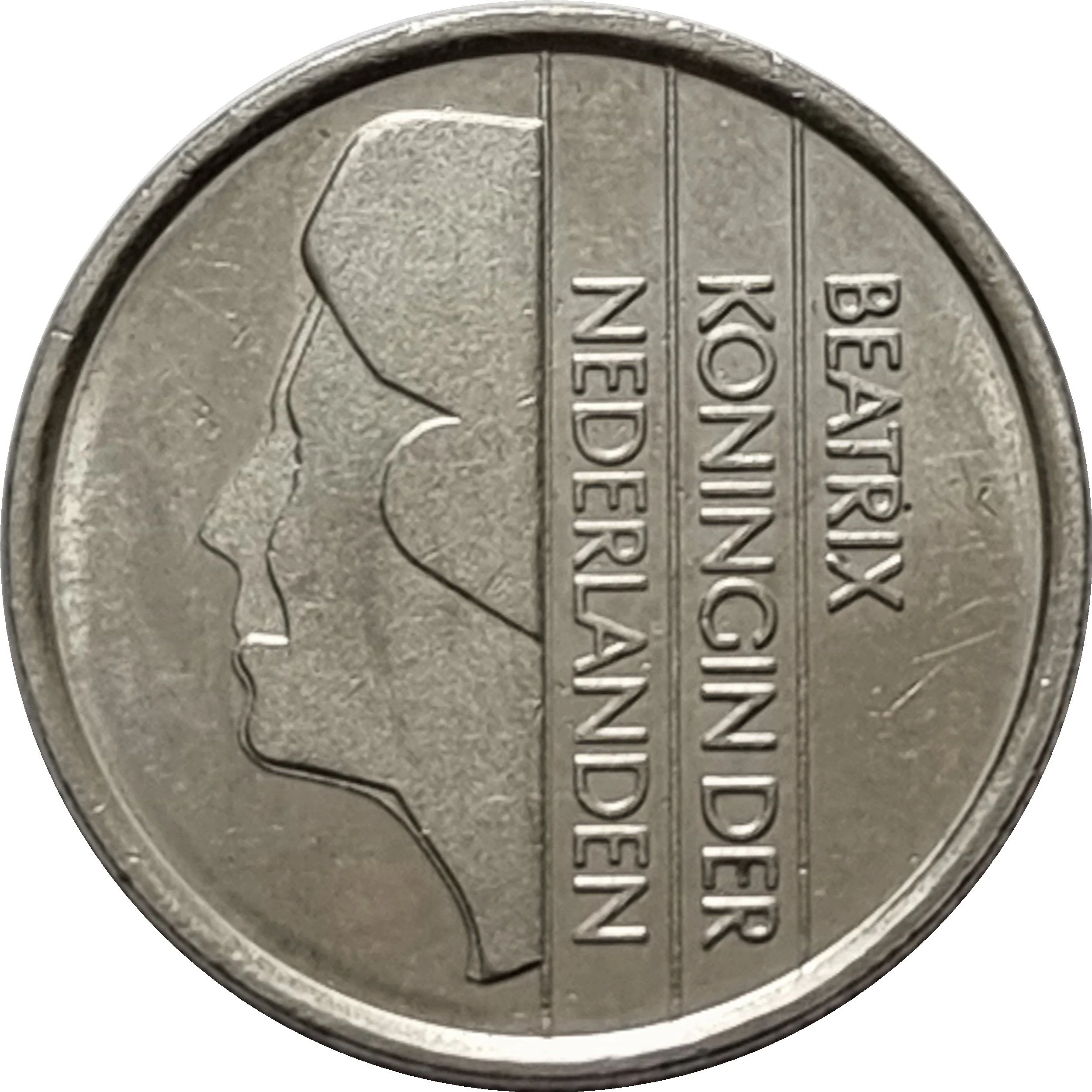
Description:
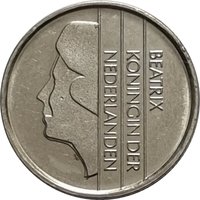
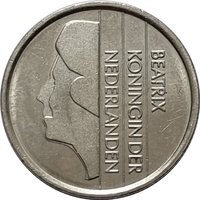
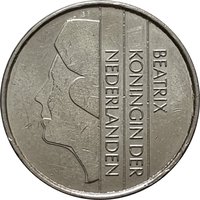
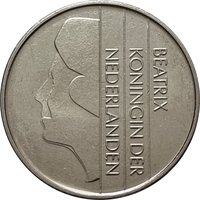
Queen Beatrix facing left, inscription to the right.
Inscription:
BEATRIX KONINGIN DER NEDERLANDEN
Translation:
Beatrix Queen of the Netherlands
Script: Latin
Language: Dutch
Engraver: Bruno Ninaber van Eyben
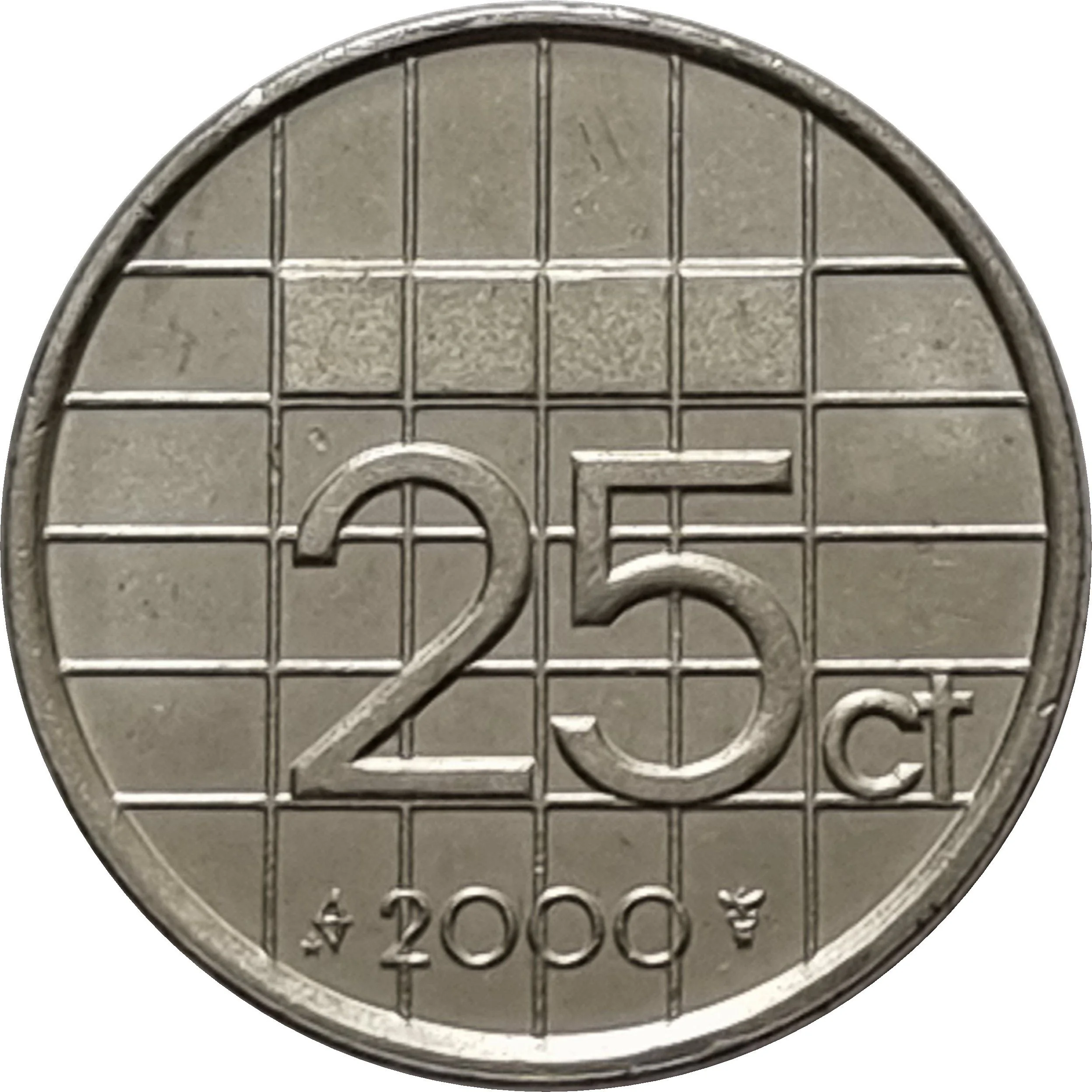
Reverse
Edge
Reeded
Mints
| Name | Mark |
|---|---|
| Royal Dutch Mint | — |
Mintings
| Year | Mint Mark | Mintage | Quality | Collection |
|---|---|---|---|---|
| 1982 | — | 18,300,000 | ||
| 1982 | — | 10,000 | Proof | |
| 1983 | — | 15,000 | Proof | |
| 1983 | — | 18,200,000 | ||
| 1984 | — | 19,200,000 | ||
| 1984 | — | 20,000 | Proof | |
| 1985 | — | 17,000 | Proof | |
| 1985 | — | 29,100,000 | ||
| 1986 | — | 20,000 | Proof | |
| 1986 | — | 20,300,000 | ||
| 1987 | — | 36,000,000 | ||
| 1987 | — | 18,000 | Proof | |
| 1988 | — | 20,000 | Proof | |
| 1988 | — | 17,400,000 | ||
| 1989 | — | 30,400,000 | ||
| 1989 | — | 15,000 | Proof | |
| 1990 | — | 15,000 | Proof | |
| 1990 | — | 23,000,000 | ||
| 1991 | — | 25,000,000 | ||
| 1991 | — | 14,000 | Proof | |
| 1992 | — | 41,500,000 | ||
| 1992 | — | 13,000 | Proof | |
| 1993 | — | 15,100,000 | ||
| 1993 | — | 12,000 | Proof | |
| 1994 | — | 1,560,000 | ||
| 1994 | — | 13,000 | Proof | |
| 1995 | — | 30,240,000 | ||
| 1995 | — | 12,000 | Proof | |
| 1996 | — | 24,840,000 | ||
| 1996 | — | 14,000 | Proof | |
| 1997 | — | 29,760,000 | ||
| 1997 | — | 12,000 | Proof | |
| 1998 | — | 69,560,000 | ||
| 1998 | — | 12,000 | Proof | |
| 1999 | — | 10,560,000 | ||
| 1999 | — | 15,000 | Proof | |
| 2000 | — | 31,000,000 | ||
| 2000 | — | 15,000 | Proof | |
| 2001 | — | 11,515,000 | ||
| 2001 | — | 17,000 | Proof |
Historical background
In 1982, the Netherlands operated within the European Monetary System (EMS), a framework established in 1979 to create a zone of monetary stability in Europe by reducing exchange rate volatility. The core of the EMS was the Exchange Rate Mechanism (ERM), which pegged participating currencies, including the Dutch guilder, within a band around a central rate against the European Currency Unit (ECU). The Netherlands was a committed and disciplined member, maintaining a very tight peg between the guilder and the Deutsche Mark (DM), the anchor currency of the system. This policy, often called the "hard guilder" policy, was a cornerstone of Dutch economic philosophy, prioritizing low inflation and exchange rate stability over autonomous monetary policy.
This commitment was tested by the economic turbulence of the early 1980s, a period marked by the aftermath of the second oil shock, a deep recession, and high unemployment. While other countries, like France, faced severe pressure and devalued their currencies within the ERM, the Dutch guilder remained remarkably stable. This stability was achieved through strict fiscal discipline and a monetary policy that closely shadowed the anti-inflationary stance of the German Bundesbank. Consequently, inflation in the Netherlands fell sharply from double digits in the late 1970s to around 6% in 1982, aligning closely with German levels and reinforcing the credibility of the peg.
The currency situation in 1982 thus reflected a nation firmly anchoring its economic fortunes to Germany and the broader project of European monetary integration. The successful maintenance of the guilder-DM link provided a stable foundation for trade and investment but came at a short-term cost, requiring high interest rates that contributed to the depth of the domestic recession. This unwavering choice set a critical precedent, solidifying the Netherlands' reputation as a core, stability-oriented member of the European monetary order, a position that would seamlessly lead to its adoption of the euro two decades later.
This commitment was tested by the economic turbulence of the early 1980s, a period marked by the aftermath of the second oil shock, a deep recession, and high unemployment. While other countries, like France, faced severe pressure and devalued their currencies within the ERM, the Dutch guilder remained remarkably stable. This stability was achieved through strict fiscal discipline and a monetary policy that closely shadowed the anti-inflationary stance of the German Bundesbank. Consequently, inflation in the Netherlands fell sharply from double digits in the late 1970s to around 6% in 1982, aligning closely with German levels and reinforcing the credibility of the peg.
The currency situation in 1982 thus reflected a nation firmly anchoring its economic fortunes to Germany and the broader project of European monetary integration. The successful maintenance of the guilder-DM link provided a stable foundation for trade and investment but came at a short-term cost, requiring high interest rates that contributed to the depth of the domestic recession. This unwavering choice set a critical precedent, solidifying the Netherlands' reputation as a core, stability-oriented member of the European monetary order, a position that would seamlessly lead to its adoption of the euro two decades later.
🌱 Very Common