

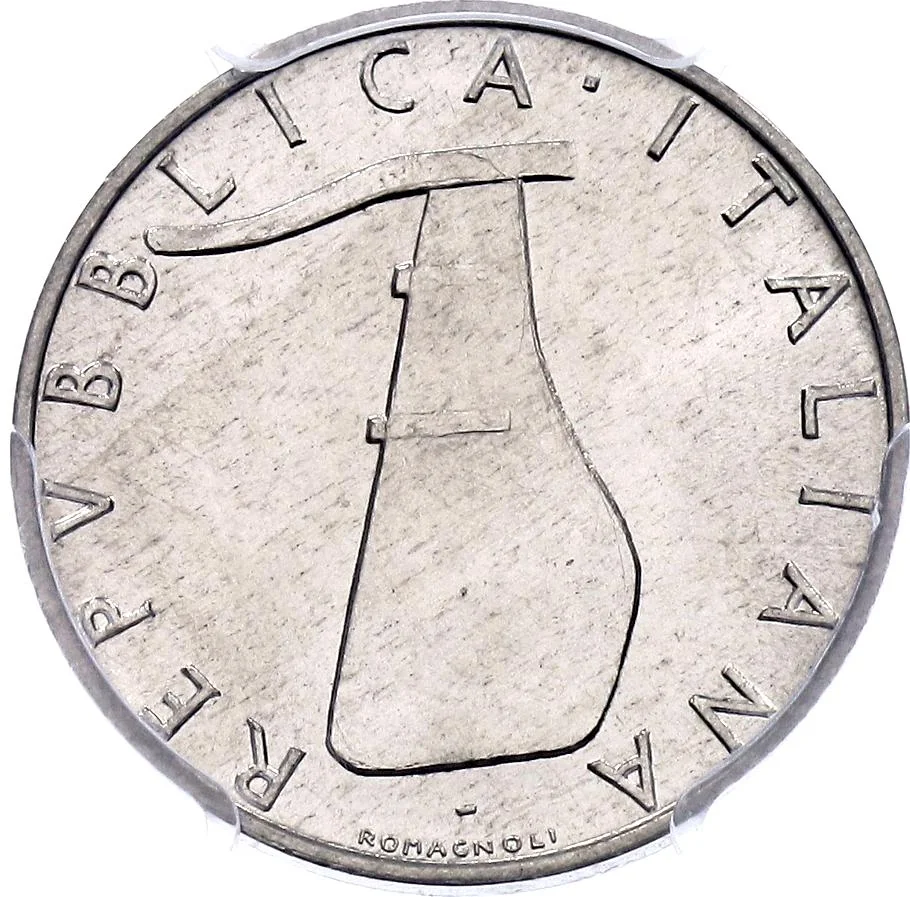
Obverse
Description:
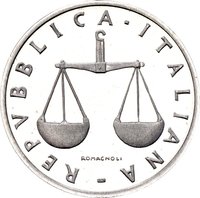
Steering control.
Inscription:
REPVBBLICA · ITALIANA
ROMAGNOLI
ROMAGNOLI
Translation:
Italian Republic
Romagnoli
Romagnoli
Script: Latin
Engraver: Pietro Giampaoli
Designer: Giuseppe Romagnoli
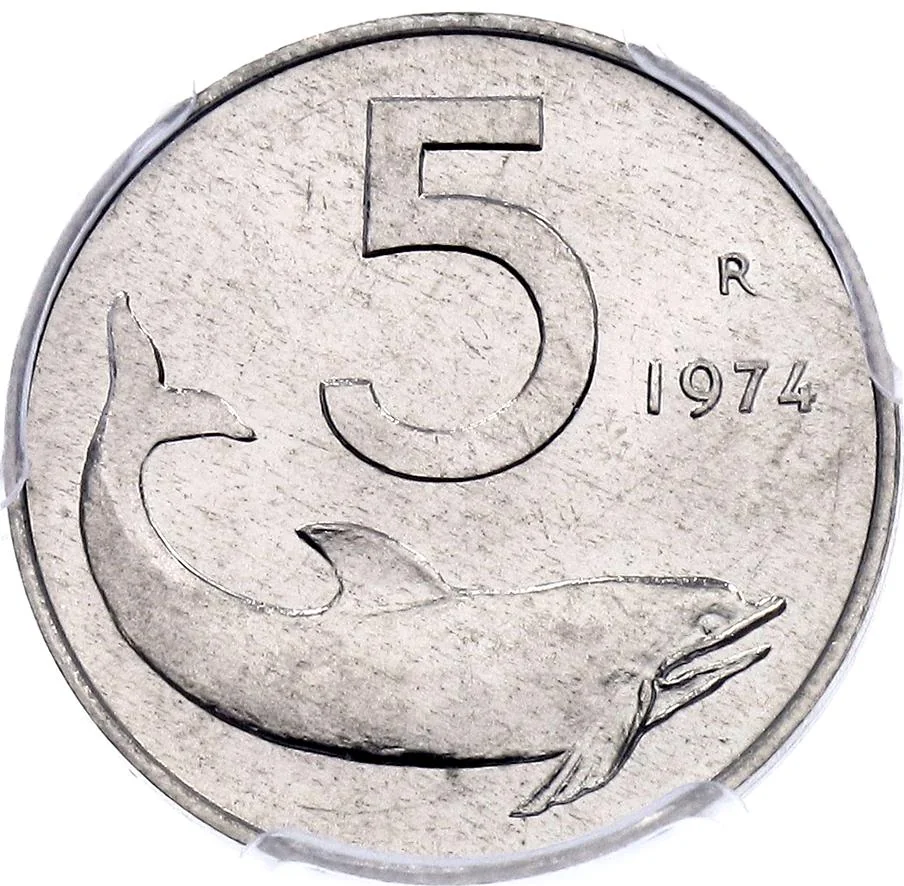
Reverse
Description:
Date left of dolphin.
Inscription:
5 R
1951
1951
Script: Latin
Engraver: Pietro Giampaoli
Designer: Giuseppe Romagnoli
Edge
Plain
Categories
| Animal> Marine mammal |
Mints
| Name | Mark |
|---|---|
| Rome | R |
Mintings
| Year | Mint Mark | Mintage | Quality | Collection |
|---|---|---|---|---|
| 1951 | R | 40,260,000 | ||
| 1952 | R | 57,400,000 | ||
| 1953 | R | 196,200,000 | ||
| 1954 | R | — | ||
| 1955 | R | 159,000,000 | ||
| 1956 | R | 400,000 | ||
| 1966 | R | 1,200,000 | ||
| 1967 | R | 10,600,000 | ||
| 1968 | R | 7,500,000 | ||
| 1969 | R | 6,995,000 | ||
| 1969 | R | 310,000 | BU | |
| 1970 | R | 4,211,000 | ||
| 1971 | R | 8,600,000 | ||
| 1972 | R | 16,400,000 | ||
| 1973 | R | 28,800,000 | ||
| 1974 | R | 6,600,000 | ||
| 1975 | R | 7,000,000 | ||
| 1976 | R | 9,000,000 | ||
| 1977 | R | 6,700,000 | ||
| 1978 | R | 3,600,000 | ||
| 1979 | R | 4,200,000 | ||
| 1980 | R | 6,000,000 | ||
| 1981 | R | 5,000,000 | ||
| 1982 | R | 8,900,000 | ||
| 1983 | R | 5,000,000 | ||
| 1984 | R | 2,100,000 | ||
| 1985 | R | 3,000,000 | ||
| 1985 | R | 20,345 | Proof | |
| 1986 | R | 17,500 | Proof | |
| 1986 | R | 5,000,000 | ||
| 1987 | R | 7,000,000 | ||
| 1987 | R | 10,000 | Proof | |
| 1988 | R | 5,000,000 | ||
| 1988 | R | 9,000 | Proof | |
| 1989 | R | 2,500,000 | ||
| 1989 | R | 9,260 | Proof | |
| 1990 | R | 2,500,000 | ||
| 1990 | R | 9,400 | Proof | |
| 1991 | R | 2,000,000 | ||
| 1991 | R | 11,000 | Proof | |
| 1992 | R | 1,000,000 | ||
| 1992 | R | 9,500 | Proof | |
| 1993 | R | 1,000,000 | ||
| 1993 | R | 8,500 | Proof | |
| 1994 | R | 1,000,000 | ||
| 1994 | R | 8,500 | Proof | |
| 1995 | R | 3,000,000 | ||
| 1995 | R | 7,960 | Proof | |
| 1996 | R | 2,500,000 | ||
| 1996 | R | 8,000 | Proof | |
| 1997 | R | 1,000,000 | ||
| 1997 | R | 8,440 | Proof | |
| 1998 | R | 9,000 | Proof | |
| 1998 | R | 1,500,000 | ||
| 1999 | R | 51,800 | BU | |
| 1999 | R | 8,500 | Proof | |
| 2000 | R | 61,400 | BU | |
| 2000 | R | 8,960 | Proof | |
| 2001 | R | 100,000 | BU | |
| 2001 | R | 10,000 | Proof |
Historical background
In 1951, Italy’s currency situation was defined by the aftermath of World War II and the early stages of the "economic miracle." The official currency was the Italian Lira (ITL), but its value and stability were still recovering from the devastation of the war. The country had undergone a painful period of high inflation and devaluation, culminating in the 1947 "Stabilization Plan" led by Governor Luigi Einaudi. This plan, involving credit restrictions and fiscal discipline, had successfully halted hyperinflation and laid a foundation for growth, but the lira remained a relatively weak and controlled currency within a complex European exchange landscape.
The international context was crucial, as Italy was a beneficiary of the Marshall Plan (1948-1951), which provided vital dollars for reconstruction and helped stabilize the balance of payments. Externally, Italy was a founding member of the European Payments Union (EPU) in 1950, a system that facilitated multilateral trade among European nations by offsetting deficits and surpluses without using scarce gold or dollars. This membership was critical for Italy, as it allowed for increased trade and economic integration while conserving foreign reserves. Domestically, however, capital controls and multiple exchange rates persisted, with the government and the Bank of Italy carefully managing the lira to support industrial exports and protect fragile sectors.
Overall, 1951 represented a period of cautious transition and guarded optimism. The lira was not yet fully convertible, and its parity was officially set at 625 lire to the US dollar—a rate that would remain fixed for over a decade. The primary focus was on using monetary policy to fuel industrial investment and export-led growth, setting the stage for the rapid expansion of the mid-1950s. While the acute crises of the immediate postwar years were over, the currency regime remained one of managed stability, designed to nurture recovery within a framework of international cooperation and domestic control.
The international context was crucial, as Italy was a beneficiary of the Marshall Plan (1948-1951), which provided vital dollars for reconstruction and helped stabilize the balance of payments. Externally, Italy was a founding member of the European Payments Union (EPU) in 1950, a system that facilitated multilateral trade among European nations by offsetting deficits and surpluses without using scarce gold or dollars. This membership was critical for Italy, as it allowed for increased trade and economic integration while conserving foreign reserves. Domestically, however, capital controls and multiple exchange rates persisted, with the government and the Bank of Italy carefully managing the lira to support industrial exports and protect fragile sectors.
Overall, 1951 represented a period of cautious transition and guarded optimism. The lira was not yet fully convertible, and its parity was officially set at 625 lire to the US dollar—a rate that would remain fixed for over a decade. The primary focus was on using monetary policy to fuel industrial investment and export-led growth, setting the stage for the rapid expansion of the mid-1950s. While the acute crises of the immediate postwar years were over, the currency regime remained one of managed stability, designed to nurture recovery within a framework of international cooperation and domestic control.
🌱 Very Common