

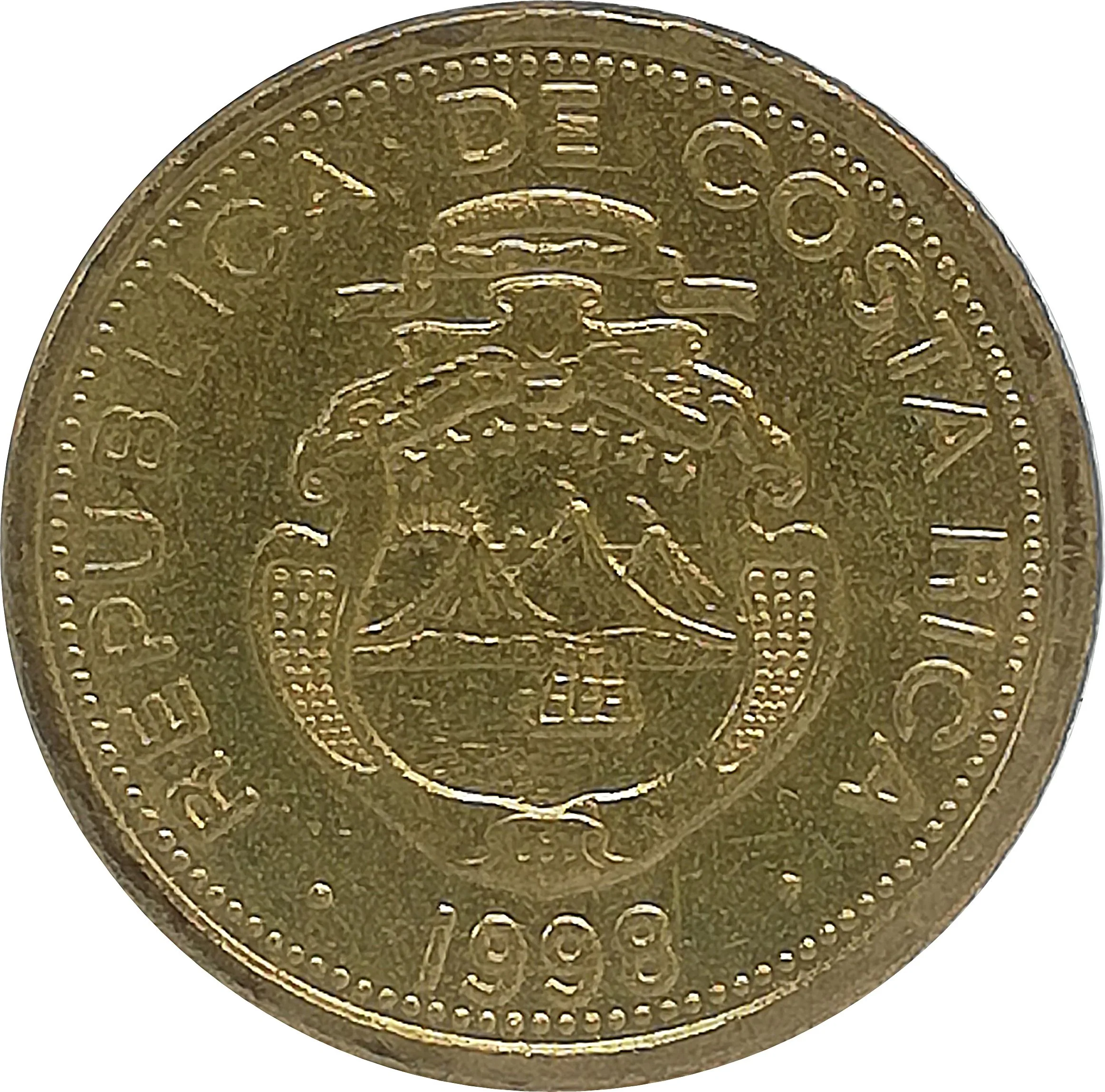
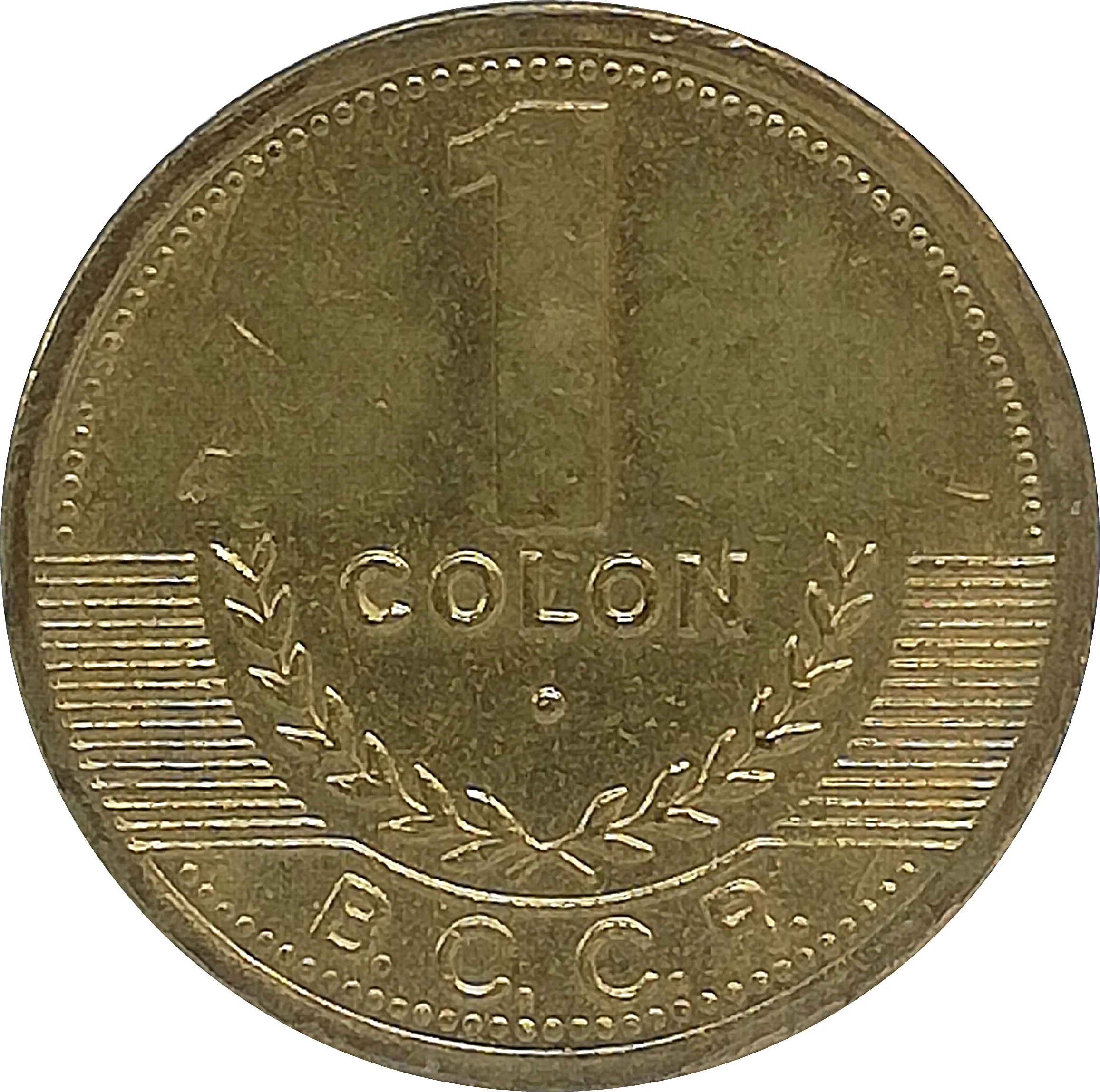
1 colón – Costa Rica
Add to wishlist
Costa Rica
Context
Year: 1998
Issuer: Costa Rica
Issuing organization: Central Bank of Costa Rica
Period:
(since 1948)
Currency:
(since 1896)
Total mintage: 15,000,000
Material
Diameter: 15 mm
Weight: 2.78 g
Thickness: 2.1 mm
Shape: Round
Composition: Aluminium bronze
Magnetic: No
Technique: Milled
Alignment: Coin alignment
flip
References
KM: #
Numista: #3979
Value
Exchange value: 1 CRC
Obverse
Description:
Costa Rica's coat of arms features seven stars for its provinces, three volcanoes for its mountain ranges, two ships for its position between the Atlantic and Pacific, and a sunrise.
Inscription:
REPUBLICA DE COSTA RICA
1998
1998
Translation:
Republic of Costa Rica
1998
1998
Script: Latin
Language: Spanish
Reverse
Edge
Segmented (4 smooth, 4 milled)
Categories
| Symbols> Coat of Arms |
| Symbol> Wreath |
Mints
| Name | Mark |
|---|---|
| Casa de Moneda de Chile | — |
Mintings
| Year | Mint Mark | Mintage | Quality | Collection |
|---|---|---|---|---|
| 1998 | — | 15,000,000 |
Historical background
In 1998, Costa Rica's currency situation was defined by a managed crawling peg exchange rate regime for the colón (₡), which had been in place since the mid-1980s. The Central Bank of Costa Rica (BCCR) carefully controlled the colón's depreciation against the US dollar within a narrow band, aiming to provide stability for trade and investment while allowing gradual adjustment for inflation differentials. This system had successfully tamed the hyperinflation of the early 1980s, but by the late 1990s, it required significant intervention and high domestic interest rates to maintain, creating persistent tensions.
The year unfolded against a backdrop of mounting pressure on the regime. Key challenges included a widening current account deficit, fueled by strong import growth, and the psychological impact of emerging market crises in Asia (1997) and soon Russia (1998), which heightened investor sensitivity. Furthermore, a constitutional ruling against a government plan to privatize the state-run telecommunications and electricity sectors (the ICE) weakened fiscal prospects and shook market confidence. These factors strained foreign reserves and led to increased speculation against the colón, as doubts grew about the sustainability of the peg.
Consequently, 1998 became a pivotal year of defensive action. The BCCR was forced to spend heavily from its reserves to defend the exchange rate band and repeatedly hiked interest rates to make colón holdings more attractive, with the monetary policy rate exceeding 30% at times. These restrictive measures, however, began to stifle economic growth and highlighted the system's vulnerability. The intense pressures of 1998 set the stage for a major policy shift that would follow in the coming years, ultimately leading to the adoption of a more flexible exchange rate system in 2006.
The year unfolded against a backdrop of mounting pressure on the regime. Key challenges included a widening current account deficit, fueled by strong import growth, and the psychological impact of emerging market crises in Asia (1997) and soon Russia (1998), which heightened investor sensitivity. Furthermore, a constitutional ruling against a government plan to privatize the state-run telecommunications and electricity sectors (the ICE) weakened fiscal prospects and shook market confidence. These factors strained foreign reserves and led to increased speculation against the colón, as doubts grew about the sustainability of the peg.
Consequently, 1998 became a pivotal year of defensive action. The BCCR was forced to spend heavily from its reserves to defend the exchange rate band and repeatedly hiked interest rates to make colón holdings more attractive, with the monetary policy rate exceeding 30% at times. These restrictive measures, however, began to stifle economic growth and highlighted the system's vulnerability. The intense pressures of 1998 set the stage for a major policy shift that would follow in the coming years, ultimately leading to the adoption of a more flexible exchange rate system in 2006.
🌱 Common