

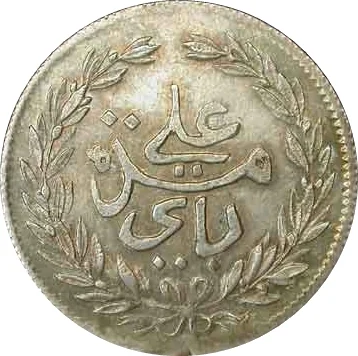
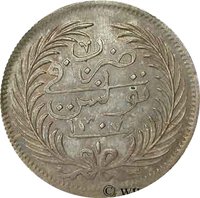
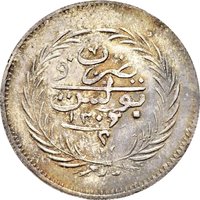
Obverse
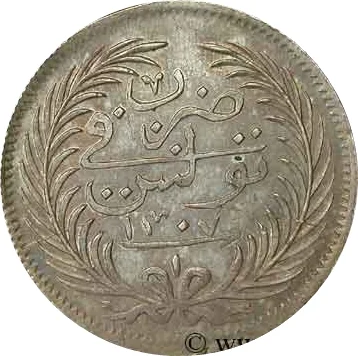
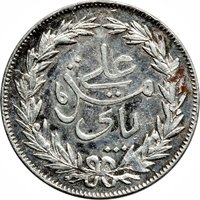
Reverse
Edge
Mintings
| Year | Mint Mark | Mintage | Quality | Collection |
|---|---|---|---|---|
| 1883 | — | — | ||
| 1884 | — | — | ||
| 1885 | — | — | ||
| 1886 | — | — | ||
| 1887 | — | — | ||
| 1888 | — | — | ||
| 1889 | — | — | ||
| 1890 | — | — | ||
| 1891 | — | — |
Historical background
In 1883, Tunisia found itself in a precarious financial and political position, directly leading to a profound currency crisis. The root cause was the massive debt accrued by the Beylik throughout the 1860s and 1870s, primarily from loans with European banks to fund modernization and cover budget shortfalls. By 1869, Tunisia was declared bankrupt, leading to the establishment of the International Financial Commission—controlled by France, Britain, and Italy—to manage its treasury and repay creditors. This commission imposed severe austerity, but financial instability persisted, creating a chaotic monetary environment.
The currency situation on the ground was characterized by extreme complexity and devaluation. Multiple currencies circulated simultaneously: the Ottoman piastre, Spanish and French francs, Italian lire, and various local copper coins. The standard Ottoman piastre, once containing 7.2 grams of silver, had been heavily debased. By 1883, its value had plummeted, and its silver content was significantly reduced, causing rampant inflation and a loss of public confidence. This monetary anarchy severely disrupted trade, complicated tax collection, and eroded the local economy, as merchants and the population struggled with unpredictable exchange rates and worthless coinage.
This financial disarray provided the immediate pretext for France, which already controlled Algeria, to solidify its dominance. While the French military had already invaded in 1881, leading to the Treaty of Bardo, the ongoing currency and debt crisis was used to justify a tighter grip. In 1883, with the Convention of La Marsa, France formally established a protectorate over Tunisia. A key provision was France's guarantee of Tunisia's debt, which in practice meant complete French control over all state revenues and expenditures. Consequently, the franc was gradually introduced as the stable reference currency, beginning the process of aligning Tunisia's monetary system with that of France and ending the era of chaotic circulation.
The currency situation on the ground was characterized by extreme complexity and devaluation. Multiple currencies circulated simultaneously: the Ottoman piastre, Spanish and French francs, Italian lire, and various local copper coins. The standard Ottoman piastre, once containing 7.2 grams of silver, had been heavily debased. By 1883, its value had plummeted, and its silver content was significantly reduced, causing rampant inflation and a loss of public confidence. This monetary anarchy severely disrupted trade, complicated tax collection, and eroded the local economy, as merchants and the population struggled with unpredictable exchange rates and worthless coinage.
This financial disarray provided the immediate pretext for France, which already controlled Algeria, to solidify its dominance. While the French military had already invaded in 1881, leading to the Treaty of Bardo, the ongoing currency and debt crisis was used to justify a tighter grip. In 1883, with the Convention of La Marsa, France formally established a protectorate over Tunisia. A key provision was France's guarantee of Tunisia's debt, which in practice meant complete French control over all state revenues and expenditures. Consequently, the franc was gradually introduced as the stable reference currency, beginning the process of aligning Tunisia's monetary system with that of France and ending the era of chaotic circulation.
Series: 1883 Tunisia circulation coins
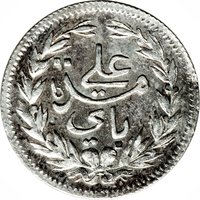
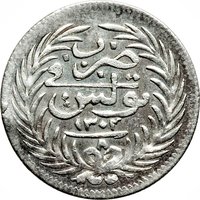
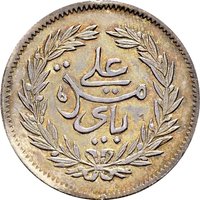
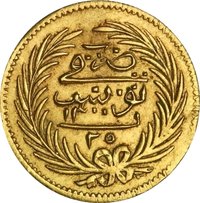
💎 Extremely Rare